Home > Press > Quantum dots cast light on biomedical processes
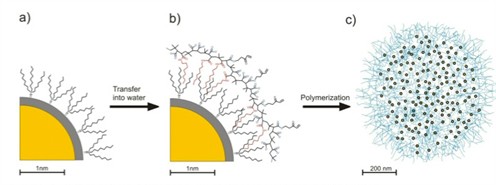 |
| Quantum dots made water-soluble by a coating can, in turn, be combined with polymers and be coupled to other quantum dots |
Abstract:
The light emitted by quantum dots is both more intense and longer lasting than that produced by the fluorescent markers commonly used in medical and biological applications. Yet these nano-scale light sources still suffer from one major drawback - they do not dissolve in water. Researchers at the University of Twente's MESA+ Institute for Nanotechnology and at the A*STAR agency in Singapore have found a way to remedy this. They have developed a coating which allows quantum dots to be used inside the human body, even inside living cells. The researchers published details of their coating 'recipe' in the October issue of Nature Protocols.
Quantum dots cast light on biomedical processes
Enschede, The Netherlands | Posted on October 27th, 2011The new coating enables quantum dots, which are semiconductor nanocrystals, to literally cast light on biological processes. These dots are "nuggets", consisting of several hundred to several thousand atoms, that emit visible light when they are exposed to invisible UV radiation, for example. They range from a few nanometres to several tens of nanometres in size. The coating's benefits are not limited to improved solubility in water alone. Other molecules can "lock on" to its surface - so called 'click chemistry'. This could make coated quantum dots sensitive to certain substances, for example, or allow them to bind to specific types of cells, such as tumour cells.
Better option
Scientists studying biological processes often use fluorescent tags that bind to biomolecules. This makes it relatively easy to track such molecules, even inside living cells. Quantum dots are a better option. They emit long-lasting, bright light, the colour of which depends on the size of the quantum dots used. For a number of reasons, including their toxicity, they were previously unsuitable for use in living organisms.
The researchers therefore developed an amphiphilic coating, i.e. one with both hydrophobic and hydrophilic properties. The "water hating" side of the polymer material attaches to the surface of the quantum dot. Its exposed hydrophilic side then makes the quantum dot/coating combination soluble in water. The coating builds up on the surface of the quantum dot through a process of self-assembly. The coating polymer has the added benefit that other molecules can be bound to it. Another important plus is that it does not adversely affect the quantum dot's light-emitting properties.
The study is a collaborative venture between the University of Twente's MESA+ Institute for Nanotechnology and the A*STAR agency's Institute of Materials Research and Engineering, in Singapore. It is headed by Professor Julius Vancso, Professor of Materials Science and Technology of Polymers at the University of Twente, who is also a visiting scientist at the Singapore institute.
The article entitled "Synthesis of functionalized amphiphilic polymers for coating quantum dots" by Dominik Jańczewski, Nikodem Tomczak, Ming-Yong Han and Julius Vancso appeared in the October edition of Nature Protocols. Copies are available on request.
####
For more information, please click here
Contacts:
University of Twente
PO Box 217
7500 AE Enschede, The Netherlands
Tel + 31 (0)53 489 9111
Fax + 31 (0)53 489 2000
Copyright © University of Twente
If you have a comment, please Contact us.Issuers of news releases, not 7th Wave, Inc. or Nanotechnology Now, are solely responsible for the accuracy of the content.
Bookmark:


| Related News Press |
News and information
 Quantum computer improves AI predictions April 17th, 2026
Flexible sensor gains sensitivity under pressure April 17th, 2026
A reusable chip for particulate matter sensing April 17th, 2026
Detecting vibrational quantum beating in the predissociation dynamics of SF6 using time-resolved photoelectron spectroscopy April 17th, 2026
Imaging
Simple algorithm paired with standard imaging tool could predict failure in lithium metal batteries August 8th, 2025
Discoveries
Quantum computer improves AI predictions April 17th, 2026
Flexible sensor gains sensitivity under pressure April 17th, 2026
A reusable chip for particulate matter sensing April 17th, 2026
Detecting vibrational quantum beating in the predissociation dynamics of SF6 using time-resolved photoelectron spectroscopy April 17th, 2026
Announcements
A fundamentally new therapeutic approach to cystic fibrosis: Nanobody repairs cellular defect April 17th, 2026
UC Irvine physicists discover method to reverse ‘quantum scrambling’ : The work addresses the problem of information loss in quantum computing system April 17th, 2026
Quantum Dots/Rods
A new kind of magnetism November 17th, 2023
IOP Publishing celebrates World Quantum Day with the announcement of a special quantum collection and the winners of two prestigious quantum awards April 14th, 2023
Qubits on strong stimulants: Researchers find ways to improve the storage time of quantum information in a spin rich material January 27th, 2023
NIST’s grid of quantum islands could reveal secrets for powerful technologies November 18th, 2022
Research partnerships
Lab to industry: InSe wafer-scale breakthrough for future electronics August 8th, 2025
HKU physicists uncover hidden order in the quantum world through deconfined quantum critical points April 25th, 2025
 |
||
 |
||
| The latest news from around the world, FREE | ||
 |
||
|
|
||
| Premium Products | ||
 |
||
|
Only the news you want to read!
Learn More |
||
 |
||
|
Full-service, expert consulting
Learn More |
||
|
|
||