Home > Press > Sound gives nanocavity a twist
 |
Abstract:
Researchers from Augsburg, Munich and Santa Barbara (California) successfully combined the worlds of nanophotonics and nanomechanical systems. The scientists work for the cluster of excellence Nanosystems Initiative Munich (NIM), the Center for Nanoscience (CeNS), the Augsburg Center for Innovative Technologies (ACIT) and for the California NanoSystems Institute (CNSI) at Santa Barbara.
Sound gives nanocavity a twist
Munich, Germany and Santa Barbara, CA | Posted on October 21st, 2011NIM graduate student Daniel Fuhrmann and his supervisor Hubert Krenner demonstrate in the latest issue of Nature Photonics that a sound wave can be used to control a photonic crystal. Quantum effects within the crystal lead to an fast and very efficient generation and modulation of single photons, the quanta of light. Hubert Krenner recently established a prestigious Emmy Noether Junior Research Group at the Chair of Achim Wixforth at Augsburg University.
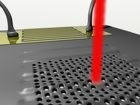
For their experiments the team fabricated a freestanding nanomembrane of semiconducting material. Into the membrane they drilled a large periodic array of tiny holes using cleanroom nanofabrication. In this structure, a photonic crystal, they trapped light of a well-defined wavelength or color inside a region where they skipped three holes. As light emitters they placed so-called quantum dots inside of this nanocavity. These quantum dots are often called artificial atoms because they - just like real atoms - emit light at sharp spectral lines and as single quanta (photons).
Until now the key challenge in this system was to overlap the wavelength of the light trapped in the nanocavity and the light emitted by the quantum dot. When the two wavelengths are in resonance the quantum mechanical Purcell effect leads to a dramatic increase of the light extraction efficiency. The NIM-CNSI research team solved this problem very elegantly: the scientists used a nanoquake, so-called surface acoustic waves. These waves periodically stretch and compress the thin membrane and its precisely ordered array of holes. The nanoquakes deform the photonic crystal at radio frequency and the wavelength of the light inside the nanocavity oscillates back and forth in less than a third of a nanosecond. This is more than ten times faster than any other approach worldwide.
NIM-graduate student Daniel Fuhrmann is excited about the success of his experiments: "The idea of an acoustically modulated photonic crystal existed in our lab for quite a long time. After all the hard work it made me really proud to actually see the wavelength of the nanocavity oscillating with the shaking of the nanoquake. I am also very happy that we again have shown that surface acoustic waves, our special tool in Augsburg, lead to surprising results and outstanding research also in the field of nanophotonics"
The Augsburg group is renowned for their pioneering work and application of surface acoustic waves. They apply these to various types of nanosystems ranging from biological and biophysical systems over microfluidics to fundamental physical effect such as the Quantum Hall Effect. All these experiments have attracted large attention worldwide and built the outstanding reputation of their research using their nanoquakes on a chip.
The experiment by Daniel Fuhrmann and his colleagues from Bavaria and California is an excellent example for a successful international collaboration between the two high-tech states on both sides of the Atlantic Ocean. Hubert Krenner and Achim Wixforth both spent a long time at UC Santa Barbara and frequently visit their Californian colleagues. The project was seed-funded by the Bavarian-Californian Technology Center (BaCaTeC) and carried out supported by NIM within a PhD student scholarship of the Bayerische Forschungsstiftung (BFS).
Based on these groundbreaking experiments researchers expect that a highly efficient, acoustically triggered "single photon source" will be realized. Such a device is crucially required for inherently secure quantum-cryptography and the optical quantum computer.
####
For more information, please click here
Contacts:
Dr. Birgit Gebauer
Outreach Manager
Nanosystems Initiative Munich
Schellingstraße 4
80799 München, Germany
Phone: +49 (89) 2180 5091
Fax: +49 (89) 2180 5649
birgit.gebauer(at)lmu.de
Copyright © Nanosystems Initiative Munich
If you have a comment, please Contact us.Issuers of news releases, not 7th Wave, Inc. or Nanotechnology Now, are solely responsible for the accuracy of the content.
Bookmark:


| Related Links |
| Related News Press |
News and information
 Quantum computer improves AI predictions April 17th, 2026
Flexible sensor gains sensitivity under pressure April 17th, 2026
A reusable chip for particulate matter sensing April 17th, 2026
Detecting vibrational quantum beating in the predissociation dynamics of SF6 using time-resolved photoelectron spectroscopy April 17th, 2026
Quantum Computing
Quantum computer improves AI predictions April 17th, 2026
UC Irvine physicists discover method to reverse ‘quantum scrambling’ : The work addresses the problem of information loss in quantum computing system April 17th, 2026
Researchers develop molecular qubits that communicate at telecom frequencies October 3rd, 2025
Optical computing/Photonic computing
ICFO researchers overcome long-standing bottleneck in single photon detection with twisted 2D materials August 8th, 2025
Programmable electron-induced color router array May 14th, 2025
Discoveries
Quantum computer improves AI predictions April 17th, 2026
Flexible sensor gains sensitivity under pressure April 17th, 2026
A reusable chip for particulate matter sensing April 17th, 2026
Detecting vibrational quantum beating in the predissociation dynamics of SF6 using time-resolved photoelectron spectroscopy April 17th, 2026
Announcements
A fundamentally new therapeutic approach to cystic fibrosis: Nanobody repairs cellular defect April 17th, 2026
UC Irvine physicists discover method to reverse ‘quantum scrambling’ : The work addresses the problem of information loss in quantum computing system April 17th, 2026
Photonics/Optics/Lasers
Metasurfaces smooth light to boost magnetic sensing precision January 30th, 2026
From sensors to smart systems: the rise of AI-driven photonic noses January 30th, 2026
Research partnerships
Lab to industry: InSe wafer-scale breakthrough for future electronics August 8th, 2025
HKU physicists uncover hidden order in the quantum world through deconfined quantum critical points April 25th, 2025
Quantum nanoscience
Beyond silicon: Electronics at the scale of a single molecule January 30th, 2026
MXene nanomaterials enter a new dimension Multilayer nanomaterial: MXene flakes created at Drexel University show new promise as 1D scrolls January 30th, 2026
ICFO researchers overcome long-standing bottleneck in single photon detection with twisted 2D materials August 8th, 2025
 |
||
 |
||
| The latest news from around the world, FREE | ||
 |
||
|
|
||
| Premium Products | ||
 |
||
|
Only the news you want to read!
Learn More |
||
 |
||
|
Full-service, expert consulting
Learn More |
||
|
|
||