Home > Press > Nanopores on a Chip: Applications for Analytical Tasks in Chemistry and Biology
 |
Abstract:
Biological nanopores are proteins of only a few nanometers in diameter that form tiny water-filled canals. They have proven to be promising tools in the field of nanobiotechnology. In a joint project at the University of Freiburg, a research group led by Prof. Dr. Jan C. Behrends, Institute of Physiology, and scientists working under Prof. Dr. Jürgen Rühe, Department of Microsystems Technology (IMTEK), have succeeded in arranging nanopores on a tiny microchip and using it to determine the mass of chain-like molecules, so-called polymers, with a high degree of precision. In these experiments, the nanopores assume the role of the actual sensor.. The first author of the study, now published in the renowned journal ACSNano of the American Chemical Society, Dr. Gerhard Baaken, hopes that the new development will be instrumental in exploiting the great potential of nanopore analysis for chemistry and the life sciences.
Nanopores on a Chip: Applications for Analytical Tasks in Chemistry and Biology
Freiburg, Germany | Posted on October 7th, 2011In their natural environment, nanopores often have the function of transporting larger molecules. For instance, they convey proteins through membranes. Bacteria also use nanopores to destroy the cells of infected organisms. This is also true of alpha-hemolysin, a protein produced by staphylococci to destroy red blood cells. This protein has also recently found applications in analytical tasks in chemistry and biology. If a large-sized molecule gets into the pore, it becomes partially blocked for fractions of a second. By measuring the electrical conductivity of the hemolysin pore, scientists can detect the presence of a single molecule—in a fashion similar to the function of a light barrier. By the same principle it is also possible to make a very precise measurement of the size of the molecule. Scientists are very optimistic about the potential applications—not only for the analysis of synthetic polymer mixtures, but also for the analysis of genetic material and even as a quick and inexpensive way to sequence DNA.
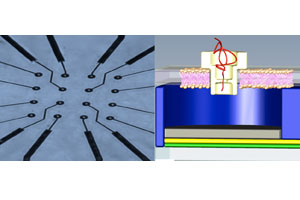
The Freiburg research team has now succeeded in conducting such measurements on a specially developed biohybrid microsensor made of biological and micro-technical parts. It contains 16 miniaturized artificial cell membranes on only one square millimeter. The individual membranes are spread over minuscule pits, each with a diameter of approximately two-hundredths of a millimeter. That is the equivalent of around one-third of the thickness of a human hair. In their publication, the authors demonstrate that they can use the chip to obtain the distributions of polymer sizes that are accurate to a single chain element. Currently, results of such precision require expensive equipment filling entire rooms. The project is a good example of successful collaboration among strongly diverging disciplines.
####
For more information, please click here
Contacts:
Dr. Gerhard Baaken
Department of Microsystems Engineering (IMTEK)
University of Freiburg
Phone: 0761-203-5145
Prof. Dr. Jan Behrends
Institute of Physiology
University of Freiburg
Phone: 0761-203-5146
Melanie Hübner
+49 (0) 761/203-4302
Copyright © AlphaGalileo
If you have a comment, please Contact us.Issuers of news releases, not 7th Wave, Inc. or Nanotechnology Now, are solely responsible for the accuracy of the content.
Bookmark:


| Related News Press |
News and information
 Quantum computer improves AI predictions April 17th, 2026
Flexible sensor gains sensitivity under pressure April 17th, 2026
A reusable chip for particulate matter sensing April 17th, 2026
Detecting vibrational quantum beating in the predissociation dynamics of SF6 using time-resolved photoelectron spectroscopy April 17th, 2026
Sensors
Flexible sensor gains sensitivity under pressure April 17th, 2026
Tiny nanosheets, big leap: A new sensor detects ethanol at ultra-low levels January 30th, 2026
From sensors to smart systems: the rise of AI-driven photonic noses January 30th, 2026
Sensors innovations for smart lithium-based batteries: advancements, opportunities, and potential challenges August 8th, 2025
Discoveries
Quantum computer improves AI predictions April 17th, 2026
Flexible sensor gains sensitivity under pressure April 17th, 2026
A reusable chip for particulate matter sensing April 17th, 2026
Detecting vibrational quantum beating in the predissociation dynamics of SF6 using time-resolved photoelectron spectroscopy April 17th, 2026
Announcements
A fundamentally new therapeutic approach to cystic fibrosis: Nanobody repairs cellular defect April 17th, 2026
UC Irvine physicists discover method to reverse ‘quantum scrambling’ : The work addresses the problem of information loss in quantum computing system April 17th, 2026
Nanobiotechnology
A fundamentally new therapeutic approach to cystic fibrosis: Nanobody repairs cellular defect April 17th, 2026
New molecular technology targets tumors and simultaneously silences two ‘undruggable’ cancer genes August 8th, 2025
New imaging approach transforms study of bacterial biofilms August 8th, 2025
Electrifying results shed light on graphene foam as a potential material for lab grown cartilage June 6th, 2025
 |
||
 |
||
| The latest news from around the world, FREE | ||
 |
||
|
|
||
| Premium Products | ||
 |
||
|
Only the news you want to read!
Learn More |
||
 |
||
|
Full-service, expert consulting
Learn More |
||
|
|
||