Home > Press > Optofluidics could change energy field, say engineers
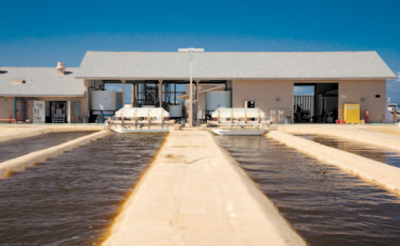 |
| Cellana A bioreactor with an open pond like this one, which uses photosynthesis to make fuels, could be improved with the use of optofluidic technologies. |
Abstract:
The ability to manipulate light and fluids on a single chip, broadly called "optofluidics," has led to such technologies as liquid-crystal displays and liquid-filled optical fibers for fast data transfer. Optofluidics is now also on the cusp of improving such green technologies as solar-powered bioreactors, say Cornell researchers.
Optofluidics could change energy field, say engineers
Ithaca, NY | Posted on September 12th, 2011The biggest challenge, says Cornell's David Erickson, associate professor of mechanical and aerospace engineering, is how to upscale optofluidic chips, which are built at nanometer scales, to deliver enough energy to make a difference. These challenges and opportunities are detailed in a Nature Photonics Review article by Erickson and two colleagues, published online Sept. 11.
"Over the last five years or so, we have developed many new technologies to precisely deliver light and fluids and biology to the same place at the same time," Erickson said. "It's these new tools that we want to apply to the area of energy."
For example, photobioreactors are large-scale systems that use microorganisms such as algae or cyanobacteria, to convert light and carbon dioxide into hydrocarbon fuels. Photobioreactors employ photosynthesis for energy conversion, and Erickson envisions using an optofluidic chip to optimize how light and chemicals are distributed in the reactor.
In such systems as open-air ponds that harvest algae and collect sunlight, the light is scattered haphazardly, and the top layer gets more exposure. Optofluidic technologies, such as plasmonic nanoparticles or photonic waveguides, could more directly target the microorganisms and lead to greater energy output.
Similarly, the paper also describes how optofluidic devices could be used to improve photocatalytic systems, in which light energy splits water into the components hydrogen and oxygen, or converts carbon dioxide and water into hydrocarbon fuels. Other applications include optofluidic chips in solar collectors.
Erickson authored the review with Demetri Psaltis of Ecole Polytechnique Federal Lausanne, Switzerland, and David Sinton of the University of Toronto. His research is supported by the Academic Venture Fund of Cornell's Atkinson Center for a Sustainable Future and the National Science Foundation. Erickson is also a member of the Kavli Institute at Cornell for Nanoscale Science.
####
For more information, please click here
Contacts:
Media Contact:
Blaine Friedlander
(607) 254-8093
Cornell Chronicle:
Anne Ju
(607) 255-9735
Copyright © Cornell University
If you have a comment, please Contact us.Issuers of news releases, not 7th Wave, Inc. or Nanotechnology Now, are solely responsible for the accuracy of the content.
Bookmark:


| Related News Press |
News and information
 Quantum computer improves AI predictions April 17th, 2026
Flexible sensor gains sensitivity under pressure April 17th, 2026
A reusable chip for particulate matter sensing April 17th, 2026
Detecting vibrational quantum beating in the predissociation dynamics of SF6 using time-resolved photoelectron spectroscopy April 17th, 2026
Microfluidics/Nanofluidics
Projecting light to dispense liquids: A new route to ultra-precise microdroplets January 30th, 2026
Implantable device shrinks pancreatic tumors: Taming pancreatic cancer with intratumoral immunotherapy April 14th, 2023
Researchers design new inks for 3D-printable wearable bioelectronics: Potential uses include printing electronic tattoos for medical tracking applications August 19th, 2022
Govt.-Legislation/Regulation/Funding/Policy
Quantum computer improves AI predictions April 17th, 2026
Metasurfaces smooth light to boost magnetic sensing precision January 30th, 2026
New imaging approach transforms study of bacterial biofilms August 8th, 2025
Discoveries
Quantum computer improves AI predictions April 17th, 2026
Flexible sensor gains sensitivity under pressure April 17th, 2026
A reusable chip for particulate matter sensing April 17th, 2026
Detecting vibrational quantum beating in the predissociation dynamics of SF6 using time-resolved photoelectron spectroscopy April 17th, 2026
Announcements
A fundamentally new therapeutic approach to cystic fibrosis: Nanobody repairs cellular defect April 17th, 2026
UC Irvine physicists discover method to reverse ‘quantum scrambling’ : The work addresses the problem of information loss in quantum computing system April 17th, 2026
Energy
Sensors innovations for smart lithium-based batteries: advancements, opportunities, and potential challenges August 8th, 2025
Simple algorithm paired with standard imaging tool could predict failure in lithium metal batteries August 8th, 2025
Photonics/Optics/Lasers
Metasurfaces smooth light to boost magnetic sensing precision January 30th, 2026
From sensors to smart systems: the rise of AI-driven photonic noses January 30th, 2026
Solar/Photovoltaic
Spinel-type sulfide semiconductors to operate the next-generation LEDs and solar cells For solar-cell absorbers and green-LED source October 3rd, 2025
KAIST researchers introduce new and improved, next-generation perovskite solar cell November 8th, 2024
Groundbreaking precision in single-molecule optoelectronics August 16th, 2024
Development of zinc oxide nanopagoda array photoelectrode: photoelectrochemical water-splitting hydrogen production January 12th, 2024
 |
||
 |
||
| The latest news from around the world, FREE | ||
 |
||
|
|
||
| Premium Products | ||
 |
||
|
Only the news you want to read!
Learn More |
||
 |
||
|
Full-service, expert consulting
Learn More |
||
|
|
||