Home > Press > Etch-a-sketch with superconductors: A breakthrough in controlling defects could lead to new generation of electronic devices
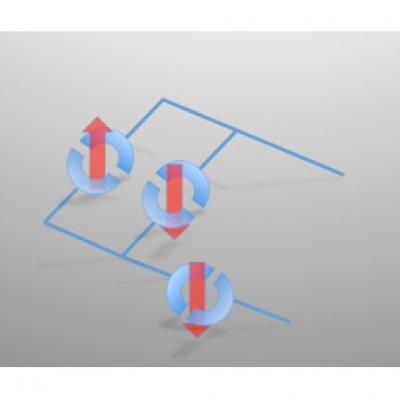 |
| In future, X-ray beams could be used to write superconducting circuits, such as those depicted in the image. Here, solid lines indicate electrical connections while semicircles denote superconducting junctions, whose states are indicated by red arrows.
Credit: UCL Press Office |
Abstract:
Reporting in Nature Materials this week, researchers from the London Centre for Nanotechnology and the Physics Department of Sapienza University of Rome have discovered a technique to 'draw' superconducting shapes using an X-ray beam. This ability to create and control tiny superconducting structures has implications for a completely new generation of electronic devices.
Etch-a-sketch with superconductors: A breakthrough in controlling defects could lead to new generation of electronic devices
London, UK | Posted on August 22nd, 2011Superconductivity is a special state where a material conducts electricity with no resistance, meaning absolutely zero energy is wasted.
The research group has shown that they can manipulate regions of high temperature superconductivity, in a particular material which combines oxygen, copper and a heavier, 'rare earth' element called lanthanum. Illuminating with X-rays causes a small scale re-arrangement of the oxygen atoms in the material, resulting in high temperature superconductivity, of the type originally discovered for such materials 25 years ago by IBM scientists. The X-ray beam is then used like a pen to draw shapes in two dimensions.
A well as being able to write superconductors with dimensions much smaller than the width of a human hair, the group is able to erase those structures by applying heat treatments. They now have the tools to write and erase with high precision, using just a few simple steps and without the chemicals ordinarily used in device fabrication. This ability to re-arrange the underlying structure of a material has wider applications to similar compounds containing metal atoms and oxygen, ranging from fuel cells to catalysts.
Prof. Aeppli, Director of the London Centre for Nanotechnology and the UCL investigator on the project, said: "Our validation of a one-step, chemical-free technique to generate superconductors opens up exciting new possibilities for electronic devices, particularly in re-writing superconducting logic circuits. Of profound importance is the key to solving the notorious 'travelling salesman problem', which underlies many of the world's great computational challenges. We want to create computers on demand to solve this problem, with applications from genetics to logistics. A discovery like this means a paradigm shift in computing technology is one step closer."
Prof Bianconi, the leader of the team from Sapienza, added: "It is amazing that in a few simple steps, we can now add superconducting 'intelligence' directly to a material consisting mainly of the common elements copper and oxygen."
The X-ray experiments were performed at the Elettra (Trieste) synchrotron radiation facility. The work is published in Nature Materials, 21 August 2011 (doi:1038/nmat3088) and follows on from previous discovery of fractal-like structures in superconductors (doi:10.1038/nature09260).
####
For more information, please click here
Contacts:
Dave Weston
44-020-310-83844
Copyright © University College London
If you have a comment, please Contact us.Issuers of news releases, not 7th Wave, Inc. or Nanotechnology Now, are solely responsible for the accuracy of the content.
Bookmark:


| Related News Press |
News and information
 Quantum computer improves AI predictions April 17th, 2026
Flexible sensor gains sensitivity under pressure April 17th, 2026
A reusable chip for particulate matter sensing April 17th, 2026
Detecting vibrational quantum beating in the predissociation dynamics of SF6 using time-resolved photoelectron spectroscopy April 17th, 2026
Superconductivity
MXene nanomaterials enter a new dimension Multilayer nanomaterial: MXene flakes created at Drexel University show new promise as 1D scrolls January 30th, 2026
Chip Technology
A reusable chip for particulate matter sensing April 17th, 2026
Metasurfaces smooth light to boost magnetic sensing precision January 30th, 2026
Discoveries
Quantum computer improves AI predictions April 17th, 2026
Flexible sensor gains sensitivity under pressure April 17th, 2026
A reusable chip for particulate matter sensing April 17th, 2026
Detecting vibrational quantum beating in the predissociation dynamics of SF6 using time-resolved photoelectron spectroscopy April 17th, 2026
Announcements
A fundamentally new therapeutic approach to cystic fibrosis: Nanobody repairs cellular defect April 17th, 2026
UC Irvine physicists discover method to reverse ‘quantum scrambling’ : The work addresses the problem of information loss in quantum computing system April 17th, 2026
Research partnerships
Lab to industry: InSe wafer-scale breakthrough for future electronics August 8th, 2025
HKU physicists uncover hidden order in the quantum world through deconfined quantum critical points April 25th, 2025
 |
||
 |
||
| The latest news from around the world, FREE | ||
 |
||
|
|
||
| Premium Products | ||
 |
||
|
Only the news you want to read!
Learn More |
||
 |
||
|
Full-service, expert consulting
Learn More |
||
|
|
||