Home > Press > How to Outshine a Quantum Dot
 |
Abstract:
Biologists use fluorescent particles for the visualization and tracking of cells and proteins; generally, the brighter the particle the better. Quantum dots are the brightest colloidal particles available. Nanometer-sized semiconductor crystals, they shine brighter and longer than other fluorescent particles.
How to Outshine a Quantum Dot
Germany | Posted on June 22nd, 2011However, quantum dots have their limitations, especially when used for biological applications. They can be instable in aqueous environments and are subject to "blinking" or flickering. But perhaps the greatest drawback is their potential toxicity. They are made from alloys such as cadmium selenide or indium arsenide that could be broken down releasing toxic ions.
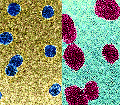
On the other hand traditional fluorescent materials such as organic dyes are not as bright as quantum dots and suffer from photo-bleaching. Igor Solokov and coworkers have used an inorganic silica shield to prevent the photobleaching of organic dyes. Using sol/gel assembly, they trapped the organic dyes inside a silica matrix, creating particles of the size of 20-50 nm. They found that the relative brightness of a single particle is equivalent to that of up to 770 free dye molecules or up to 39 quantum dots. Moreover, the particles were stable for at least 120 days.
####
For more information, please click here
Copyright © Wiley-VCH Materials Science Journals
If you have a comment, please Contact us.Issuers of news releases, not 7th Wave, Inc. or Nanotechnology Now, are solely responsible for the accuracy of the content.
Bookmark:


| Related Links |
 I. Sokolov et al., Adf. Funct. Mater. ; DOI: 10.1002/adfm.201100311
| Related News Press |
News and information
Quantum computer improves AI predictions April 17th, 2026
Flexible sensor gains sensitivity under pressure April 17th, 2026
A reusable chip for particulate matter sensing April 17th, 2026
Detecting vibrational quantum beating in the predissociation dynamics of SF6 using time-resolved photoelectron spectroscopy April 17th, 2026
Imaging
Simple algorithm paired with standard imaging tool could predict failure in lithium metal batteries August 8th, 2025
Discoveries
Quantum computer improves AI predictions April 17th, 2026
Flexible sensor gains sensitivity under pressure April 17th, 2026
A reusable chip for particulate matter sensing April 17th, 2026
Detecting vibrational quantum beating in the predissociation dynamics of SF6 using time-resolved photoelectron spectroscopy April 17th, 2026
Announcements
A fundamentally new therapeutic approach to cystic fibrosis: Nanobody repairs cellular defect April 17th, 2026
UC Irvine physicists discover method to reverse ‘quantum scrambling’ : The work addresses the problem of information loss in quantum computing system April 17th, 2026
Quantum Dots/Rods
A new kind of magnetism November 17th, 2023
IOP Publishing celebrates World Quantum Day with the announcement of a special quantum collection and the winners of two prestigious quantum awards April 14th, 2023
Qubits on strong stimulants: Researchers find ways to improve the storage time of quantum information in a spin rich material January 27th, 2023
NIST’s grid of quantum islands could reveal secrets for powerful technologies November 18th, 2022
 |
||
 |
||
| The latest news from around the world, FREE | ||
 |
||
|
|
||
| Premium Products | ||
 |
||
|
Only the news you want to read!
Learn More |
||
 |
||
|
Full-service, expert consulting
Learn More |
||
|
|
||