Home > Press > Quantum sensor tracked in human cells could aid drug discovery
 |
Abstract:
Groundbreaking research has shown a quantum atom has been tracked inside a living human cell and may lead to improvements in the testing and development of new drugs.
Quantum sensor tracked in human cells could aid drug discovery
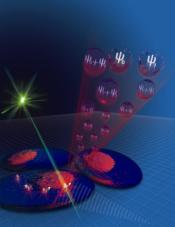
Melbourne, Australia | Posted on May 26th, 2011Professor Lloyd Hollenberg from the University of Melbourne's School of Physics who led the research said it is the first time a single atom encased in nanodiamond has been used as a sensor to explore the nanoscale environment inside a living human cell.
"It is exciting to see how the atom experiences the biological environment at the nanoscale," he said.
"This research paves the way towards a new class of quantum sensors used for biological research into the development of new drugs and nanomedicine."
The sensor is capable of detecting biological processes at a molecular level, such as the regulation of chemicals in and out of the cell, which is critical in understanding how drugs work.
The paper has been published in the journal Nature Nanotechnology.
Funded by the ARC Centre of Excellence for Quantum Computation and Communication Technology, the research was conducted by a cross-disciplinary team from the University of Melbourne's Physics, Chemistry, and Chemical and Biomolecular Engineering departments.
The researchers developed state of the art technology to control and manipulate the atom in the nanodiamond before inserting it into the human cells in the lab.
Biologist Dr Yan Yan of the University's Department of Chemical and Biomolecular Engineering who works in the field of nanomedicine, said the sensor provides critical information about the movement of the nanodiamonds inside the living cell.
"This is important for the new field of nanomedicine where drug delivery is dependant on the uptake of similar sized nanoparticles into the cell."
Quantum physicist and PhD student Liam McGuinness from the University's School of Physics said that monitoring the atomic sensor in a living cell was a significant achievement. "Previously, these atomic level quantum measurements could only be achieved under carefully controlled conditions of a physics lab," he said.
It is hoped in the next few years, that following these proof of principle experiments, the researchers will be able to develop the technology and provide a new set of tools for drug discovery and nanomedicine.
####
About University of Melbourne
Established in 1853, the University of Melbourne is a public-spirited institution that makes distinctive contributions to society in research, teaching and engagement.
Melbourne's teaching excellence has been rewarded two years in a row by grants from the Commonwealth Government's Learning and Teaching Performance Fund for Australian universities that demonstrate excellence in undergraduate teaching and learning.
Melbourne was also one of only three Australian universities to win ten citations-the maximum number of awards possible-under the Carrick Citations for Outstanding Contributions to Student Learning. The citations recognise commitment by university staff who have shown outstanding leadership and innovation in teaching, and dedication and enthusiasm for student learning.
For more information, please click here
Contacts:
Rebecca Scott
University of Melbourne
Mobile: 0417164791
Copyright © University of Melbourne
If you have a comment, please Contact us.Issuers of news releases, not 7th Wave, Inc. or Nanotechnology Now, are solely responsible for the accuracy of the content.
Bookmark:


| Related News Press |
News and information
 Quantum computer improves AI predictions April 17th, 2026
Flexible sensor gains sensitivity under pressure April 17th, 2026
A reusable chip for particulate matter sensing April 17th, 2026
Detecting vibrational quantum beating in the predissociation dynamics of SF6 using time-resolved photoelectron spectroscopy April 17th, 2026
Nanomedicine
A fundamentally new therapeutic approach to cystic fibrosis: Nanobody repairs cellular defect April 17th, 2026
New molecular technology targets tumors and simultaneously silences two ‘undruggable’ cancer genes August 8th, 2025
New imaging approach transforms study of bacterial biofilms August 8th, 2025
Electrifying results shed light on graphene foam as a potential material for lab grown cartilage June 6th, 2025
Sensors
Flexible sensor gains sensitivity under pressure April 17th, 2026
Tiny nanosheets, big leap: A new sensor detects ethanol at ultra-low levels January 30th, 2026
From sensors to smart systems: the rise of AI-driven photonic noses January 30th, 2026
Sensors innovations for smart lithium-based batteries: advancements, opportunities, and potential challenges August 8th, 2025
Discoveries
Quantum computer improves AI predictions April 17th, 2026
Flexible sensor gains sensitivity under pressure April 17th, 2026
A reusable chip for particulate matter sensing April 17th, 2026
Detecting vibrational quantum beating in the predissociation dynamics of SF6 using time-resolved photoelectron spectroscopy April 17th, 2026
Announcements
A fundamentally new therapeutic approach to cystic fibrosis: Nanobody repairs cellular defect April 17th, 2026
UC Irvine physicists discover method to reverse ‘quantum scrambling’ : The work addresses the problem of information loss in quantum computing system April 17th, 2026
Quantum nanoscience
Beyond silicon: Electronics at the scale of a single molecule January 30th, 2026
MXene nanomaterials enter a new dimension Multilayer nanomaterial: MXene flakes created at Drexel University show new promise as 1D scrolls January 30th, 2026
ICFO researchers overcome long-standing bottleneck in single photon detection with twisted 2D materials August 8th, 2025
 |
||
 |
||
| The latest news from around the world, FREE | ||
 |
||
|
|
||
| Premium Products | ||
 |
||
|
Only the news you want to read!
Learn More |
||
 |
||
|
Full-service, expert consulting
Learn More |
||
|
|
||