Home > Press > High Spatial Resolution Testing of Both Color and Intensity of OLED Displays
 |
Abstract:
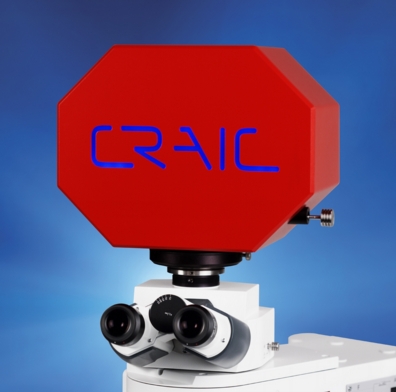
The 308 FPD™ spectrophotometer is used to measure color and relative intensity on the micron scale allowing for microscopic spatial resolution mapping. It is easily attached to inspection microscopes and probe stations.
High Spatial Resolution Testing of Both Color and Intensity of OLED Displays
San Dimas, CA | Posted on May 16th, 2011Organic Light Emitting Diodes (OLED) are being developed for the next generation of displays and light sources. The 308 FPD™ microscope spectrophotometer , from CRAIC Technologies, is designed to measure and compare the spectral output, intensity and color consistency of each of the microscopic pixels commonly found in OLED devices.
Organic light emitting diodes (OLED) have an emissive electroluminescent layer that consists of organic molecules in a supporting matrix. For displays, this layer is formed into millions of microscopic pixels in ordered rows and columns. As different organic compounds are used to generate different colors, pixels with different organic compounds can generate different colors for full color, high resolution displays. The biggest advantages of the OLED devices, u nlike the traditional Liquid Crystal Displays (LCD), is that the pixels combine both the light source and the color source. This means that OLED displays are lighter and thinner and use less electricity than an LCD. However, consistency of the intensity and the color of the optical emission across the device is critical. This is where instruments such as the 308 FPD™ spectrophotometer for microscopes are used.
The 308 FPD™ is a spectrophotometer that is designed to add to the open photoport of a microscope or probe station. It allows the user to acquire images and acquire spectra of microscopic sample areas quickly and rapidly. When added to the appropriate microscope or probe station, the 308 FPD™ can be used to measure the color and intensity of each pixel of a OLED display. Pixels can then be compared with one another for consistency or maps of both the intensity and color can be generated for each device. And as instruments such as the 308 FPD™ can acquire spectra on the order of a few milliseconds, entire OLED displays can be mapped quickly and accurately. This will ensure the consistency of both color and intensity across the entire device as well as from device to device.
For more information about the microspectral analysis of OLED displays with CRAIC Technologies, please visit www.microspectra.com.
####
About CRAIC Technologies, Inc.
CRAIC Technologies, Inc. is a global technology leader focused on innovations for microscopy and microspectroscopy in the ultraviolet, visible and near-infrared regions. CRAIC Technologies creates cutting-edge solutions, with the very best in customer support, by listening to our customers and implementing solutions that integrate operational excellence and technology expertise. CRAIC Technologies provides answers for customers in forensic sciences, biotechnology, semiconductor, geology, nanotechnology and materials science markets who demand quality, accuracy, precision, speed and the best in customer support.
For more information, please click here
Contacts:
CRAIC Technologies, Inc.
+1-310-573-8180
Copyright © CRAIC Technologies, Inc.
If you have a comment, please Contact us.Issuers of news releases, not 7th Wave, Inc. or Nanotechnology Now, are solely responsible for the accuracy of the content.
Bookmark:


| Related News Press |
News and information
 Quantum computer improves AI predictions April 17th, 2026
Flexible sensor gains sensitivity under pressure April 17th, 2026
A reusable chip for particulate matter sensing April 17th, 2026
Detecting vibrational quantum beating in the predissociation dynamics of SF6 using time-resolved photoelectron spectroscopy April 17th, 2026
Display technology/LEDs/SS Lighting/OLEDs
Spinel-type sulfide semiconductors to operate the next-generation LEDs and solar cells For solar-cell absorbers and green-LED source October 3rd, 2025
Efficient and stable hybrid perovskite-organic light-emitting diodes with external quantum efficiency exceeding 40 per cent July 5th, 2024
Announcements
A fundamentally new therapeutic approach to cystic fibrosis: Nanobody repairs cellular defect April 17th, 2026
UC Irvine physicists discover method to reverse ‘quantum scrambling’ : The work addresses the problem of information loss in quantum computing system April 17th, 2026
Tools
Metasurfaces smooth light to boost magnetic sensing precision January 30th, 2026
From sensors to smart systems: the rise of AI-driven photonic noses January 30th, 2026
Japan launches fully domestically produced quantum computer: Expo visitors to experience quantum computing firsthand August 8th, 2025
 |
||
 |
||
| The latest news from around the world, FREE | ||
 |
||
|
|
||
| Premium Products | ||
 |
||
|
Only the news you want to read!
Learn More |
||
 |
||
|
Full-service, expert consulting
Learn More |
||
|
|
||