Home > Press > The University of Leipzig adds JPK's CellHesion 200 capability to enhance cell-cell force measurements
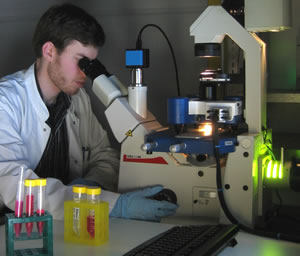 |
| Steve Pawlizak, a post graduate student in Professor Käs' group at the University of Leipzig using the JPK CellHesion 200 system. |
Abstract:
JPK Instruments, a world-leading manufacturer of nanoanalytic instrumentation for research in life sciences and soft matter, reports that the University of Leipzig has chosen the CellHesion® 200 system for their Institute of Experimental Physics I.
The University of Leipzig adds JPK's CellHesion 200 capability to enhance cell-cell force measurements
Berlin, Germany | Posted on May 4th, 2011The research of the Institute of Experimental Physics I is focused on soft condensed matter as bulk material, in interaction with surfaces and interfaces, and with single molecules. The systems under study cover a wealth like small tracer molecules, liquid crystals, polymers, polymer-networks, proteins, and even living biological cells. It is objective of the research of the Institute of Experimental Physics I to explore the physical basis of structure-property relationships in these systems.
Professor Josef A. Käs moved his group to Leipzig in 2001 from the University of Texas at Austin. At this time, he became one of the first users of the JPK NanoWizard® series of atomic force microscopes to start a close series of interactions between his group and JPK. Most recently, Professor Käs added the JPK CellHesion 200 system to provide the ability to study the interplay between compartmentalization of cell and tumor spreading.
Compartmentalization is the formation of cellular compartments (e.g. tissues and organs). It generates well-defined boundaries for various differentiated cell types. Cells of the same type adhere better to each other, whereas mixtures of different migrating cell types segregate. According to the differential adhesion hypothesis (Malcom S. Steinberg, 1960s), cell sorting and formation of cellular compartments result from different adhesiveness of participating cells. The group tries to apply and verify the concept of compartmentalization and differential adhesion hypothesis to tumor development and spreading. It is known that young tumor cells are confined to their compartment of origin. With rising malignancy up to metastasis, tumor cells become able to overcome compartment boundaries. The goal is to clarify whether tumor stages can be characterized by cellular adhesiveness. This is why they are measuring healthy and cancerous cells of different malignancy with the JPK CellHesion 200.
Another project applying CellHesion 200 is one studying biocompatibility. Magnetic shape memory alloys are a class of smart materials which have a high potential for actuators in biomedical applications. These are tested for their biocompatibility by coating those materials with different cell adhesion proteins and using the CellHesion 200 for cell-substrate adhesion measurements.
JPK's CellHesion 200 system is a dedicated stand-alone platform for cell adhesion and cytomechanics studies to be used with inverted optical or confocal microscopes. It enables the quantification of single cell-cell and cell-surface interactions under physiological conditions. This ground-breaking technique, known as single cell force spectroscopy (SCFS), measures the interaction forces between a living cell bound to a cantilever and a target cell, functionalized substrate or biomaterial. In parallel, cytomechanical characteristics including stiffness and elasticity can be determined. Data can be measured for a number of important parameters involved in cellular adhesion, including maximum cell adhesion force, single unbinding events, tether characteristics, and work of removal.
Choosing to work with JPK has proved very beneficial for the Käs group. Speaking on behalf of the group, post graduate student Steve Pawlizak says "In our opinion, JPK offers the best SFM solution for biological or biophysical application available on the market. In a convenient way, it enables simultaneous use of SFM and a variety of light microscopy techniques such as bright field, phase contrast, epi-fluorescence as well as laser scanning microscopy on inverted research microscopes. This is absolutely necessary for our applications in cellular biophysics."
####
About JPK Instruments (JPK)
JPK Instruments AG is a world-leading manufacturer of nanoanalytic instruments - particularly atomic force microscope (AFM) systems and optical tweezers - for a broad range of applications reaching from soft matter physics to nano-optics, from surface chemistry to cell and molecular biology. From its earliest days applying atomic force microscope (AFM) technology, JPK has recognized the opportunities provided by nanotechnology for transforming life sciences and soft matter research. This focus has driven JPK’s success in uniting the worlds of nanotechnology tools and life science applications by offering cutting-edge technology and unique applications expertise. Headquartered in Berlin and with direct operations in Dresden, Cambridge (UK), Singapore, Tokyo (Japan) and Paris (France), JPK maintains a global network of distributors and support centers and provides on the spot applications and service support to an ever-growing community of researchers.
For more information, please click here
Contacts:
Jezz Leckenby
NetDyaLog Limited
T: +44 (0) 1799 521881
M: +44 (0) 7843 012997
or
Claudia Boettcher
JPK Instruments
T: +49 (0) 30 5331 12070
Copyright © JPK Instruments (JPK)
If you have a comment, please Contact us.Issuers of news releases, not 7th Wave, Inc. or Nanotechnology Now, are solely responsible for the accuracy of the content.
Bookmark:


| Related News Press |
News and information
 Quantum computer improves AI predictions April 17th, 2026
Flexible sensor gains sensitivity under pressure April 17th, 2026
A reusable chip for particulate matter sensing April 17th, 2026
Detecting vibrational quantum beating in the predissociation dynamics of SF6 using time-resolved photoelectron spectroscopy April 17th, 2026
Imaging
Simple algorithm paired with standard imaging tool could predict failure in lithium metal batteries August 8th, 2025
Announcements
A fundamentally new therapeutic approach to cystic fibrosis: Nanobody repairs cellular defect April 17th, 2026
UC Irvine physicists discover method to reverse ‘quantum scrambling’ : The work addresses the problem of information loss in quantum computing system April 17th, 2026
Tools
Metasurfaces smooth light to boost magnetic sensing precision January 30th, 2026
From sensors to smart systems: the rise of AI-driven photonic noses January 30th, 2026
Japan launches fully domestically produced quantum computer: Expo visitors to experience quantum computing firsthand August 8th, 2025
New-Contracts/Sales/Customers
Bruker Light-Sheet Microscopes at Major Comprehensive Cancer Center: New Advanced Imaging Center Powered by Two MuVi and LCS SPIM Microscopes March 25th, 2021
Arrowhead Pharmaceuticals Announces Closing of Agreement with Takeda November 27th, 2020
Veeco Announces Aledia Order of 300mm MOCVD Equipment for microLED Displays: Propel™ Platform First 300mm System with EFEM Designed for Advanced Display Applications October 20th, 2020
GREENWAVES TECHNOLOGIES Announces Next Generation GAP9 Hearables Platform Using GLOBALFOUNDRIES 22FDX Solution October 16th, 2020
 |
||
 |
||
| The latest news from around the world, FREE | ||
 |
||
|
|
||
| Premium Products | ||
 |
||
|
Only the news you want to read!
Learn More |
||
 |
||
|
Full-service, expert consulting
Learn More |
||
|
|
||