Home > Press > Improved Electrical Conductivity in Polymeric Composites
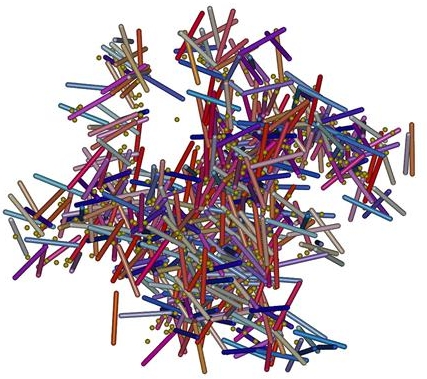 |
| Percolating network of rods and spheres |
Abstract:
Physicists at the University of Luxembourg have developed a new method to improve the electrical conductivity of polymeric composites. Polymeric composites consist of two or more materials and are used for example to shield off electrostatics in airplanes. By introducing additives into polymeric composites, favourable properties can be achieved. For instance, they develop favourable electrical properties when reinforced with carbon nanotubes. Such composites are used to make flat-panel displays and solar cells more efficient.
Improved Electrical Conductivity in Polymeric Composites
Luxembourg | Posted on May 3rd, 2011The researchers in Luxembourg, in cooperation with scientists from the Netherlands, have studied the electrical percolation of carbon nanotubes in a polymer matrix and shown the percolation threshold - the point at which the polymer composite becomes conductive - can be considerably lowered if small quantities of a conductive polymer latex are added. The simulations were done in Luxembourg, while the experiments took place at Eindhoven University.
"In this project, the idea is to use as little as possible carbon nanotubes and still benefit from their favourable properties", says the project leader at the University of Luxembourg, Prof. Tania Schilling, "we have discovered that, by adding a second component, we could make use of the resulting interactions to reach our goal." By mixing finely dispersed particles, so-called colloidal particles, of differing shapes and sizes in the medium, system-spanning networks form: the prerequisite for electrically conductive composites.
The recent finding of the materials scientists of the University of Luxembourg was published in the peer-reviewed, scientific journal „Nature Nanotechnology". This finding is a result of a cooperation of scientists at the University of Luxembourg, the Technische Universiteit Eindhoven and the Dutch Polymer Institute.
Full bibliographic information
Controlling electrical percolation in multicomponent carbon nanotube dispersions
by Andriy V. Kyrylyuk,Marie Claire Hermant, Tanja Schilling, Bert Klumperman, Cor E. Koning & Paul van der Schoot
####
For more information, please click here
Contacts:
Tanja Schilling
University of Luxembourg
+352 46 66 44 6970
Copyright © AlphaGalileo
If you have a comment, please Contact us.Issuers of news releases, not 7th Wave, Inc. or Nanotechnology Now, are solely responsible for the accuracy of the content.
Bookmark:


| Related News Press |
News and information
 Quantum computer improves AI predictions April 17th, 2026
Flexible sensor gains sensitivity under pressure April 17th, 2026
A reusable chip for particulate matter sensing April 17th, 2026
Detecting vibrational quantum beating in the predissociation dynamics of SF6 using time-resolved photoelectron spectroscopy April 17th, 2026
Flexible Electronics
Flexible sensor gains sensitivity under pressure April 17th, 2026
MXene nanomaterials enter a new dimension Multilayer nanomaterial: MXene flakes created at Drexel University show new promise as 1D scrolls January 30th, 2026
Physics
UC Irvine physicists discover method to reverse ‘quantum scrambling’ : The work addresses the problem of information loss in quantum computing system April 17th, 2026
Quantum computers simulate fundamental physics: shedding light on the building blocks of nature June 6th, 2025
A 1960s idea inspires NBI researchers to study hitherto inaccessible quantum states June 6th, 2025
Display technology/LEDs/SS Lighting/OLEDs
Spinel-type sulfide semiconductors to operate the next-generation LEDs and solar cells For solar-cell absorbers and green-LED source October 3rd, 2025
Nanotubes/Buckyballs/Fullerenes/Nanorods/Nanostrings/Nanosheets
Tiny nanosheets, big leap: A new sensor detects ethanol at ultra-low levels January 30th, 2026
Enhancing power factor of p- and n-type single-walled carbon nanotubes April 25th, 2025
Chainmail-like material could be the future of armor: First 2D mechanically interlocked polymer exhibits exceptional flexibility and strength January 17th, 2025
Innovative biomimetic superhydrophobic coating combines repair and buffering properties for superior anti-erosion December 13th, 2024
Discoveries
Quantum computer improves AI predictions April 17th, 2026
Flexible sensor gains sensitivity under pressure April 17th, 2026
A reusable chip for particulate matter sensing April 17th, 2026
Detecting vibrational quantum beating in the predissociation dynamics of SF6 using time-resolved photoelectron spectroscopy April 17th, 2026
Announcements
A fundamentally new therapeutic approach to cystic fibrosis: Nanobody repairs cellular defect April 17th, 2026
UC Irvine physicists discover method to reverse ‘quantum scrambling’ : The work addresses the problem of information loss in quantum computing system April 17th, 2026
Energy
Sensors innovations for smart lithium-based batteries: advancements, opportunities, and potential challenges August 8th, 2025
Simple algorithm paired with standard imaging tool could predict failure in lithium metal batteries August 8th, 2025
Solar/Photovoltaic
Spinel-type sulfide semiconductors to operate the next-generation LEDs and solar cells For solar-cell absorbers and green-LED source October 3rd, 2025
KAIST researchers introduce new and improved, next-generation perovskite solar cell November 8th, 2024
Groundbreaking precision in single-molecule optoelectronics August 16th, 2024
Development of zinc oxide nanopagoda array photoelectrode: photoelectrochemical water-splitting hydrogen production January 12th, 2024
 |
||
 |
||
| The latest news from around the world, FREE | ||
 |
||
|
|
||
| Premium Products | ||
 |
||
|
Only the news you want to read!
Learn More |
||
 |
||
|
Full-service, expert consulting
Learn More |
||
|
|
||