Home > Press > Seeing below the surface: Engineers devise a new way to inspect advanced materials used to build airplanes
 |
Abstract:
In recent years, many airplane manufacturers have started building their planes from advanced composite materials, which consist of high-strength fibers, such as carbon or glass, embedded in a plastic or metal matrix. Such materials are stronger and more lightweight than aluminum, but they are also more difficult to inspect for damage, because their surfaces usually don't reveal underlying problems.
Seeing below the surface: Engineers devise a new way to inspect advanced materials used to build airplanes
Cambridge, MA | Posted on March 27th, 2011"With aluminum, if you hit it, there's a dent there. With a composite, oftentimes if you hit it, there's no surface damage, even though there may be internal damage," says Brian L. Wardle, associate professor of aeronautics and astronautics.
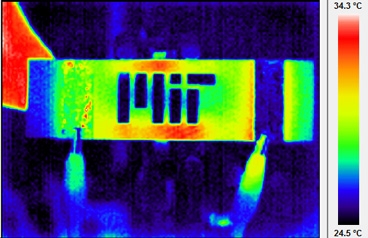
Wardle and his colleagues have devised a new way to detect that internal damage, using a simple handheld device and heat-sensitive camera. Their approach also requires engineering the composite materials to include carbon nanotubes, which generate the heat necessary for the test.
Their approach, described in the March 22 online edition of the journal Nanotechnology, could allow airlines to inspect their planes much more quickly, Wardle says. This project is part of a multiyear, aerospace-industry-funded effort to improve the mechanical properties of existing advanced aerospace-grade composites. The U.S. Air Force and Navy are also interested in the technology, and Wardle is working with them to develop it for use in their aircraft and vessels.
Uncovering damage
Advanced composite materials are commonly found not only in aircraft, but also cars, bridges and wind-turbine blades, Wardle says.
One method that inspectors now use to reveal damage in advanced composite materials is infrared thermography, which detects infrared radiation emitted when the surface is heated. In an advanced composite material, any cracks or delamination (separation of the layers that form the composite material) will redirect the flow of heat. That abnormal flow pattern can be seen with a heat-sensitive (thermographic) camera.
This is effective but cumbersome because it requires large heaters to be placed next to the surface, Wardle says. With his new approach, carbon nanotubes are incorporated into the composite material. When a small electric current is applied to the surface, the nanotubes heat up, which eliminates the need for any external heat source. The inspector can see the damage with a thermographic camera or goggles.
"It's a very clever way to utilize the properties of carbon nanotubes to deliver that thermal energy, from the inside out," says Douglas Adams, associate professor of mechanical engineering at Purdue University. Adams, who was not involved in the research, notes that two fundamental challenges remain: developing a practical way to manufacture large quantities of the new material, and ensuring that the addition of nanotubes does not detract from the material's primary function of withstanding heavy loads.
The new carbon nanotube hybrid materials that Wardle is developing have so far shown better mechanical properties, such as strength and toughness, than existing advanced composites.
####
For more information, please click here
Contacts:
Anne Trafton
MIT News Office
617.253.2700
Copyright © MIT
If you have a comment, please Contact us.Issuers of news releases, not 7th Wave, Inc. or Nanotechnology Now, are solely responsible for the accuracy of the content.
Bookmark:


| Related Links |
| Related News Press |
News and information
 Quantum computer improves AI predictions April 17th, 2026
Flexible sensor gains sensitivity under pressure April 17th, 2026
A reusable chip for particulate matter sensing April 17th, 2026
Detecting vibrational quantum beating in the predissociation dynamics of SF6 using time-resolved photoelectron spectroscopy April 17th, 2026
Nanotubes/Buckyballs/Fullerenes/Nanorods/Nanostrings/Nanosheets
Tiny nanosheets, big leap: A new sensor detects ethanol at ultra-low levels January 30th, 2026
Enhancing power factor of p- and n-type single-walled carbon nanotubes April 25th, 2025
Chainmail-like material could be the future of armor: First 2D mechanically interlocked polymer exhibits exceptional flexibility and strength January 17th, 2025
Innovative biomimetic superhydrophobic coating combines repair and buffering properties for superior anti-erosion December 13th, 2024
Discoveries
Quantum computer improves AI predictions April 17th, 2026
Flexible sensor gains sensitivity under pressure April 17th, 2026
A reusable chip for particulate matter sensing April 17th, 2026
Detecting vibrational quantum beating in the predissociation dynamics of SF6 using time-resolved photoelectron spectroscopy April 17th, 2026
Materials/Metamaterials/Magnetoresistance
First real-time observation of two-dimensional melting process: Researchers at Mainz University unveil new insights into magnetic vortex structures August 8th, 2025
Researchers unveil a groundbreaking clay-based solution to capture carbon dioxide and combat climate change June 6th, 2025
A 1960s idea inspires NBI researchers to study hitherto inaccessible quantum states June 6th, 2025
Institute for Nanoscience hosts annual proposal planning meeting May 16th, 2025
Announcements
A fundamentally new therapeutic approach to cystic fibrosis: Nanobody repairs cellular defect April 17th, 2026
UC Irvine physicists discover method to reverse ‘quantum scrambling’ : The work addresses the problem of information loss in quantum computing system April 17th, 2026
Aerospace/Space
Decoding hydrogen‑bond network of electrolyte for cryogenic durable aqueous zinc‑ion batteries January 30th, 2026
ICFO researchers overcome long-standing bottleneck in single photon detection with twisted 2D materials August 8th, 2025
Onion-like nanoparticles found in aircraft exhaust May 14th, 2025
 |
||
 |
||
| The latest news from around the world, FREE | ||
 |
||
|
|
||
| Premium Products | ||
 |
||
|
Only the news you want to read!
Learn More |
||
 |
||
|
Full-service, expert consulting
Learn More |
||
|
|
||