Home > Press > Predicting a chain of order: Calculations can now predict when and how spins of electrons and ions arrange in one-dimensional multiferroic materials
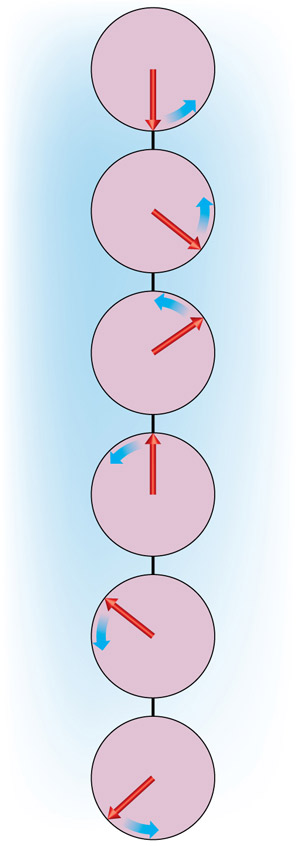 |
| Figure 1: A one-dimensional chain of spins (red arrows), showing a chiral ordering (or spiral), which rotate (blue arrows) in response to incoming light radiation. |
Abstract:
The properties of a material are greatly affected by the electrical and magnetic structure of its constituent ions and electrons. In a ferromagnet, for example, neighboring electron spins point in the same direction, producing a strong external magnetic field. In an antiferromagnet, however, neighboring spins point in opposite directions, negating its magnetism. This behavior can be exploited in devices ranging from switches to memory and computers.
Predicting a chain of order: Calculations can now predict when and how spins of electrons and ions arrange in one-dimensional multiferroic materials
Japan | Posted on March 8th, 2011Multiferroic materials exhibit an even richer physics—and an expanded set of applications—because their magnetic and electrical orderings are linked. However, the magnetic and electrical structuring of multiferroics is not yet completely understood. Now, Shunsuke Furukawa, Masahiro Sato and Shigeki Onoda of the RIKEN Advanced Science Institute, Wako, have successfully calculated how magnetic ordering arises in one-dimensional multiferroic materials—the simplest example of these materials1.
This simplicity means that one-dimensional multiferroic materials are useful models for understanding multidimensional, or ‘bulk', multiferroic materials. Their one-dimensional chain of spins can not only assume a variety of ferromagnetic and anti-ferromagnetic alignments, but they can also arrange into more complicated patterns, including spirals defined over long portions of the chain—referred to as ‘long-range chiral order' (Fig. 1). Understanding these exotic patterns may lead to new foundational science, as well as new applications. In addition, a one-dimensional chain can also exhibit the electrical control of magnetic structure and the response to light that is characteristic of more complex multiferroics.
Onoda and colleagues focused on describing the magnetic structure in a one-dimensional chain in terms of how strongly neighboring spins were coupled to each other. They began by using a computational technique that uniquely allows for the accurate treatment of an infinitely large collection of spins to construct a phase diagram describing how spin ordering changed as the type of spin-to-spin coupling in the material changed. Most notably, the diagram indicated that ferromagnetic coupling between nearest neighbors was much more likely to cause a long-range chiral order than anti-ferromagnetic coupling.
This observation successfully explained the experimentally observed spin ordering of several one-dimensional multiferroic cuprates. In particular, the research team was able to correctly predict that the bulk multiferroic material LiCu2O2, whose unique physics has drawn the attention of physicists for over a decade, exhibits chiral order and has a unique response to light. "These results confirm that one-dimensional multiferroics are an ideal laboratory for studying spin dynamics", says Onoda, and he feels that the calculations will promote studies on new one-dimensional multiferroics and other novel states of matter.
The corresponding author for this highlight is based at the Condensed Matter Theory Laboratory, RIKEN Advance Science Institute
####
For more information, please click here
Copyright © Riken Research
If you have a comment, please Contact us.Issuers of news releases, not 7th Wave, Inc. or Nanotechnology Now, are solely responsible for the accuracy of the content.
Bookmark:


| Related Links |
| Related News Press |
News and information
 Quantum computer improves AI predictions April 17th, 2026
Flexible sensor gains sensitivity under pressure April 17th, 2026
A reusable chip for particulate matter sensing April 17th, 2026
Detecting vibrational quantum beating in the predissociation dynamics of SF6 using time-resolved photoelectron spectroscopy April 17th, 2026
Physics
UC Irvine physicists discover method to reverse ‘quantum scrambling’ : The work addresses the problem of information loss in quantum computing system April 17th, 2026
Quantum computers simulate fundamental physics: shedding light on the building blocks of nature June 6th, 2025
Chip Technology
A reusable chip for particulate matter sensing April 17th, 2026
Metasurfaces smooth light to boost magnetic sensing precision January 30th, 2026
Memory Technology
Researchers tackle the memory bottleneck stalling quantum computing October 3rd, 2025
First real-time observation of two-dimensional melting process: Researchers at Mainz University unveil new insights into magnetic vortex structures August 8th, 2025
Utilizing palladium for addressing contact issues of buried oxide thin film transistors April 5th, 2024
Discoveries
Quantum computer improves AI predictions April 17th, 2026
Flexible sensor gains sensitivity under pressure April 17th, 2026
A reusable chip for particulate matter sensing April 17th, 2026
Detecting vibrational quantum beating in the predissociation dynamics of SF6 using time-resolved photoelectron spectroscopy April 17th, 2026
Announcements
A fundamentally new therapeutic approach to cystic fibrosis: Nanobody repairs cellular defect April 17th, 2026
UC Irvine physicists discover method to reverse ‘quantum scrambling’ : The work addresses the problem of information loss in quantum computing system April 17th, 2026
 |
||
 |
||
| The latest news from around the world, FREE | ||
 |
||
|
|
||
| Premium Products | ||
 |
||
|
Only the news you want to read!
Learn More |
||
 |
||
|
Full-service, expert consulting
Learn More |
||
|
|
||