Home > Press > Silk moth's antenna inspires new nanotech tool with applications in Alzheimer's research
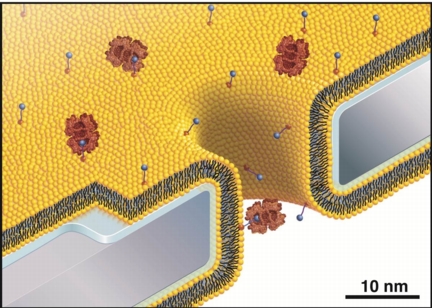 |
| A new oily coating that improves the functionality of nanopores was inspired by a similar layer in the silk moth's antenna. Nanopores are measurement devices that enable the study of single molecules or proteins. Credit: Chris Burke |
Abstract:
By mimicking the structure of the silk moth's antenna, University of Michigan researchers led the development of a better nanopore---a tiny tunnel-shaped tool that could advance understanding of a class of neurodegenerative diseases that includes Alzheimer's.
Silk moth's antenna inspires new nanotech tool with applications in Alzheimer's research
Ann Arbor, MI | Posted on February 28th, 2011A paper on the work is newly published online in Nature Nanotechnology. This project is headed by Michael Mayer, an associate professor in the U-M departments of Biomedical Engineering and Chemical Engineering. Also collaborating are Jerry Yang, an associate professor at the University of California, San Diego and Jiali Li, an associate professor at the University of Arkansas.
Nanopores---essentially holes drilled in a silicon chip---are miniscule measurement devices that enable the study of single molecules or proteins. Even today's best nanopores clog easily, so the technology hasn't been widely adopted in the lab. Improved versions are expected to be major boons for faster, cheaper DNA sequencing and protein analysis.
The team engineered an oily coating that traps and smoothly transports molecules of interest through nanopores. The coating also allows researchers to adjust the size of the pore with close-to-atomic precision.
"What this gives us is an improved tool to characterize biomolecules," Mayer said. "It allows us to gain understanding about their size, charge, shape, concentration and the speed at which they assemble. This could help us possibly diagnose and understand what is going wrong in a category of neurodegenerative disease that includes Parkinson's, Huntington's and Alzheimer's."
Mayer's "fluid lipid bilayer" resembles a coating on the male silk moth's antenna that helps it smell nearby female moths. The coating catches pheromone molecules in the air and carries them through nanotunnels in the exoskeleton to nerve cells that send a message to the bug's brain.
"These pheromones are lipophilic. They like to bind to lipids, or fat-like materials. So they get trapped and concentrated on the surface of this lipid layer in the silk moth. The layer greases the movement of the pheromones to the place where they need to be. Our new coating serves the same purpose," Mayer said.
One of Mayer's main research tracks is to study proteins called amyloid-beta peptides that are thought to coagulate into fibers that affect the brain in Alzheimer's. He is interested in studying the size and shape of these fibers and how they form.
"Existing techniques don't allow you to monitor the process very well. We wanted to see the clumping of these peptides using nanopores, but every time we tried it, the pores clogged up," Mayer said. "Then we made this coating, and now our idea works."
To use nanopores in experiments, researchers position the pore-pricked chip between two chambers of saltwater. They drop the molecules of interest into one of the chambers and send an electric current through the pore. As each molecule or protein passes through the pore, it changes the pore's electrical resistance. The amount of change observed tells the researchers valuable information about the molecule's size, electrical charge and shape.
Due to their small footprint and low power requirements, nanopores could also be used to detect biological warfare agents.
A research highlight on this work will appear in an upcoming edition of Nature. The paper is titled "Controlling protein translocation through nanopores with bio-inspired fluid walls."
This research is funded by the National Science Foundation, the National Institutes of Health, the Alzheimer's Disease Research Center, the Alzheimer's Association and the National Human Genome Research Institute. The university is pursuing patent protection for the intellectual property, and is seeking commercialization partners to help bring the technology to market.
####
About University of Michigan
The University of Michigan College of Engineering is ranked among the top engineering schools in the country. At $180 million annually, its engineering research budget is one of largest of any public university. Michigan Engineering is home to 11 academic departments, numerous research centers and expansive entrepreneurial programs. The College plays a leading role in the Michigan Memorial Phoenix Energy Institute and hosts the world-class Lurie Nanofabrication Facility. Michigan Engineering's premier scholarship, international scale and multidisciplinary scope combine to create The Michigan Difference.
For more information, please click here
Contacts:
Nicole Casal Moore
(734) 647-7087
Copyright © University of Michigan
If you have a comment, please Contact us.Issuers of news releases, not 7th Wave, Inc. or Nanotechnology Now, are solely responsible for the accuracy of the content.
Bookmark:


| Related Links |
| Related News Press |
News and information
 Quantum computer improves AI predictions April 17th, 2026
Flexible sensor gains sensitivity under pressure April 17th, 2026
A reusable chip for particulate matter sensing April 17th, 2026
Detecting vibrational quantum beating in the predissociation dynamics of SF6 using time-resolved photoelectron spectroscopy April 17th, 2026
Nanomedicine
A fundamentally new therapeutic approach to cystic fibrosis: Nanobody repairs cellular defect April 17th, 2026
New molecular technology targets tumors and simultaneously silences two ‘undruggable’ cancer genes August 8th, 2025
New imaging approach transforms study of bacterial biofilms August 8th, 2025
Electrifying results shed light on graphene foam as a potential material for lab grown cartilage June 6th, 2025
Discoveries
Quantum computer improves AI predictions April 17th, 2026
Flexible sensor gains sensitivity under pressure April 17th, 2026
A reusable chip for particulate matter sensing April 17th, 2026
Detecting vibrational quantum beating in the predissociation dynamics of SF6 using time-resolved photoelectron spectroscopy April 17th, 2026
Announcements
A fundamentally new therapeutic approach to cystic fibrosis: Nanobody repairs cellular defect April 17th, 2026
UC Irvine physicists discover method to reverse ‘quantum scrambling’ : The work addresses the problem of information loss in quantum computing system April 17th, 2026
Tools
Metasurfaces smooth light to boost magnetic sensing precision January 30th, 2026
From sensors to smart systems: the rise of AI-driven photonic noses January 30th, 2026
Japan launches fully domestically produced quantum computer: Expo visitors to experience quantum computing firsthand August 8th, 2025
 |
||
 |
||
| The latest news from around the world, FREE | ||
 |
||
|
|
||
| Premium Products | ||
 |
||
|
Only the news you want to read!
Learn More |
||
 |
||
|
Full-service, expert consulting
Learn More |
||
|
|
||