Home > Press > The surface swap
 |
Abstract:
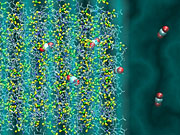
Two tiny molecular layers in a liquid that traps carbon dioxide constantly swap places, influencing how much of the greenhouse gas is absorbed, according to scientists at DOE's Pacific Northwest National Laboratory, University of Wisconsin, and Louisiana Tech University.
The surface swap
Richland, WA | Posted on January 12th, 2011The scientists made this discovery after building a computational model and studying the carbon capture liquid, known as BMIMF4.
Burning coal in power plants and industrial uses of fossil fuels generate significant amounts of carbon dioxide. Scientists and industry leaders want to remove carbon dioxide from emissions, preventing its access to the environment. One option is to pump the gaseous emissions through a liquid that traps only carbon dioxide, and not other gases. The study provides insights into the nanostructure of BMIMF4's surface.
"The surface is of particular interest because that's where carbon dioxide first encounters the charged, carbon capture liquid," said Dr. Liem Dang, a theoretical chemist at PNNL. DOE's Chemical Sciences, Geosciences and Biosciences Division of the Office of Basic Energy Sciences, PNNL's Energy Conversion Initiative and Laboratory Directed Research and Development, and the Louisiana Board of Regents Research Competitiveness Subprogram funded this work.
####
For more information, please click here
Contacts:
Kristin Manke
509.372.6011
Copyright © Pacific Northwest National Laboratory
If you have a comment, please Contact us.Issuers of news releases, not 7th Wave, Inc. or Nanotechnology Now, are solely responsible for the accuracy of the content.
Bookmark:


| Related News Press |
News and information
 Quantum computer improves AI predictions April 17th, 2026
Flexible sensor gains sensitivity under pressure April 17th, 2026
A reusable chip for particulate matter sensing April 17th, 2026
Detecting vibrational quantum beating in the predissociation dynamics of SF6 using time-resolved photoelectron spectroscopy April 17th, 2026
Govt.-Legislation/Regulation/Funding/Policy
Quantum computer improves AI predictions April 17th, 2026
Metasurfaces smooth light to boost magnetic sensing precision January 30th, 2026
New imaging approach transforms study of bacterial biofilms August 8th, 2025
Academic/Education
Rice University launches Rice Synthetic Biology Institute to improve lives January 12th, 2024
Multi-institution, $4.6 million NSF grant to fund nanotechnology training September 9th, 2022
Announcements
A fundamentally new therapeutic approach to cystic fibrosis: Nanobody repairs cellular defect April 17th, 2026
UC Irvine physicists discover method to reverse ‘quantum scrambling’ : The work addresses the problem of information loss in quantum computing system April 17th, 2026
Environment
A reusable chip for particulate matter sensing April 17th, 2026
Researchers unveil a groundbreaking clay-based solution to capture carbon dioxide and combat climate change June 6th, 2025
 |
||
 |
||
| The latest news from around the world, FREE | ||
 |
||
|
|
||
| Premium Products | ||
 |
||
|
Only the news you want to read!
Learn More |
||
 |
||
|
Full-service, expert consulting
Learn More |
||
|
|
||