Home > Press > NanoSIMS suggests arsenic as a life building block
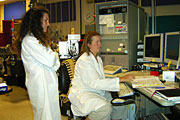 |
| LLNL's Jennifer Pett-Ridge, right, runs the NanoSIMS and analyzes some arsenic-grown cells from Mono Lake as NASA/USGS's Felisa Wolfe-Simon observes. |
Abstract:
Arsenic -- an element that triggers death for most Earthly life forms -- is actually allowing for bacterium to thrive and reproduce.
NanoSIMS suggests arsenic as a life building block
Livermore, CA | Posted on January 12th, 2011In a study that may prompt the rewriting of textbooks, a team of astrobiologists and chemists has found the first known living organism that can use arsenic in place of phosphorus in its major macromolecules. The new findings, published in the Dec. 2 issue of Science Express, could redefine origins of life research and alter the way we describe life as we know it.
Oxygen, carbon, hydrogen, nitrogen, sulfur and phosphorous are the six basic building blocks of life on Earth. These elements make up nucleic acids, proteins and lipids -- the bulk of living matter.
The new study by DOE's Lawrence Livermore National Laboratory and led by NASA and the U.S. Geological Survey has found that a bacterium isolated from Mono Lake may substitute arsenic for phosphorus to sustain its growth.
Mono Lake, located in eastern California, is an alkaline and hypersaline lake with high dissolved arsenic concentrations and is believed to have formed more than 760,000 years ago from neighboring volcanic eruptions.
LLNL's Jennifer Pett-Ridge and Peter Weber were able to identify low concentrations of arsenic found in individual cells of bacteria and extracted DNA by using the Lab's Nano SIMS.
NanoSIMS is a tool which allows precise, spatially explicit, elemental and isotopic analysis down to the 50-nanomenter scale; it also offers a range of advantages for sensitive and high-resolution measurements.
NanoSIMS not only measures the elemental concentrations, but it also images them. It collects a picture of the image and identifies how much of a specific element is found in the sample. "We found that arsenic was higher in the cells than in the environment outside the cells," Pett-Ridge said.
####
For more information, please click here
Contacts:
Lynda Seaver
925.423.3103
Copyright © Lawrence Livermore National Laboratory
If you have a comment, please Contact us.Issuers of news releases, not 7th Wave, Inc. or Nanotechnology Now, are solely responsible for the accuracy of the content.
Bookmark:


| Related News Press |
News and information
 Quantum computer improves AI predictions April 17th, 2026
Flexible sensor gains sensitivity under pressure April 17th, 2026
A reusable chip for particulate matter sensing April 17th, 2026
Detecting vibrational quantum beating in the predissociation dynamics of SF6 using time-resolved photoelectron spectroscopy April 17th, 2026
Announcements
A fundamentally new therapeutic approach to cystic fibrosis: Nanobody repairs cellular defect April 17th, 2026
UC Irvine physicists discover method to reverse ‘quantum scrambling’ : The work addresses the problem of information loss in quantum computing system April 17th, 2026
Tools
Metasurfaces smooth light to boost magnetic sensing precision January 30th, 2026
From sensors to smart systems: the rise of AI-driven photonic noses January 30th, 2026
Japan launches fully domestically produced quantum computer: Expo visitors to experience quantum computing firsthand August 8th, 2025
 |
||
 |
||
| The latest news from around the world, FREE | ||
 |
||
|
|
||
| Premium Products | ||
 |
||
|
Only the news you want to read!
Learn More |
||
 |
||
|
Full-service, expert consulting
Learn More |
||
|
|
||