Home > Press > Flares on the Move
 |
Abstract:
Nanoparticle test kit shows how nanoparticles of different size disperse in tumor tissue
Flares on the Move
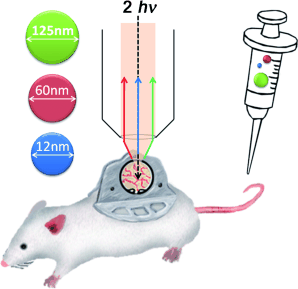
Weinheim, Germany | Posted on January 11th, 2011Nanoparticles play a significant role in the development of future diagnostic and therapeutic techniques for tumors, for example as transporters for drugs or as contrast agents. Absorption and dispersion of nanoparticles in tumor tissue depend strongly on particle size. In order to systematically study this, scientists at the Massachusetts Institute of Technology (MIT, Cambridge, USA) and Harvard Medical School (Boston, USA) have now produced a set of fluorescent nanoparticles of various diameters between 10 and 150 nm. As the team led by Moungi G. Bawendi and Daniel G. Nocera reports in the journal Angewandte Chemie, they were able to use these to simultaneously follow the dispersion of particles of different sizes through mouse tumors in real time.
In order for nanoparticle-based biomedical techniques to work, the nanoparticles must be of optimal size. For studies, it is thus desirable to simultaneously observe the behavior of particles of different size in the same tumor in vivo. This requires chemically comparable particles of various sizes, each size group consisting of particles of uniform size and composition. Additionally, it must be possible to simultaneously detect and differentiate the various particles. Also, they must be biocompatible, and may not form aggregates or adsorb proteins. This complex challenge has now been met.
The researchers developed a set of nanoparticles in various sizes, which can be detected by means of fluorescing quantum dots. Quantum dots are semiconducting structures at the boundary between macroscopic solid bodies and the quantum-mechanical nano-world. By selectively producing quantum dots of different sizes, it is possible to obtain quantum dots that fluoresce at different defined wavelengths, which allows them to be simultaneously detected and differentiated.
To produce nanoparticles in different size classes, the scientists coated cadmium selenide/cadmium sulfide quantum dots with polymer ligands such as silicon dioxide and polyethylene glycol. They attained particles larger than 100 nm in diameter by attaching quantum dots to prefabricated silicon dioxide particles and then coating them with polyethylene glycol. For each size class they selected quantum dots that give off light of a different wavelength.
The researchers intravenously injected a mixture of particles with diameters of 12, 60, and 125 nm into mice with cancer. Fluorescence microscopy was used to follow the particles' entry into the tumor tissue in vivo. Whereas the 12 nm particles easily passed from the blood vessels into the tissue and rapidly spread out, the 60 nm particles passed through the walls of the vein but stayed within 10 µm of the vessel wall, unable to pass farther into the tissue. The 125 nm particles essentially did not pass through the walls of the blood vessels at all.
Author: Moungi G. Bawendi, Daniel G. Nocera, Massachusetts Institute of Technology, Cambridge (USA), web.mit.edu/chemistry/www/faculty/nocera.html
Title: A Nanoparticle Size Series for In Vivo Fluorescence Imaging
Angewandte Chemie International Edition 2010, 49, No. 46, 8649-8652, Permalink to the article: dx.doi.org/10.1002/anie.201003142
####
For more information, please click here
Copyright © Angewandte Chemie International Edition
If you have a comment, please Contact us.Issuers of news releases, not 7th Wave, Inc. or Nanotechnology Now, are solely responsible for the accuracy of the content.
Bookmark:


| Related News Press |
News and information
 Quantum computer improves AI predictions April 17th, 2026
Flexible sensor gains sensitivity under pressure April 17th, 2026
A reusable chip for particulate matter sensing April 17th, 2026
Detecting vibrational quantum beating in the predissociation dynamics of SF6 using time-resolved photoelectron spectroscopy April 17th, 2026
Possible Futures
A fundamentally new therapeutic approach to cystic fibrosis: Nanobody repairs cellular defect April 17th, 2026
UC Irvine physicists discover method to reverse ‘quantum scrambling’ : The work addresses the problem of information loss in quantum computing system April 17th, 2026
Nanomedicine
A fundamentally new therapeutic approach to cystic fibrosis: Nanobody repairs cellular defect April 17th, 2026
New molecular technology targets tumors and simultaneously silences two ‘undruggable’ cancer genes August 8th, 2025
New imaging approach transforms study of bacterial biofilms August 8th, 2025
Electrifying results shed light on graphene foam as a potential material for lab grown cartilage June 6th, 2025
Announcements
A fundamentally new therapeutic approach to cystic fibrosis: Nanobody repairs cellular defect April 17th, 2026
UC Irvine physicists discover method to reverse ‘quantum scrambling’ : The work addresses the problem of information loss in quantum computing system April 17th, 2026
Quantum Dots/Rods
A new kind of magnetism November 17th, 2023
IOP Publishing celebrates World Quantum Day with the announcement of a special quantum collection and the winners of two prestigious quantum awards April 14th, 2023
Qubits on strong stimulants: Researchers find ways to improve the storage time of quantum information in a spin rich material January 27th, 2023
NIST’s grid of quantum islands could reveal secrets for powerful technologies November 18th, 2022
Nanobiotechnology
A fundamentally new therapeutic approach to cystic fibrosis: Nanobody repairs cellular defect April 17th, 2026
New molecular technology targets tumors and simultaneously silences two ‘undruggable’ cancer genes August 8th, 2025
New imaging approach transforms study of bacterial biofilms August 8th, 2025
Electrifying results shed light on graphene foam as a potential material for lab grown cartilage June 6th, 2025
 |
||
 |
||
| The latest news from around the world, FREE | ||
 |
||
|
|
||
| Premium Products | ||
 |
||
|
Only the news you want to read!
Learn More |
||
 |
||
|
Full-service, expert consulting
Learn More |
||
|
|
||