Home > Press > All that Glitters is Gold
 |
Abstract:
Gold Cyclization Reaction Provides Important Building Blocks for Pharmaceuticals
All that Glitters is Gold
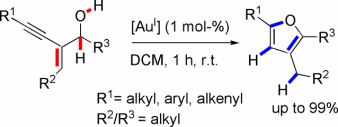
Weinheim, Germany | Posted on January 7th, 2011In many significant natural products, furans are a key motif. These oxygen-containing five-membered heterocycles are also versatile building blocks in the construction of highly complex target structures. As such, they are important scaffolds in organic and pharmaceutical chemistry. As reported in the European Journal of Organic Chemistry, A. Stephen K. Hashmi and a team at Universität Heidelberg (Germany) have now introduced a general protocol for the preparation of highly substituted furans through a gold-catalyzed cyclization reaction.
The efficiency of reactions is often thought of in terms of atom economy, and the search for more efficient alternatives to classical chemical reactions is now an area of intense research. In this context, transition-metal catalysts are becoming a popular choice amongst chemists, because they are often used in only very small amounts, which conforms to the atom-economy rule and minimizes waste. Notably, in contrast to the often harsh conditions required to perform classical chemical transformations, most transition-metal catalyzed reactions can be performed under mild reaction conditions and within a short timeframe.
Because gold catalysts are robust, their popularity has increased significantly in the last few years. Gold catalysts can easily be handled in air, and they are also tolerant to water. Moreover, gold catalysts often show higher activity and higher selectivity than their more popular palladium counterparts. Gold is particularly well suited for substrates that bear a triple carbon-carbon bond (i.e., an alkyne), as it coordinates preferentially to this bond, resulting in a highly reactive complex that is prone to attack. As such, the gold-catalyzed cyclization of an alkyne tethered to an alcohol can provide easy access to highly substituted furans.
The German research team found that the gold(I)-catalyzed cyclization of various 2-alkynylallyl alcohols proceeded well and afforded the desired furan products with the use of low catalyst loadings under very mild reaction conditions. Importantly, both di- and trisubstituted furans could be obtained, which allows structural variety in the building blocks. Bifunctional substrates could also be cyclized to provide chemically interesting bisfurans. This synthetically simple route provides quick and easy access to highly substituted furan building blocks, which may help to facilitate the study of this important class of compounds.
Author: A. Stephen K. Hashmi, Universität Heidelberg (Germany),
Title: Cyclization of 2-Alkynylallyl Alcohols to Highly Substituted Furans by Gold(I)-Carbene Complexes
European Journal of Organic Chemistry, Permalink to the article: dx.doi.org/10.1002/ejoc.201001479
####
For more information, please click here
Copyright © European Journal of Organic Chemistry
If you have a comment, please Contact us.Issuers of news releases, not 7th Wave, Inc. or Nanotechnology Now, are solely responsible for the accuracy of the content.
Bookmark:


| Related News Press |
News and information
 Quantum computer improves AI predictions April 17th, 2026
Flexible sensor gains sensitivity under pressure April 17th, 2026
A reusable chip for particulate matter sensing April 17th, 2026
Detecting vibrational quantum beating in the predissociation dynamics of SF6 using time-resolved photoelectron spectroscopy April 17th, 2026
Chemistry
Projecting light to dispense liquids: A new route to ultra-precise microdroplets January 30th, 2026
From sensors to smart systems: the rise of AI-driven photonic noses January 30th, 2026
"Nanoreactor" cage uses visible light for catalytic and ultra-selective cross-cycloadditions October 3rd, 2025
Cambridge chemists discover simple way to build bigger molecules – one carbon at a time June 6th, 2025
Academic/Education
Rice University launches Rice Synthetic Biology Institute to improve lives January 12th, 2024
Multi-institution, $4.6 million NSF grant to fund nanotechnology training September 9th, 2022
Discoveries
Quantum computer improves AI predictions April 17th, 2026
Flexible sensor gains sensitivity under pressure April 17th, 2026
A reusable chip for particulate matter sensing April 17th, 2026
Detecting vibrational quantum beating in the predissociation dynamics of SF6 using time-resolved photoelectron spectroscopy April 17th, 2026
Announcements
A fundamentally new therapeutic approach to cystic fibrosis: Nanobody repairs cellular defect April 17th, 2026
UC Irvine physicists discover method to reverse ‘quantum scrambling’ : The work addresses the problem of information loss in quantum computing system April 17th, 2026
 |
||
 |
||
| The latest news from around the world, FREE | ||
 |
||
|
|
||
| Premium Products | ||
 |
||
|
Only the news you want to read!
Learn More |
||
 |
||
|
Full-service, expert consulting
Learn More |
||
|
|
||