Home > Press > Asylum Research Installs Dual AFMs at University of Melbourne, Australia
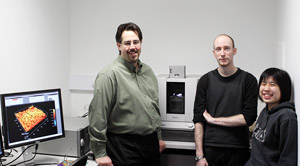 |
| Shown with the Cypher AFM system, left to right: Dr. Raymond Dagastine, Dr. Rico Tabor and Dr. Sin Ying Tan of the University of Melbourne’s Department of Chemical and Biomolecular Engineering. |
Abstract:
Asylum Research, the technology leader in scanning probe/atomic force microscopy (AFM/SPM), announced today that it has delivered a dual system order for a Cypher™ AFM and an MFP-3D-BIO™ AFM to the University of Melbourne's Department of Chemical and Biomolecular Engineering.
Asylum Research Installs Dual AFMs at University of Melbourne, Australia
Raleigh, NC | Posted on August 27th, 2010Dr. Raymond Dagastine's group will use the Asylum AFMs to develop nano-scale experiments and theories to measure and predict interactions, collisions, and coalescence between droplets and bubbles that underpin innovative applications of foams and emulsions and other soft matter materials. The approach provides a "front seat" view of how drops or bubbles collide in solution and how the physical mechanisms are dependent on the types of molecules coating their interfaces.
Dr. Dagastine commented, "We chose the combination of the Asylum MFP-3D and Cypher AFMs for their visionary design and stability, the cross compatibility of the software, and the ease of implementing specialized user controls and inputs. This coupled with Asylum's superior technical support makes the MFD-3D-BIO and Cypher the ideal combination of instruments for high-end research and surface characterization on the nano-scale. These outstanding AFMs will allow us an unprecedented opportunity to visualize the interactions and surfaces in soft matter materials through high resolution imagining on the nano to molecular scale, as well as cutting edge force measurements on the nano-scale with integration of a variety of optical characterization methods."
Shane Huntington of The Innovation Group, Asylum's representative in Australia for over a decade, commented, "As a company made up of AFM researchers, we are excited to be working with distinguished users such as Dr. Dagastine. We offer collaboration with our customers on the details of their research and stand ready with long-term service and support. The Innovation Group has installed more AFM systems in Australia than the current reps of all other AFM companies combined."
####
For more information, please click here
Contacts:
Jennifer Jones
Asylum Research Corp.
940 Main Campus Drive, Suite 130
Raleigh, NC 27606
919-828-6490 office
919-828-6491 fax
Copyright © Asylum Research
If you have a comment, please Contact us.Issuers of news releases, not 7th Wave, Inc. or Nanotechnology Now, are solely responsible for the accuracy of the content.
Bookmark:


| Related News Press |
News and information
 Quantum computer improves AI predictions April 17th, 2026
Flexible sensor gains sensitivity under pressure April 17th, 2026
A reusable chip for particulate matter sensing April 17th, 2026
Detecting vibrational quantum beating in the predissociation dynamics of SF6 using time-resolved photoelectron spectroscopy April 17th, 2026
Academic/Education
Rice University launches Rice Synthetic Biology Institute to improve lives January 12th, 2024
Multi-institution, $4.6 million NSF grant to fund nanotechnology training September 9th, 2022
Announcements
A fundamentally new therapeutic approach to cystic fibrosis: Nanobody repairs cellular defect April 17th, 2026
UC Irvine physicists discover method to reverse ‘quantum scrambling’ : The work addresses the problem of information loss in quantum computing system April 17th, 2026
Tools
Metasurfaces smooth light to boost magnetic sensing precision January 30th, 2026
From sensors to smart systems: the rise of AI-driven photonic noses January 30th, 2026
Japan launches fully domestically produced quantum computer: Expo visitors to experience quantum computing firsthand August 8th, 2025
 |
||
 |
||
| The latest news from around the world, FREE | ||
 |
||
|
|
||
| Premium Products | ||
 |
||
|
Only the news you want to read!
Learn More |
||
 |
||
|
Full-service, expert consulting
Learn More |
||
|
|
||