Home > Press > Smallest U-M logo demonstrates advanced display technology
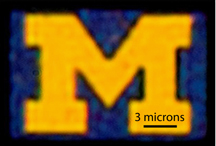 |
| An optical microscopy image of a 12-by-9-micron U-M logo produced with this new color filter process. The image is a bit blurry because it has been magnified about 5,000 times. Credit: Jay Guo. |
Abstract:
In a step toward more efficient, smaller and higher-definition display screens, a University of Michigan professor has developed a new type of color filter made of nano-thin sheets of metal with precisely spaced gratings.
Smallest U-M logo demonstrates advanced display technology
Ann Arbor, MI | Posted on August 26th, 2010The gratings, sliced into metal-dielectric-metal stacks, act as resonators. They trap and transmit light of a particular color, or wavelength, said Jay Guo, an associate professor in the Department of Electrical Engineering and Computer Science. A dielectric is a material that does not conduct electricity.
"Simply by changing the space between the slits, we can generate different colors," Guo said. "Through nanostructuring, we can render white light any color."
A paper on the research is published Aug. 24 in Nature Communications.
His team used this technique to make what they believes is the smallest color U-M logo. At about 12-by-9 microns, it's about 1/6 the width of a human hair.
Conventional LCDs, or liquid crystal displays, are inefficient and manufacturing-intensive to produce. Only about 5 percent of their back-light travels through them and reaches our eyes, Guo said. They contain two layers of polarizers, a color filter sheet, and two layers of electrode-laced glass in addition to the liquid crystal layer. Chemical colorants for red, green and blue pixel components must be patterned in different regions on the screen in separate steps.
Guo's color filter acts as a polarizer simultaneously, eliminating the need for additional polarizer layers. In Guo's displays, reflected light could be recycled to save much of the light that would otherwise be wasted.
Because these new displays contain fewer layers, they would be simpler to manufacture, Guo said. The new color filters contain just three layers: two metal sheets sandwiching a dielectric. Red, green and blue pixel components could be made in one step by cutting arrays of slits in the stack. This structure is also more robust and can endure higher- powered light.
Red light emanates from slits set around 360 nanometers apart; green from those about 270 nanometers apart and blue from those approximately 225 nanometers apart. The differently spaced gratings essentially catch different wavelengths of light and resonantly transmit through the stacks.
"Amazingly, we found that even a few slits can already produce well-defined color, which shows its potential for extremely high-resolution display and spectral imaging," Guo said.
The pixels in Guo's displays are about an order of magnitude smaller than those on a typical computer screen. They're about eight times smaller than the pixels on the iPhone 4, which are about 78 microns. He envisions that this pixel size could make this technology useful in projection displays, as well as wearable, bendable or extremely compact displays.
The paper is called "Plasmonic nano-resonators for high resolution color filtering and spectral imaging."
Guo is also an associate professor in the Department of Macromolecular Science and Engineering. This research is supported in part by the Air Force Office of Scientific Research and the Defense Advanced Research Projects Agency. The university is pursuing patent protection for the intellectual property and is seeking commercialization partners to help bring the technology to market.
####
About University of Michigan College of Engineering
The University of Michigan College of Engineering is ranked among the top engineering schools in the country. At $160 million annually, its engineering research budget is one of the largest of any public university. Michigan Engineering is home to 11 academic departments and a National Science Foundation Engineering Research Center. The college plays a leading role in the Michigan Memorial Phoenix Energy Institute and hosts the world-class Lurie Nanofabrication Facility. Michigan Engineering's premier scholarship, international scale and multidisciplinary scope combine to create The Michigan Difference. Find out more at www.engin.umich.edu
For more information, please click here
Contacts:
Nicole Casal Moore
Phone: (734) 647-7087
Copyright © University of Michigan College of Engineering
If you have a comment, please Contact us.Issuers of news releases, not 7th Wave, Inc. or Nanotechnology Now, are solely responsible for the accuracy of the content.
Bookmark:


| Related News Press |
News and information
 Quantum computer improves AI predictions April 17th, 2026
Flexible sensor gains sensitivity under pressure April 17th, 2026
A reusable chip for particulate matter sensing April 17th, 2026
Detecting vibrational quantum beating in the predissociation dynamics of SF6 using time-resolved photoelectron spectroscopy April 17th, 2026
Thin films
Tiny nanosheets, big leap: A new sensor detects ethanol at ultra-low levels January 30th, 2026
Display technology/LEDs/SS Lighting/OLEDs
Spinel-type sulfide semiconductors to operate the next-generation LEDs and solar cells For solar-cell absorbers and green-LED source October 3rd, 2025
Efficient and stable hybrid perovskite-organic light-emitting diodes with external quantum efficiency exceeding 40 per cent July 5th, 2024
Academic/Education
Rice University launches Rice Synthetic Biology Institute to improve lives January 12th, 2024
Multi-institution, $4.6 million NSF grant to fund nanotechnology training September 9th, 2022
Announcements
A fundamentally new therapeutic approach to cystic fibrosis: Nanobody repairs cellular defect April 17th, 2026
UC Irvine physicists discover method to reverse ‘quantum scrambling’ : The work addresses the problem of information loss in quantum computing system April 17th, 2026
 |
||
 |
||
| The latest news from around the world, FREE | ||
 |
||
|
|
||
| Premium Products | ||
 |
||
|
Only the news you want to read!
Learn More |
||
 |
||
|
Full-service, expert consulting
Learn More |
||
|
|
||