 |
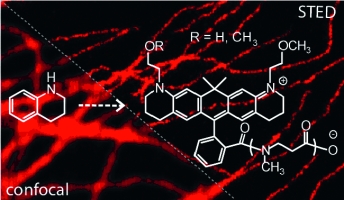
| Far-field optical nanoscopy methods, especially STED (stimulated emission depletion), pose very strict and, at times, contradictory requirements on the utilized fluorescent markers. Photostable fluorescent dyes that absorb in the red optical region are indispensable as labels for various micro- and nanoscopic studies (e.g., with commercially available STED microscopes). Despite many attempts to design novel and improved red-emitting dyes, the number of compounds that perform satisfactorily in fluorescence-based microscopy is still limited. |
Abstract:
Red-Emitting Dyes for Optical Microscopy and Nanoscopy
Written in Red
EU | Posted on July 7th, 2010Far-field optical nanoscopy methods, especially STED (stimulated emission depletion), pose very strict and, at times, contradictory requirements on the utilized fluorescent markers. Photostable fluorescent dyes that absorb in the red optical region are indispensable as labels for various micro- and nanoscopic studies (e.g., with commercially available STED microscopes). Despite many attempts to design novel and improved red-emitting dyes, the number of compounds that perform satisfactorily in fluorescence-based microscopy is still limited. Because of this, a great deal of research is being carried out by a large multidisciplinary team headed by Prof. Stefan W. Hell at the Department of NanoBiophotonics in Max Planck Institute for Biophysical Chemistry (Göttingen). In their recent paper published in the European Journal of Organic Chemistry the team describes a general synthetic route to new improved carbopyronine dyes and their performance in confocal and STED microscopy.
The new dyes have large fluorescence quantum yields, high water solubility, and the required positions of the absorption and emission bands in the red. The chemists came up with a synthetically feasible structural scaffold with functional groups that can be varied in the final steps of the synthesis or even in the resulting fluorescent dye to fit a given task. According to Dr. Kirill Kolmakov, who performed the synthesis, his "table book" contained a dissertation and articles and patents by Prof. K. Drexhage and co-workers, whose contribution to the synthesis of carbopyronines is fundamental. However, the synthetic approach presented in their EurJOC article is by far more flexible and improved. In particular, it starts from one simple precursor and utilizes a minimum amount of protecting groups. The key feature of the general strategy described therein is the interplay of certain protecting groups. Protecting groups will take an even more important part in the design and synthesis of caged carbopyronines and rhodamines that emit in the far-red spectral region. Besides the interesting chemistry, the team demonstrates that the performance of a dye in confocal microscopy and under STED conditions does not necessarily correlate. Dr. Kolmakov thus emphasizes that for their future research work, they will have to reconsider some of their old views on the "ideal" STED dye. All these make the primary article a good example of teamwork that is strategically sound, brilliantly planned, and perfectly delivered.
Author: Vladimir N. Belov, Max Planck Institute for Biophysical Chemistry, Göttingen (Germany),
Title: A Versatile Route to Red-Emitting Carbopyronine Dyes for Optical Microscopy and Nanoscopy
European Journal of Organic Chemistry, 2010, No. 19, 3593-3610, Permalink to the article: dx.doi.org/10.1002/ejoc.201000343
####
For more information, please click here
Copyright © European Journal of Organic Chemistry
If you have a comment, please Contact us.Issuers of news releases, not 7th Wave, Inc. or Nanotechnology Now, are solely responsible for the accuracy of the content.
Bookmark:


| Related News Press |
News and information
 Quantum computer improves AI predictions April 17th, 2026
Flexible sensor gains sensitivity under pressure April 17th, 2026
A reusable chip for particulate matter sensing April 17th, 2026
Detecting vibrational quantum beating in the predissociation dynamics of SF6 using time-resolved photoelectron spectroscopy April 17th, 2026
Announcements
A fundamentally new therapeutic approach to cystic fibrosis: Nanobody repairs cellular defect April 17th, 2026
UC Irvine physicists discover method to reverse ‘quantum scrambling’ : The work addresses the problem of information loss in quantum computing system April 17th, 2026
Tools
Metasurfaces smooth light to boost magnetic sensing precision January 30th, 2026
From sensors to smart systems: the rise of AI-driven photonic noses January 30th, 2026
Japan launches fully domestically produced quantum computer: Expo visitors to experience quantum computing firsthand August 8th, 2025
 |
||
 |
||
| The latest news from around the world, FREE | ||
 |
||
|
|
||
| Premium Products | ||
 |
||
|
Only the news you want to read!
Learn More |
||
 |
||
|
Full-service, expert consulting
Learn More |
||
|
|
||