Home > Press > Graphene and DNA team up to sense trouble
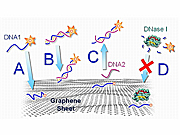 |
| An illustration of how fluorescent-tagged DNA interacts with functionalized graphene. Both single-stranded DNA (A) and double-stranded DNA (B) are adsorbed onto a graphene surface, but the interaction is stronger with ssDNA, causing the fluorescence on the ssDNA to darken more. C) A complementary DNA nears the ssDNA and causes the adsorbed ssDNA to detach from the graphene surface. D) DNA adsorbed onto graphene is protected from being broken down. |
Abstract:
Just as in formulaic geek-tough guy buddy movies, nobody was convinced that delicate single-stranded DNA could work with graphene, a tough nanomaterial made of sheets of carbon atoms.
Graphene and DNA team up to sense trouble
Posted on June 23rd, 2010However, scientists at DOE's Pacific Northwest National Laboratory and Princeton University believed the two would make a great team for detecting diseases using blood, saliva, and other biological fluids. And, just like in the movies, DNA and graphene really get the job done. Through a series of studies at DOE's EMSL, the team found that the single-stranded DNA picks out biomolecules that indicate disease with a high degree of specificity. The graphene protects the DNA from being broken down by enzymes while it works. This research could lead to stable biosensors that are more accurate than conventional sensors and for application in gene therapy. PNNL's Transformational Materials Science Initiative funded this study.
####
For more information, please click here
Contacts:
Kristin Manke
509.372.6011
Copyright © DOE Pulse
If you have a comment, please Contact us.Issuers of news releases, not 7th Wave, Inc. or Nanotechnology Now, are solely responsible for the accuracy of the content.
Bookmark:


| Related News Press |
News and information
 Quantum computer improves AI predictions April 17th, 2026
Flexible sensor gains sensitivity under pressure April 17th, 2026
A reusable chip for particulate matter sensing April 17th, 2026
Detecting vibrational quantum beating in the predissociation dynamics of SF6 using time-resolved photoelectron spectroscopy April 17th, 2026
Govt.-Legislation/Regulation/Funding/Policy
Quantum computer improves AI predictions April 17th, 2026
Metasurfaces smooth light to boost magnetic sensing precision January 30th, 2026
New imaging approach transforms study of bacterial biofilms August 8th, 2025
Possible Futures
A fundamentally new therapeutic approach to cystic fibrosis: Nanobody repairs cellular defect April 17th, 2026
UC Irvine physicists discover method to reverse ‘quantum scrambling’ : The work addresses the problem of information loss in quantum computing system April 17th, 2026
Academic/Education
Rice University launches Rice Synthetic Biology Institute to improve lives January 12th, 2024
Multi-institution, $4.6 million NSF grant to fund nanotechnology training September 9th, 2022
Nanomedicine
A fundamentally new therapeutic approach to cystic fibrosis: Nanobody repairs cellular defect April 17th, 2026
New molecular technology targets tumors and simultaneously silences two ‘undruggable’ cancer genes August 8th, 2025
New imaging approach transforms study of bacterial biofilms August 8th, 2025
Electrifying results shed light on graphene foam as a potential material for lab grown cartilage June 6th, 2025
Announcements
A fundamentally new therapeutic approach to cystic fibrosis: Nanobody repairs cellular defect April 17th, 2026
UC Irvine physicists discover method to reverse ‘quantum scrambling’ : The work addresses the problem of information loss in quantum computing system April 17th, 2026
Nanobiotechnology
A fundamentally new therapeutic approach to cystic fibrosis: Nanobody repairs cellular defect April 17th, 2026
New molecular technology targets tumors and simultaneously silences two ‘undruggable’ cancer genes August 8th, 2025
New imaging approach transforms study of bacterial biofilms August 8th, 2025
Electrifying results shed light on graphene foam as a potential material for lab grown cartilage June 6th, 2025
 |
||
 |
||
| The latest news from around the world, FREE | ||
 |
||
|
|
||
| Premium Products | ||
 |
||
|
Only the news you want to read!
Learn More |
||
 |
||
|
Full-service, expert consulting
Learn More |
||
|
|
||