Home > Press > Towards nanowire solar cells with a 65-percent efficiency
 |
Abstract:
TU/e researchers want to develop solar cells with an efficiency of over 65 percent by means of nanotechnology. In Southern Europe and North Africa these new solar cells can generate a substantial portion of the European demand for electricity. The Dutch government reserves EUR 1.2 million for the research.
Towards nanowire solar cells with a 65-percent efficiency
The Netherlands | Posted on June 17th, 2010An agency of the Ministry of Economic Affairs, will grant the EUR 1.2 million to researchers dr. Jos Haverkort, dr. Erik Bakkers en dr. ir. Geert Verbong for their research into nanowire solar cells. It is their expectation that, when combined with mirror systems, these solar cells can generate a sizeable portion of the European electricity demand in Southern Europe and North Africa.
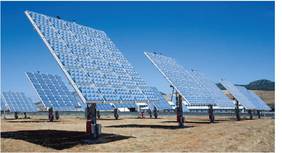
The current thin-film solar cells (type III/V) have an efficiency that lies around 40 percent, but they are very expensive and can only be applied as solar panels on satellites. By using mirror systems that focus one thousand times they can now also be deployed on earth in a cost-effective manner. The TU/ researchers expect that in ten years their nano-structured solar cells can attain an efficiency of more than 65 percent. Jos Haverkort: "If the Netherlands wants to timely participate in a commercial exploitation of nanowire solar cells, there is a great urgency to get on board now." The research is conducted together with Philips MiPlaza.
They think that nanotechnology, in combination with the use of concentrated sunlight through mirror systems, has the potential to lead to the world's most efficient solar cell system with a cost price lower than 50 cent per Watt peak. In comparison: for the present generation of solar cells that cost price is 1.50 euro per Watt peak.
Stacking
Nanowires make it possible to stack a number of subcells (junctions). In this process each subcell converts one color of sunlight optimally to electricity. The highest yield reported until now in a nanowire solar cell is 8.4 percent. Haverkort: "We expect that a protective shell around the nanowires is the critical step towards attaining the same efficiency with nanowire solar cells as with thin-film cells." Haverkort thinks that at 5 to 10 junctions he will arrive at an efficiency of 65 percent.
Scarcity of raw materials
In addition, the researchers expect considerable savings can be made on production costs, because nanowires grow on a cheap silicon substrate and also grow faster, which results in a lower cost of ownership of the growth equipment. What is more, the combination of the mirror systems with nanotechnology will imply an acceptable use of the scarce and hence expensive metals gallium and indium.
####
For more information, please click here
Copyright © Technische Universiteit Eindhoven
If you have a comment, please Contact us.Issuers of news releases, not 7th Wave, Inc. or Nanotechnology Now, are solely responsible for the accuracy of the content.
Bookmark:


| Related News Press |
News and information
 Quantum computer improves AI predictions April 17th, 2026
Flexible sensor gains sensitivity under pressure April 17th, 2026
A reusable chip for particulate matter sensing April 17th, 2026
Detecting vibrational quantum beating in the predissociation dynamics of SF6 using time-resolved photoelectron spectroscopy April 17th, 2026
Govt.-Legislation/Regulation/Funding/Policy
Quantum computer improves AI predictions April 17th, 2026
Metasurfaces smooth light to boost magnetic sensing precision January 30th, 2026
New imaging approach transforms study of bacterial biofilms August 8th, 2025
Possible Futures
A fundamentally new therapeutic approach to cystic fibrosis: Nanobody repairs cellular defect April 17th, 2026
UC Irvine physicists discover method to reverse ‘quantum scrambling’ : The work addresses the problem of information loss in quantum computing system April 17th, 2026
Announcements
A fundamentally new therapeutic approach to cystic fibrosis: Nanobody repairs cellular defect April 17th, 2026
UC Irvine physicists discover method to reverse ‘quantum scrambling’ : The work addresses the problem of information loss in quantum computing system April 17th, 2026
Energy
Sensors innovations for smart lithium-based batteries: advancements, opportunities, and potential challenges August 8th, 2025
Simple algorithm paired with standard imaging tool could predict failure in lithium metal batteries August 8th, 2025
Solar/Photovoltaic
Spinel-type sulfide semiconductors to operate the next-generation LEDs and solar cells For solar-cell absorbers and green-LED source October 3rd, 2025
KAIST researchers introduce new and improved, next-generation perovskite solar cell November 8th, 2024
Groundbreaking precision in single-molecule optoelectronics August 16th, 2024
Development of zinc oxide nanopagoda array photoelectrode: photoelectrochemical water-splitting hydrogen production January 12th, 2024
 |
||
 |
||
| The latest news from around the world, FREE | ||
 |
||
|
|
||
| Premium Products | ||
 |
||
|
Only the news you want to read!
Learn More |
||
 |
||
|
Full-service, expert consulting
Learn More |
||
|
|
||