Home > Press > Imec’s novel strategy to tune plasmon resonances has potential applications in biomolecular detection
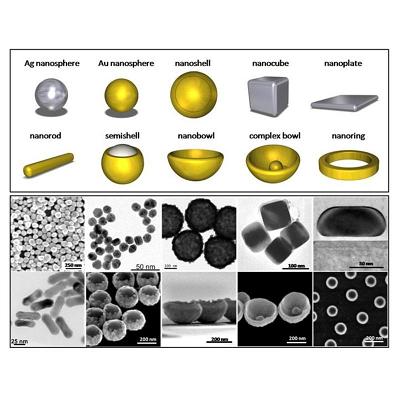 |
| Schematic illustration of various shapes of plasmonic nanostructures and (bottom) the corresponding electron microscopy images. |
Abstract:
Researchers at imec have developed an innovative strategy to tune plasmon resonances. They do so by breaking the symmetric geometry of the nanostructures, using a combination of bottom-up and top-down fabrication processes. Such broken symmetry can lead to strongly enhanced local electric fields. A potential application is the detection of biomolecules via surface-enhanced Raman scattering (SERS).
Imec’s novel strategy to tune plasmon resonances has potential applications in biomolecular detection
The Netherlands | Posted on April 21st, 2010Metal-based nanophotonics (plasmonics) is a field concerned with manipulating and focusing light on nanoscale structures that are much smaller than conventional optic components. Plasmonic technology, today still in an experimental stage, has the potential to be used in future applications such as nanoscale optical interconnects for high performance computer chips, highly efficient thin-film solar cells, and extremely sensitive (bio)molecular sensors.
Plasmonic applications can be made from nanostructured (noble) metals. When such nanostructures are illuminated with visible to near-infrared light, the excitation of collective oscillations of conduction electrons - called surface plasmons - generates strong optical resonances, focusing electromagnetic energy in deep-sub-wavelength-scales. The resonance spectra of the metallic nanostructures strongly depend on their geometry. Imec has extensive experience in synthesizing various shapes of nanostructures to tune the resonances from the ultraviolet to the near-infrared region. Examples of such shapes are nanospheres, nanocubes, nanorods, nanoshells, and nanorings.
Recently, researchers at imec have developed an innovative strategy to precisely tune the plasmon resonances. They do so by breaking the symmetric geometry of the nanostructures, using a combination of bottom-up and top-down fabrication processes. This allows making a geometrical transition from nanocubes to nanoplates (see Jian Ye, et al. Nanotechnology, 2008, 19, 325702), from nanoshells to semishells and nanobowls (see Jian Ye, et al. the Journal of Physical Chemistry C, 2009, 113, 3110; Jian Ye, et al. Langmuir, 2009, 25, 1822; Jian Ye, et al. ACS Nano, 2010, 4, 1457), from nanocages to open-nanocages (see Jian Ye, et al. Optics Express, 2009, 17, 23765).
Combining bottom-up and top-down fabrication turns out to be a cost-effective method to obtain large areas covered with engineered metal nanostructures. The nano-dimensions are still set by the bottom-up fabrication procedures, and the geometrical tweaking occurs through well-characterized top-down fabrication techniques such as metal evaporation and ion milling.
Imec has gained a substantial insight in the optical properties of these nanostructures using a combination of electromagnetic simulations and advanced optical spectroscopy. This allows explaining the optical properties using the so-called plasmon hybridization model, where the resonances of complex nanostructures can be described as bonding and anti-bonding arrangements of the parent plasmon resonances of the individual constituents. This paves the way to tweaking the optical properties of metal nanostructures for various applications. More specifically, the broken symmetry can lead to strongly enhanced local electric fields, which show a potential application in surface-enhanced Raman scattering-based bio-molecular detection.
####
About imec
Imec is Europe’s largest independent research center in nanoelectronics and nano-technology. Its staff of more than 1,750 people includes over 550 industrial residents and guest researchers. Imec’s research is applied in better healthcare, smart electronics, sustainable energy, and safer transport.
For more information, please click here
Copyright © imec
If you have a comment, please Contact us.Issuers of news releases, not 7th Wave, Inc. or Nanotechnology Now, are solely responsible for the accuracy of the content.
Bookmark:


| Related News Press |
News and information
 Quantum computer improves AI predictions April 17th, 2026
Flexible sensor gains sensitivity under pressure April 17th, 2026
A reusable chip for particulate matter sensing April 17th, 2026
Detecting vibrational quantum beating in the predissociation dynamics of SF6 using time-resolved photoelectron spectroscopy April 17th, 2026
Thin films
Tiny nanosheets, big leap: A new sensor detects ethanol at ultra-low levels January 30th, 2026
Utilizing palladium for addressing contact issues of buried oxide thin film transistors April 5th, 2024
Understanding the mechanism of non-uniform formation of diamond film on tools: Paving the way to a dry process with less environmental impact March 24th, 2023
New study introduces the best graphite films: The work by Distinguished Professor Feng Ding at UNIST has been published in the October 2022 issue of Nature Nanotechnology November 4th, 2022
Possible Futures
A fundamentally new therapeutic approach to cystic fibrosis: Nanobody repairs cellular defect April 17th, 2026
UC Irvine physicists discover method to reverse ‘quantum scrambling’ : The work addresses the problem of information loss in quantum computing system April 17th, 2026
Nanomedicine
A fundamentally new therapeutic approach to cystic fibrosis: Nanobody repairs cellular defect April 17th, 2026
New molecular technology targets tumors and simultaneously silences two ‘undruggable’ cancer genes August 8th, 2025
New imaging approach transforms study of bacterial biofilms August 8th, 2025
Electrifying results shed light on graphene foam as a potential material for lab grown cartilage June 6th, 2025
Nanobiotechnology
A fundamentally new therapeutic approach to cystic fibrosis: Nanobody repairs cellular defect April 17th, 2026
New molecular technology targets tumors and simultaneously silences two ‘undruggable’ cancer genes August 8th, 2025
New imaging approach transforms study of bacterial biofilms August 8th, 2025
Electrifying results shed light on graphene foam as a potential material for lab grown cartilage June 6th, 2025
Photonics/Optics/Lasers
Metasurfaces smooth light to boost magnetic sensing precision January 30th, 2026
From sensors to smart systems: the rise of AI-driven photonic noses January 30th, 2026
Solar/Photovoltaic
Spinel-type sulfide semiconductors to operate the next-generation LEDs and solar cells For solar-cell absorbers and green-LED source October 3rd, 2025
KAIST researchers introduce new and improved, next-generation perovskite solar cell November 8th, 2024
Groundbreaking precision in single-molecule optoelectronics August 16th, 2024
Development of zinc oxide nanopagoda array photoelectrode: photoelectrochemical water-splitting hydrogen production January 12th, 2024
 |
||
 |
||
| The latest news from around the world, FREE | ||
 |
||
|
|
||
| Premium Products | ||
 |
||
|
Only the news you want to read!
Learn More |
||
 |
||
|
Full-service, expert consulting
Learn More |
||
|
|
||