Home > Press > Revolutionising industrial catalysts
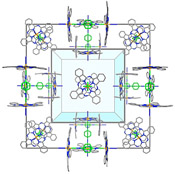 |
| The crystal structure of the nanoporous crystal showing the ‘molecular wall-tie’ ligands (green) binding between the iron centres |
Abstract:
Scientists are a step closer to being able to prepare porous solids that can mimic the sophisticated chemistry found in nature thanks to new research involving Cardiff University.
Revolutionising industrial catalysts
Wales | Posted on April 19th, 2010Researchers from the University's School of Chemistry and the University of Manchester have succeeded in engineering crystals that are able to maintain their structure, providing a permanent porous matrix within which chemical reactions can take place. Their findings are published in the journal Science.
With this new porous crystal, made from an iron-containing compound called phthalocyanine, the group are looking to nature to maximise its potential within the field of industrial catalysts.
They are taking their initiative from enzymes - nature's catalysts that have a wide range of roles in biological environments, including speeding up chemical reactions within the human body. The research team are particularly interested in hemoproteins, a type of protein that is unusual in the diversity of tasks they are able to perform.
Lead author on the paper, Professor Neil McKeown, School of Chemistry, explains the significance of the group's achievement: "Normally the voids within nanoporous crystals of this type need to be filled with organic solvent and if this is removed they simply collapse losing their porosity and therefore the space in which to carry out chemical reactions. But by taking inspiration from the use of cavity wall-ties in architectural engineering, we have stabilised our crystals with the addition of suitable ligands, that can bind simultaneously to two iron atoms, thus acting as ‘molecular wall-ties."
The design of the new type of crystal is such that they can exist happily in water based environments and are accessible to gas molecules. This aspect makes them a contender for future industrial catalysts.
The group used the Science and Technology Facilities Council's Daresbury Laboratory and Diamond's Single Crystal Diffraction beamline I19 to understand whether it is possible to make porous crystals with the reactivity of hemoproteins in order to produce more effective man-made catalysts.
This research was funded by the Engineering and Physical Sciences Research Council (EPSRC). The full article ‘Heme-Like Coordination Chemistry Within Nanoporous Molecular Crystals' C. Grazia Bezzu, Madeleine Helliwell, John E. Warren, David R. Allan, Neil B. McKeown, is published in Science and available online here: www.sciencemag.org/cgi/content/abstract/327/5973/1627
####
About Cardiff University
Cardiff University is recognised in independent government assessments as one of Britain's leading teaching and research universities.
Founded by Royal Charter in 1883, the University today combines impressive modern facilities and a dynamic approach to teaching and research with its proud heritage of service and achievement.
For more information, please click here
Copyright © Cardiff University
If you have a comment, please Contact us.Issuers of news releases, not 7th Wave, Inc. or Nanotechnology Now, are solely responsible for the accuracy of the content.
Bookmark:


| Related News Press |
News and information
 Quantum computer improves AI predictions April 17th, 2026
Flexible sensor gains sensitivity under pressure April 17th, 2026
A reusable chip for particulate matter sensing April 17th, 2026
Detecting vibrational quantum beating in the predissociation dynamics of SF6 using time-resolved photoelectron spectroscopy April 17th, 2026
Chemistry
Projecting light to dispense liquids: A new route to ultra-precise microdroplets January 30th, 2026
From sensors to smart systems: the rise of AI-driven photonic noses January 30th, 2026
"Nanoreactor" cage uses visible light for catalytic and ultra-selective cross-cycloadditions October 3rd, 2025
Cambridge chemists discover simple way to build bigger molecules – one carbon at a time June 6th, 2025
Possible Futures
A fundamentally new therapeutic approach to cystic fibrosis: Nanobody repairs cellular defect April 17th, 2026
UC Irvine physicists discover method to reverse ‘quantum scrambling’ : The work addresses the problem of information loss in quantum computing system April 17th, 2026
Academic/Education
Rice University launches Rice Synthetic Biology Institute to improve lives January 12th, 2024
Multi-institution, $4.6 million NSF grant to fund nanotechnology training September 9th, 2022
Announcements
A fundamentally new therapeutic approach to cystic fibrosis: Nanobody repairs cellular defect April 17th, 2026
UC Irvine physicists discover method to reverse ‘quantum scrambling’ : The work addresses the problem of information loss in quantum computing system April 17th, 2026
Industrial
Tiny nanosheets, big leap: A new sensor detects ethanol at ultra-low levels January 30th, 2026
Quantum interference in molecule-surface collisions February 28th, 2025
Boron nitride nanotube fibers get real: Rice lab creates first heat-tolerant, stable fibers from wet-spinning process June 24th, 2022
 |
||
 |
||
| The latest news from around the world, FREE | ||
 |
||
|
|
||
| Premium Products | ||
 |
||
|
Only the news you want to read!
Learn More |
||
 |
||
|
Full-service, expert consulting
Learn More |
||
|
|
||