Home > Press > Asylum Research Offers New Solar Application Note by Ginger Group
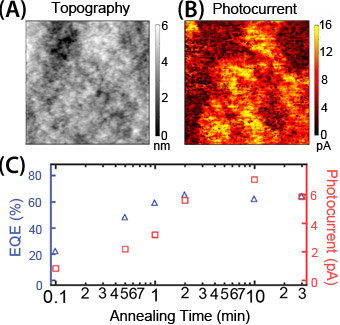 |
| Microscopic heterogeneity in (A) topography and (B) photocurrent on P3HT/PCBM blends. (C) Correlation between spatially-averaged photocurrent measured via photoconductive AFM (pcAFM) and EQE measurements for P3HT/PCBM blends annealed for different lengths of time indicate that pcAFM data are qualitatively consistent with expected device performance. |
Abstract:
Asylum Research, a technology leader in scanning probe/atomic force microscopy (AFM/SPM) announces a new application note by the Ginger group at the University of Washington, focusing on their work on Organic Photovoltaics (OPVs). The application note is entitled "New Scanning Probe Techniques for Analyzing Organic Photovoltaic Materials and Devices," by Rajiv Giridharagopal, Guozheng Shao, Chris Groves, and David S. Ginger, Department of Chemistry, University of Washington, Seattle. All work for the application note was performed using an MFP-3D-BIO™ Atomic Force Microscope from Asylum Research.
Asylum Research Offers New Solar Application Note by Ginger Group
Raleigh, NC | Posted on April 1st, 2010The note reviews the instrumental issues associated with the application of scanning probe microscopy techniques, such as photoconductive atomic force microscopy and time-resolved electrostatic force microscopy, which have been shown to be useful in the study of nanostructured organic solar cells. These techniques offer unique insight into the underlying heterogeneity of OPV devices and provide a nanoscale basis for understanding how morphology directly affects OPV operation and efficiency. The note is available on request from Asylum Research and can also be downloaded at www.asylumresearch.com/Applications/Photovoltaics/Photovoltaics.shtml.
"The customizability of the MFP-3D and Asylum's support were critical to the success of the experiments that got me tenure," said co-author and Group Leader, David Ginger. "This note summarizes the instrumental side of our work to date and, in particular, describes some of the new SPM techniques that have been proven to be very useful in evaluating OPV materials."
####
About Asylum Research
Asylum Research is the technology leader in atomic force and scanning probe microscopy (AFM/SPM) for both materials and bioscience applications. Founded in 1999, we are an employee owned company dedicated to innovative instrumentation for nanoscience and nanotechnology, with over 250 years combined AFM/SPM experience among our staff. Our instruments are used for a variety of nanoscience applications in material science, physics, polymers, chemistry, biomaterials, and bioscience, including single molecule mechanical experiments on DNA, protein unfolding and polymer elasticity, as well as force measurements for biomaterials, chemical sensing, polymers, colloidal forces, adhesion, and more. Asylum’s product line offers imaging and measurement capabilities for a wide range of samples, including advanced techniques such as electrical characterization (CAFM, KFM, EFM), high voltage piezoresponse force microscopy (PFM), thermal analysis, quantitative nanoindenting, and a wide range of environmental accessories and application-ready modules.
Asylum’s MFP-3D set the standard for AFM technology, with unprecedented precision and flexibility. The MFP-3D is the first AFM with true independent piezo positioning in all three axes, combined with low noise closed-loop feedback sensor technology. The MFP-3D offers both top and bottom sample viewing and easy integration with most commercially-available inverted optical microscopes.
Asylum’s new Cypher AFM is the world’s first new small sample AFM/SPM in over a decade, and sets the new standard as the world’s highest resolution AFM. Cypher provides low-drift closed loop atomic resolution for the most accurate images and measurements possible today, rapid AC imaging with small cantilevers, Spot-On™ automated laser alignment for easy setup, integrated thermal, acoustic and vibration control, and broad support for all major AFM/SPM scanning modes and capabilities.
Asylum Research offers the lowest cost of ownership of any AFM company. Ask us about our industry-best 2-year warranty, our legendary product and applications support, and our exclusive 6-month money-back satisfaction guarantee. We are dedicated to providing the most technically advanced AFMs for researchers who want to take their experiments to the next level. Asylum Research also distributes third party cantilevers from Olympus, Nanoworld/Nanosensors, and our own MFM and iDrive™ tips.
For more information, please click here
Contacts:
Jennifer Jones
Asylum Research Corp.
940 Main Campus Drive, Suite 130
Raleigh, NC 27606
919-861-7420 office
919-861-7425 fax
Corporate Office:
6310 Hollister Ave
Santa Barbara, CA 93117
805-696-6466 office
888-472-2795 toll free
Copyright © Asylum Research
If you have a comment, please Contact us.Issuers of news releases, not 7th Wave, Inc. or Nanotechnology Now, are solely responsible for the accuracy of the content.
Bookmark:


| Related News Press |
News and information
 Quantum computer improves AI predictions April 17th, 2026
Flexible sensor gains sensitivity under pressure April 17th, 2026
A reusable chip for particulate matter sensing April 17th, 2026
Detecting vibrational quantum beating in the predissociation dynamics of SF6 using time-resolved photoelectron spectroscopy April 17th, 2026
Display technology/LEDs/SS Lighting/OLEDs
Spinel-type sulfide semiconductors to operate the next-generation LEDs and solar cells For solar-cell absorbers and green-LED source October 3rd, 2025
Efficient and stable hybrid perovskite-organic light-emitting diodes with external quantum efficiency exceeding 40 per cent July 5th, 2024
Announcements
A fundamentally new therapeutic approach to cystic fibrosis: Nanobody repairs cellular defect April 17th, 2026
UC Irvine physicists discover method to reverse ‘quantum scrambling’ : The work addresses the problem of information loss in quantum computing system April 17th, 2026
Tools
Metasurfaces smooth light to boost magnetic sensing precision January 30th, 2026
From sensors to smart systems: the rise of AI-driven photonic noses January 30th, 2026
Japan launches fully domestically produced quantum computer: Expo visitors to experience quantum computing firsthand August 8th, 2025
Solar/Photovoltaic
Spinel-type sulfide semiconductors to operate the next-generation LEDs and solar cells For solar-cell absorbers and green-LED source October 3rd, 2025
KAIST researchers introduce new and improved, next-generation perovskite solar cell November 8th, 2024
Groundbreaking precision in single-molecule optoelectronics August 16th, 2024
Development of zinc oxide nanopagoda array photoelectrode: photoelectrochemical water-splitting hydrogen production January 12th, 2024
 |
||
 |
||
| The latest news from around the world, FREE | ||
 |
||
|
|
||
| Premium Products | ||
 |
||
|
Only the news you want to read!
Learn More |
||
 |
||
|
Full-service, expert consulting
Learn More |
||
|
|
||