Home > Press > NanoInk installs new nanofabrication system at the University of Strathclyde’s Centre for Molecular Nanometrology
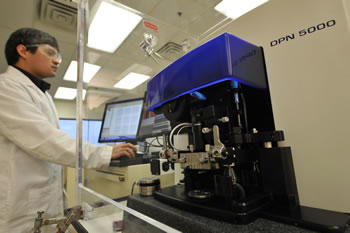 |
| The NanoInk DPN 5000 system |
Abstract:
Professor Duncan Graham and his research group at The Centre for Molecular Nanometrology at the University of Strathclyde has taken delivery of the DPN 5000 nanolithography tool, NanoInk's latest high precision Dip Pen Nanolithography® (DPN®) system.
NanoInk installs new nanofabrication system at the University of Strathclyde’s Centre for Molecular Nanometrology
Cambridge, UK | Posted on February 16th, 2010Combining high resolution lithography with world class imaging capability, the new instrument will expand the group's already formidable nanotechnology toolkit and help Graham move towards in vivo imaging approaches based on functional nanoparticles and SERS analysis.
Professor Graham is a recognized leader in the field of Surface Enhanced Raman Spectroscopy (SERS) and an early adopter of DPN technology, driven by the ability of NanoInk's instrumentation to place nanoscale features directly onto existing microstructures. The SERS substrate, Klarite®, is an array of gold-coated, microscale inverted pyramids designed to provide more consistent SERS data. Graham has demonstrated NanoInk's unique ability to precisely and controllably deposit materials to the individual pyramids. This combination of DPN and SERS is one of the few ways of extracting spectroscopic data from nanoscale patterns.
Following this early success with DPN, Graham's lab is applying NanoInk's instruments to the group's other research interests. For example, they are now using the NLP 2000 to create large area nanoscale arrays of biomolecules, nanoparticles and SAM molecules. The team has shown that they can fabricate highly sensitive protein assays, ultimately leading to the development of new devices that could revolutionize the detection of cancer biomarkers.
To learn more about DPN, its application and instrumentation platforms, please visit www.nanonink.net.
####
About NanoInk
NanoInk, Inc. is an emerging growth technology company specializing in nanometer-scale manufacturing and applications development for the life science and semiconductor industries. Using Dip Pen Nanolithography® (DPN®), a patented and proprietary nanofabrication technology, scientists are enabled to rapidly and easily create nanoscale structures from a wide variety of materials. This low cost, easy to use and scalable technique brings sophisticated nanofabrication to the laboratory desktop.
Located in the new Illinois Science + Technology Park, north of Chicago, NanoInk currently has over 140 patents and applications filed worldwide and has licensing agreements with Northwestern University, Stanford University, University of Strathclyde, University of Liverpool, California Institute of Technology and the University of Illinois at Urbana-Champaign. For more information on products and services offered by NanoInk, Inc., see www.nanonink.net
NanoInk, the NanoInk logo, Dip Pen Nanolithography, and DPN are trademarks or registered trademarks of NanoInk, Inc. Klarite is a trademark belonging to D3 Technologies Limited, Scotland.
For more information, please click here
Contacts:
Jezz Leckenby
NetDyaLog
T: +44 (0) 1799 521881
M: +44 (0) 7843 012997
Sarah Kosar Raup
NanoInk
T: +1 847 745 3619
Copyright © NanoInk
If you have a comment, please Contact us.Issuers of news releases, not 7th Wave, Inc. or Nanotechnology Now, are solely responsible for the accuracy of the content.
Bookmark:


| Related News Press |
News and information
 Quantum computer improves AI predictions April 17th, 2026
Flexible sensor gains sensitivity under pressure April 17th, 2026
A reusable chip for particulate matter sensing April 17th, 2026
Detecting vibrational quantum beating in the predissociation dynamics of SF6 using time-resolved photoelectron spectroscopy April 17th, 2026
Possible Futures
A fundamentally new therapeutic approach to cystic fibrosis: Nanobody repairs cellular defect April 17th, 2026
UC Irvine physicists discover method to reverse ‘quantum scrambling’ : The work addresses the problem of information loss in quantum computing system April 17th, 2026
Nanomedicine
A fundamentally new therapeutic approach to cystic fibrosis: Nanobody repairs cellular defect April 17th, 2026
New molecular technology targets tumors and simultaneously silences two ‘undruggable’ cancer genes August 8th, 2025
New imaging approach transforms study of bacterial biofilms August 8th, 2025
Electrifying results shed light on graphene foam as a potential material for lab grown cartilage June 6th, 2025
Announcements
A fundamentally new therapeutic approach to cystic fibrosis: Nanobody repairs cellular defect April 17th, 2026
UC Irvine physicists discover method to reverse ‘quantum scrambling’ : The work addresses the problem of information loss in quantum computing system April 17th, 2026
Tools
Metasurfaces smooth light to boost magnetic sensing precision January 30th, 2026
From sensors to smart systems: the rise of AI-driven photonic noses January 30th, 2026
Japan launches fully domestically produced quantum computer: Expo visitors to experience quantum computing firsthand August 8th, 2025
Nanobiotechnology
A fundamentally new therapeutic approach to cystic fibrosis: Nanobody repairs cellular defect April 17th, 2026
New molecular technology targets tumors and simultaneously silences two ‘undruggable’ cancer genes August 8th, 2025
New imaging approach transforms study of bacterial biofilms August 8th, 2025
Electrifying results shed light on graphene foam as a potential material for lab grown cartilage June 6th, 2025
 |
||
 |
||
| The latest news from around the world, FREE | ||
 |
||
|
|
||
| Premium Products | ||
 |
||
|
Only the news you want to read!
Learn More |
||
 |
||
|
Full-service, expert consulting
Learn More |
||
|
|
||