Home > Press > Capturing Those In-Between Moments: NIST Solves Timing Problem in Molecular Modeling
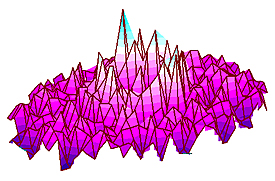 |
| Colorized simulation of what happens to 1100 carbon atoms in a ‘flat’ sheet of graphene about 20 microseconds after the central atom is moved slightly upwards. Darker violet colors indicate atoms that have dropped below their original position, whereas the lighter green colors show where atoms have risen. Credit: V.K. Tewary/NIST |
Abstract:
A theoretical physicist at the National Institute of Standards and Technology (NIST) has developed a method for calculating the motions and forces of thousands of atoms simultaneously over a wider range of time scales than previously possible. The method overcomes a longstanding timing gap in modeling nanometer-scale materials and many other physical, chemical and biological systems at atomic and molecular levels.
Capturing Those In-Between Moments: NIST Solves Timing Problem in Molecular Modeling
Boulder, CO | Posted on November 16th, 2009The new mathematical technique* can significantly improve modeling of atomic-scale processes that unfold over time, such as vibrations in a crystal. Conventional molecular dynamics (MD) techniques can accurately model processes that occur in increments measured in picoseconds to femtoseconds (trillionths to quadrillionths of a second). Other techniques can be used over longer periods to model bulk materials but not at the molecular level. The new NIST technique can access these longer time scales—in the critical range from nanoseconds to microseconds (billionths to millionths of a second)—at the molecular level. Scientists can now measure and understand what happens at key points in time that were not previously accessible, and throughout the full spectrum of time scales of interest in MD, says developer Vinod Tewary.
Modeling of material properties and physical processes is a valuable aid and supplement to theoretical and experimental studies, in part because experiments are very difficult at the nanoscale. MD calculations are usually based on the physics of individual atoms or molecules. This traditional approach is limited not only by time scale, but also by system size. It cannot be extended to processes involving thousands of atoms or more because today's computers—even supercomputers—cannot handle the billions of time steps required, Tewary says. By contrast, his new method incorporates a "Green's function," a mathematical approach that can calculate the condition of a very large system over flexible time scales in a single step. Thus, it overcomes the system size problem as well as the timing gap.
Tewary illustrated the new technique on two problems. He showed how a pulse propagating through a string of atoms, initiated by moving the middle atom, could be modeled for just a few femtoseconds with conventional MD, whereas the NIST method works for several microseconds. Tewary also calculated how ripples propagate in 1,100 carbon atoms in a sheet of graphene over periods up to about 45 microseconds, a problem that could not be solved previously. Normally thought of as a static flat sheet, the atoms in graphene actually must undulate somehow to remain stable, and the new technique shows how these ripples propagate. (See accompanying image and movie **). Consisting entirely of carbon atoms, graphene is a recently discovered honeycomb crystal material that may be an outstanding conductor for wires and other components in nanoscale electronics.
The new NIST technique is expected to enable modeling of many other processes that occur at time scales of nano- to microseconds, such as formation and growth of defects, conduction of heat, diffusion and radiation damage in materials. The technique could improve results in many different fields, from modeling of new nanotechnologies in the design stage to simulating the radiation damage from a "dirty bomb" over time.
NIST researchers plan to write a software program encoding the new technique to make it available to other users.
* V.K. Tewary. Extending time scale in molecular dynamics simulations: propagation of ripples in graphene. Physical Review B, Vol. 80, No. 16.. Published online Oct. 22, 2009.
Click http://www.nist.gov/public_affairs/techbeat/prb_gpn_wav_3d.avi to see a video clip (6.5 MB AVI file) that shows how ripples propagate in a sheet of graphene after the central atom is moved slightly upwards. The clip is a slow-motion version of action that occurs over about 45 microseconds.
####
About NIST
Founded in 1901, NIST is a non-regulatory federal agency within the U.S. Department of Commerce. NIST's mission is to promote U.S. innovation and industrial competitiveness by advancing measurement science, standards, and technology in ways that enhance economic security and improve our quality of life.
For more information, please click here
Contacts:
Laura Ost
(301) 497-4880
Copyright © NIST
If you have a comment, please Contact us.Issuers of news releases, not 7th Wave, Inc. or Nanotechnology Now, are solely responsible for the accuracy of the content.
Bookmark:


| Related News Press |
News and information
 Quantum computer improves AI predictions April 17th, 2026
Flexible sensor gains sensitivity under pressure April 17th, 2026
A reusable chip for particulate matter sensing April 17th, 2026
Detecting vibrational quantum beating in the predissociation dynamics of SF6 using time-resolved photoelectron spectroscopy April 17th, 2026
Physics
UC Irvine physicists discover method to reverse ‘quantum scrambling’ : The work addresses the problem of information loss in quantum computing system April 17th, 2026
Chemistry
Projecting light to dispense liquids: A new route to ultra-precise microdroplets January 30th, 2026
From sensors to smart systems: the rise of AI-driven photonic noses January 30th, 2026
"Nanoreactor" cage uses visible light for catalytic and ultra-selective cross-cycloadditions October 3rd, 2025
Cambridge chemists discover simple way to build bigger molecules – one carbon at a time June 6th, 2025
Possible Futures
A fundamentally new therapeutic approach to cystic fibrosis: Nanobody repairs cellular defect April 17th, 2026
UC Irvine physicists discover method to reverse ‘quantum scrambling’ : The work addresses the problem of information loss in quantum computing system April 17th, 2026
Nanoelectronics
Lab to industry: InSe wafer-scale breakthrough for future electronics August 8th, 2025
Interdisciplinary: Rice team tackles the future of semiconductors Multiferroics could be the key to ultralow-energy computing October 6th, 2023
Key element for a scalable quantum computer: Physicists from Forschungszentrum Jülich and RWTH Aachen University demonstrate electron transport on a quantum chip September 23rd, 2022
Reduced power consumption in semiconductor devices September 23rd, 2022
Materials/Metamaterials/Magnetoresistance
First real-time observation of two-dimensional melting process: Researchers at Mainz University unveil new insights into magnetic vortex structures August 8th, 2025
Researchers unveil a groundbreaking clay-based solution to capture carbon dioxide and combat climate change June 6th, 2025
A 1960s idea inspires NBI researchers to study hitherto inaccessible quantum states June 6th, 2025
Institute for Nanoscience hosts annual proposal planning meeting May 16th, 2025
Announcements
A fundamentally new therapeutic approach to cystic fibrosis: Nanobody repairs cellular defect April 17th, 2026
UC Irvine physicists discover method to reverse ‘quantum scrambling’ : The work addresses the problem of information loss in quantum computing system April 17th, 2026
Tools
Metasurfaces smooth light to boost magnetic sensing precision January 30th, 2026
From sensors to smart systems: the rise of AI-driven photonic noses January 30th, 2026
Japan launches fully domestically produced quantum computer: Expo visitors to experience quantum computing firsthand August 8th, 2025
 |
||
 |
||
| The latest news from around the world, FREE | ||
 |
||
|
|
||
| Premium Products | ||
 |
||
|
Only the news you want to read!
Learn More |
||
 |
||
|
Full-service, expert consulting
Learn More |
||
|
|
||