Home > Press > Clemson carbon nanotube research part of $3 million award to enhance energy efficiency
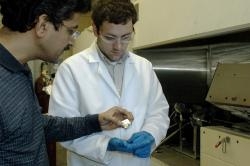 |
| Dr. Apparao Rao and graduate student Jason Reppert assess the outcome of a nanotube synthesis procedure. image by: Clemson University |
Abstract:
Clemson University is part of a five-year $3 million Air Force Office of Scientific Research award, along with the University of Texas at Dallas and Yale University, to search for nanoscale materials that superconduct to allow for efficient flow of a current.
Clemson carbon nanotube research part of $3 million award to enhance energy efficiency
Clemson, SC | Posted on November 10th, 2009Specifically, the team will explore carbon nanotube-based superconductors to develop composite wires that may eventually be used, among other things, to replace inefficient copper wiring in power lines that presently can lose up to a third of their energy as heat.
"In the superconducting state, the flow of charges does not experience resistance, so the current flow is very efficient," said Clemson University physics professor Apparao Rao. "The holy grail is to get these charges to move with similar efficiency at room temperature instead of at extremely cool temperatures."
At Clemson, Rao has used pulsed lasers to produce superconducting nanotubes that are thousands of times smaller than a strand of hair, also referred to as low-dimensional materials. The process developed in his labs yields carbon nanotubes that are doped with elemental boron, which enables the nanotubes to superconduct at low temperatures.
"We are very excited about this discovery since superconducting nanotubes are not only useful in several applications but also serve as an ideal candidate to explore the underpinning physics in low-dimensional materials, which has long been a challenge," said Rao. "Clemson's role in this research is to build on this success and experiment with nanotubes doped with other elements such as sulfur, nitrogen and phosphorous with a view toward fabricating doped nanotubes that superconduct without having to cool them to very low temperatures, which is the technology used today."
In partnership with UT Dallas and Yale, Rao says the bigger question to be addressed is the incorporation of Clemson's doped nanotubes into high-strength, lightweight superconducting wires for such uses as medical MRI imaging, efficient power lines and other Air Force applications.
NOTE: Air Force Office of Scientific Research award grant number FA9550 - 09 - 1 - 0384.
####
For more information, please click here
Contacts:
* Apparao Rao
*
* 864-656-2063
* Susan Polowczuk
Media Relations
*
* 864-656-2063
Copyright © Clemson University
If you have a comment, please Contact us.Issuers of news releases, not 7th Wave, Inc. or Nanotechnology Now, are solely responsible for the accuracy of the content.
Bookmark:


| Related News Press |
News and information
 Quantum computer improves AI predictions April 17th, 2026
Flexible sensor gains sensitivity under pressure April 17th, 2026
A reusable chip for particulate matter sensing April 17th, 2026
Detecting vibrational quantum beating in the predissociation dynamics of SF6 using time-resolved photoelectron spectroscopy April 17th, 2026
Govt.-Legislation/Regulation/Funding/Policy
Quantum computer improves AI predictions April 17th, 2026
Metasurfaces smooth light to boost magnetic sensing precision January 30th, 2026
New imaging approach transforms study of bacterial biofilms August 8th, 2025
Nanotubes/Buckyballs/Fullerenes/Nanorods/Nanostrings/Nanosheets
Tiny nanosheets, big leap: A new sensor detects ethanol at ultra-low levels January 30th, 2026
Enhancing power factor of p- and n-type single-walled carbon nanotubes April 25th, 2025
Chainmail-like material could be the future of armor: First 2D mechanically interlocked polymer exhibits exceptional flexibility and strength January 17th, 2025
Innovative biomimetic superhydrophobic coating combines repair and buffering properties for superior anti-erosion December 13th, 2024
Announcements
A fundamentally new therapeutic approach to cystic fibrosis: Nanobody repairs cellular defect April 17th, 2026
UC Irvine physicists discover method to reverse ‘quantum scrambling’ : The work addresses the problem of information loss in quantum computing system April 17th, 2026
Energy
Sensors innovations for smart lithium-based batteries: advancements, opportunities, and potential challenges August 8th, 2025
Simple algorithm paired with standard imaging tool could predict failure in lithium metal batteries August 8th, 2025
 |
||
 |
||
| The latest news from around the world, FREE | ||
 |
||
|
|
||
| Premium Products | ||
 |
||
|
Only the news you want to read!
Learn More |
||
 |
||
|
Full-service, expert consulting
Learn More |
||
|
|
||