Home > Press > UI team improves delivery of cancer-fighting molecules
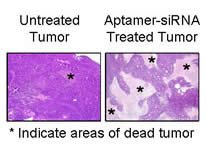 |
| A mouse tumor treated with an aptamer-siRNA combination (right) shows many dead areas (indicated by the asterisks), whereas an untreated tumor (left) is still largely intact. Delivering siRNA successfully to specific cells has been challenging. UI researchers modified siRNA so that it could be injected into the bloodstream and impact only targeted cells. |
Abstract:
Small interfering RNA (siRNA), a type of genetic material, can block potentially harmful activity in cells, such as tumor cell growth. But delivering siRNA successfully to specific cells without adversely affecting other cells has been challenging.
UI team improves delivery of cancer-fighting molecules
Iowa City, IA | Posted on August 27th, 2009University of Iowa researchers have modified siRNA so that it can be injected into the bloodstream and impact targeted cells while producing fewer side effects. The findings, which were based on animal models of prostate cancer, also could make it easier to create large amounts of targeted therapeutic siRNAs for treating cancer and other diseases. The study results appeared online Aug. 23 in the journal Nature Biotechnology.
"Our goal was to make siRNA deliverable through the bloodstream and make it more specific to the genes that are over expressed in cancer," said the study's senior author Paloma Giangrande, Ph.D., assistant professor of internal medicine and a member of Holden Comprehensive Cancer Center.
In previous research completed at Duke University, Giangrande's team showed that a compound called an aptamer can be combined with siRNA to target certain genes. When the combined molecule is directly injected into tumors in animal models, it triggers the processes that stop tumor growth. However, directly injecting the combination into tumors in humans is difficult.
In the new study, the researchers trimmed the size of a prostate cancer-specific aptamer and modified the siRNA to increase its activity. Upon injection into the bloodstream, the combination triggered tumor regression without affecting normal tissues.
Making the aptamer-siRNA combination smaller makes it easier to produce large amounts of it synthetically, Giangrande said.
The team also addressed the problem that large amounts of siRNA are needed since most of it gets excreted by the kidneys before having an effect. To keep siRNA in the body longer and thereby use less of it, the team modified it using a process called PEGlyation.
"If you want to use siRNA effectively for clinical use, especially for cancer treatment, you need to deliver it through an injection into the bloodstream, reduce the amount of side effects and be able to improve its cost-effectiveness. Our findings may help make these things possible," Giangrande said.
Although the current study focused on prostate cancer, the findings could apply to other cancers and diseases. Giangrande said the next step is to test the optimized aptamer-siRNA compound in a larger animal model.
Other researchers who contributed significantly to the study included James McNamara, Ph.D., and Anton McCaffrey, Ph.D., both UI assistant professors of internal medicine.
The study was supported by an American Cancer Society Institutional Research grant and a Lymphoma SPORE Development Research Award.
JOURNAL ARTICLE ABSTRACT: www.nature.com/nbt/journal/vaop/ncurrent/full/nbt.1560.html
####
About University of Iowa
The University of Iowa is a major national research university located on a 1,900-acre campus in Iowa City in southeast Iowa, on the Iowa River near the intersection of U.S. Interstate Highways 80 and 380. Iowa is composed of 11 colleges, the largest of which is the College of Liberal Arts and Sciences, enrolling most of Iowa's undergraduates. The Henry B. Tippie College of Business, the Roy J. and Lucille A. Carver College of Medicine, and the Colleges of Education, Engineering, Law, Nursing, Pharmacy, enroll undergraduates, and with the Colleges of Dentistry and Public Health provide graduate education in conjunction with the Graduate College.
For more information, please click here
Contacts:
Becky Soglin
319-356-7127
Copyright © University of Iowa
If you have a comment, please Contact us.Issuers of news releases, not 7th Wave, Inc. or Nanotechnology Now, are solely responsible for the accuracy of the content.
Bookmark:


| Related News Press |
News and information
 Quantum computer improves AI predictions April 17th, 2026
Flexible sensor gains sensitivity under pressure April 17th, 2026
A reusable chip for particulate matter sensing April 17th, 2026
Detecting vibrational quantum beating in the predissociation dynamics of SF6 using time-resolved photoelectron spectroscopy April 17th, 2026
Possible Futures
A fundamentally new therapeutic approach to cystic fibrosis: Nanobody repairs cellular defect April 17th, 2026
UC Irvine physicists discover method to reverse ‘quantum scrambling’ : The work addresses the problem of information loss in quantum computing system April 17th, 2026
Nanomedicine
A fundamentally new therapeutic approach to cystic fibrosis: Nanobody repairs cellular defect April 17th, 2026
New molecular technology targets tumors and simultaneously silences two ‘undruggable’ cancer genes August 8th, 2025
New imaging approach transforms study of bacterial biofilms August 8th, 2025
Electrifying results shed light on graphene foam as a potential material for lab grown cartilage June 6th, 2025
Discoveries
Quantum computer improves AI predictions April 17th, 2026
Flexible sensor gains sensitivity under pressure April 17th, 2026
A reusable chip for particulate matter sensing April 17th, 2026
Detecting vibrational quantum beating in the predissociation dynamics of SF6 using time-resolved photoelectron spectroscopy April 17th, 2026
Announcements
A fundamentally new therapeutic approach to cystic fibrosis: Nanobody repairs cellular defect April 17th, 2026
UC Irvine physicists discover method to reverse ‘quantum scrambling’ : The work addresses the problem of information loss in quantum computing system April 17th, 2026
Grants/Sponsored Research/Awards/Scholarships/Gifts/Contests/Honors/Records
Quantum computer improves AI predictions April 17th, 2026
Detecting vibrational quantum beating in the predissociation dynamics of SF6 using time-resolved photoelectron spectroscopy April 17th, 2026
Metasurfaces smooth light to boost magnetic sensing precision January 30th, 2026
Nanobiotechnology
A fundamentally new therapeutic approach to cystic fibrosis: Nanobody repairs cellular defect April 17th, 2026
New molecular technology targets tumors and simultaneously silences two ‘undruggable’ cancer genes August 8th, 2025
New imaging approach transforms study of bacterial biofilms August 8th, 2025
Electrifying results shed light on graphene foam as a potential material for lab grown cartilage June 6th, 2025
 |
||
 |
||
| The latest news from around the world, FREE | ||
 |
||
|
|
||
| Premium Products | ||
 |
||
|
Only the news you want to read!
Learn More |
||
 |
||
|
Full-service, expert consulting
Learn More |
||
|
|
||