Home > Press > Dolomite Introduces Glass Microfluidic Device for High Throughput Mixing and Reactions: The 1ml Microreactor Chip enables rapid amalgamation of fluid streams
 |
Abstract:
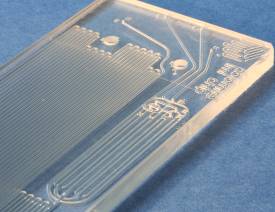
Dolomite, a world leader in microfluidic design and manufacture, has introduced the 1ml Microreactor Chip, a glass microfluidic device designed for the mixing and reacting of two or three liquid reagent streams. Ideal for solution phase chemistry, including compound synthesis and reaction kinetics studies, this chip enables rapid mixing across a wide range of flow rates.
Dolomite Introduces Glass Microfluidic Device for High Throughput Mixing and Reactions: The 1ml Microreactor Chip enables rapid amalgamation of fluid streams
Royston, UK | Posted on June 18th, 2009The chip has three glass layers that are accurately aligned and thermally fused. Each glass layer has etched microchannels providing a total reaction volume of 1ml, which is very high for a microfluidic device. By using multiple glass layers it is possible to achieve interdigitated mixing of the input streams. Interdigitated mixing involves splitting and recombining the input streams to reduce diffusion distance and hence mixing time.
First developed for leading chemistry automation innovator, Syrris, the 1ml Microreactor Chip was designed to form part of Syrris' Africa microreactor flow system. Ideally suited for applications such as reaction optimization, nanoparticle synthesis and kinetic studies, the 1ml Microreactor Chip is an integral part of the Africa system providing rapid mixing across a range of flow rates as well as providing faster and cleaner reactions.
Quick connection and disconnection of fluid pipes is enabled via the chip's compatibility with an innovative chip holder and header. Measuring at 35 x 90 x 4.5mm, this chip has a reaction volume of 1000µl. With the ability to heat or cool the fluid before mixing, the reactor chips can be mounted onto the heating module using a microreactor adaptor to provide an operating temperature ranging from -20 to 300°C.
With high visibility levels, this chip allows excellent access for optical analysis systems. Furthermore, a wide temperature and pressure range along with excellent chemical compatibility makes this microfluidic device ideal for a broad range of microfluidic applications.
####
About Dolomite
Dolomite is a global leader in the design and manufacture of microfluidics devices. With offices in the UK, US and Japan and distributors throughout the rest of the world, its clients range from universities developing leading-edge analytical equipment, to manufacturers of chemical, life sciences and clinical diagnostics systems.
Excellent microfabrication facilities that include cleanrooms, precision glass processing facilities and applications laboratories were established with £2m in funding from the UK Department of Trade and Industry's Micro and Nano Technology (MNT) Manufacturing Initiative. Dolomite’s expertise includes top quality engineering and scientific staff with strong backgrounds across the broad range of disciplines required for success in bringing microfluidics applications to the market, including chemistry, biotechnology, control system development, electronics, physics and instrument design and supply.
Syrris Limited
Established in 2001, Syrris Limited is one of the fastest growing science SMEs in the UK employing over 30 scientists and engineers at its facility in Royston (near Cambridge). Founders Mark Gilligan and Richard Gray come from a background of developing automation products for chemists at companies such as The Technology Partnership (TTP) and Mettler Toledo.
Syrris develops laboratory automation products for chemists such as the Atlas automated chemistry systems. Atlas can be configured into a wide range of different systems including Lithium and Sodium for round bottom flasks (magnetically and overhead stirred respectively) and Potassium for jacketed vessels. Other Atlas systems, designed for specific applications, including calorimetry, volumetric dosing, gravimetric dosing, pH, etc, are also available.
Syrris also specialise in flow reactors for R&D chemists, including FRX: a low cost flow chemistry system and Africa (Automated Flow Reaction Incubation and Control Apparatus): a modular system for library synthesis, aqueous work-up and reaction optimization that will ultimately reduce the time taken to develop, synthesize, screen and review a chemical entity, thus vastly speeding up the drug discovery process.
For more information, please click here
Contacts:
Product enquiries
Dolomite
Mike Hawes
+44 1763 242491
Tim Landucci
+44 1763 242491
Media enquiries
Alto Marketing Limited
Clare Russell +44 (0)1489 557672
Copyright © Dolomite
If you have a comment, please Contact us.Issuers of news releases, not 7th Wave, Inc. or Nanotechnology Now, are solely responsible for the accuracy of the content.
Bookmark:


| Related News Press |
News and information
 Quantum computer improves AI predictions April 17th, 2026
Flexible sensor gains sensitivity under pressure April 17th, 2026
A reusable chip for particulate matter sensing April 17th, 2026
Detecting vibrational quantum beating in the predissociation dynamics of SF6 using time-resolved photoelectron spectroscopy April 17th, 2026
Chemistry
Projecting light to dispense liquids: A new route to ultra-precise microdroplets January 30th, 2026
From sensors to smart systems: the rise of AI-driven photonic noses January 30th, 2026
"Nanoreactor" cage uses visible light for catalytic and ultra-selective cross-cycloadditions October 3rd, 2025
Cambridge chemists discover simple way to build bigger molecules – one carbon at a time June 6th, 2025
Microfluidics/Nanofluidics
Projecting light to dispense liquids: A new route to ultra-precise microdroplets January 30th, 2026
Chip Technology
A reusable chip for particulate matter sensing April 17th, 2026
Metasurfaces smooth light to boost magnetic sensing precision January 30th, 2026
Announcements
A fundamentally new therapeutic approach to cystic fibrosis: Nanobody repairs cellular defect April 17th, 2026
UC Irvine physicists discover method to reverse ‘quantum scrambling’ : The work addresses the problem of information loss in quantum computing system April 17th, 2026
 |
||
 |
||
| The latest news from around the world, FREE | ||
 |
||
|
|
||
| Premium Products | ||
 |
||
|
Only the news you want to read!
Learn More |
||
 |
||
|
Full-service, expert consulting
Learn More |
||
|
|
||