Home > Press > "Instant On" Computing: Materials researchers say rebooting soon may be a thing of the past
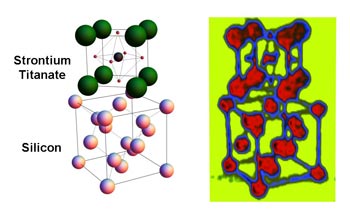 |
| Researchers report matching the spacing of silicon atoms--the principal component of computer semiconductors--and the spacing of atoms in a material called strontium titanate--a normally non-ferroelectric variant of a material used in "instant memory smart cards." The matched spacing allows the silicon to squeeze the strontium titanate in such a way that it produces ferroelectric properities. Ferroelectric materials provide low-power, high-efficiency electronic memory for devices such as "smart cards" that can instantly reveal and update stored information when waved before a reader. When applied to computer transistors, these materials could allow "instant-on" capability, eliminating the time-consuming booting and rebooting of computer operating systems.
Credit: Jeremy Levy, University of Pittsburgh |
Abstract:
The ferroelectric materials found in today's "smart cards" used in subway, ATM and fuel cards soon may eliminate the time-consuming booting and rebooting of computer operating systems by providing an "instant-on" capability as well as preventing losses from power outages.
"Instant On" Computing: Materials researchers say rebooting soon may be a thing of the past
Arlington, VA | Posted on April 17th, 2009Researchers supported by a National Science Foundation (NSF) nanoscale interdisciplinary research team award and three Materials Research Science and Engineering Centers at Cornell University, Penn State University and Northwestern University recently added ferroelectric capability to material used in common computer transistors, a feat scientists tried to achieve for more than half a century. They reported their findings in the April 17 journal Science.
Ferroelectric materials provide low-power, high-efficiency electronic memory. Smart cards use the technology to instantly reveal and update stored information when waved before a reader. A computer with this capability could instantly provide information and other data to the user.
Researchers led by Cornell University materials scientist Darrell Schlom took strontium titanate, a normally non-ferroelectric variant of the ferroelectric material used in smart cards, and deposited it on silicon--the principal component of most semiconductors and integrated circuits--in such a way that the silicon squeezed it into a ferroelectric state.
"It's great to see fundamental research on ordered layering of materials, or epitaxial growth, under strained conditions pay off in such a practical manner, particularly as it relates to ultra-thin ferroelectrics" said Lynnette Madsen, the NSF program director responsible for the Nanoscale Interdisciplinary Research Team award.
The result could pave the way for a next-generation of memory devices that are lower power, higher speed and more convenient to use. For everyday computer users, it could mean no more waiting for the operating system to come online or to access memory slowly from the hard drive.
"Several hybrid transistors have been proposed specifically with ferroelectrics in mind," said Schlom. "By creating a ferroelectric directly on silicon, we are bringing this possibility closer to realization."
More research is needed to achieve a ferroelectric transistor that would make "instant on" computing a reality, but having the materials in direct contact, free of intervening reaction layers, is an important step.
The paper's first author, Maitri P. Warusawithana, is a postdoctoral associate in Schlom's lab. The research team also includes scientists at the National Institute of Standards and Technology, Motorola Corp., Ames Laboratory and Intel Corp.
Along with NSF, the Office of Naval Research and the Department of Energy funded the research.
####
About National Science Foundation
The National Science Foundation (NSF) is an independent federal agency that supports fundamental research and education across all fields of science and engineering, with an annual budget of $6.06 billion. NSF funds reach all 50 states through grants to over 1,900 universities and institutions. Each year, NSF receives about 45,000 competitive requests for funding, and makes over 11,500 new funding awards. NSF also awards over $400 million in professional and service contracts yearly.
For more information, please click here
Contacts:
Media Contacts
Bobbie Mixon
NSF
(703) 292-8485
Program Contacts
Lynnette D. Madsen
NSF
(703) 292-4936
Principal Investigators
Darrell Schlom
Cornell University
(607) 255-9617
Copyright © National Science Foundation
If you have a comment, please Contact us.Issuers of news releases, not 7th Wave, Inc. or Nanotechnology Now, are solely responsible for the accuracy of the content.
Bookmark:


| Related News Press |
News and information
 Quantum computer improves AI predictions April 17th, 2026
Flexible sensor gains sensitivity under pressure April 17th, 2026
A reusable chip for particulate matter sensing April 17th, 2026
Detecting vibrational quantum beating in the predissociation dynamics of SF6 using time-resolved photoelectron spectroscopy April 17th, 2026
Govt.-Legislation/Regulation/Funding/Policy
Quantum computer improves AI predictions April 17th, 2026
Metasurfaces smooth light to boost magnetic sensing precision January 30th, 2026
New imaging approach transforms study of bacterial biofilms August 8th, 2025
Chip Technology
A reusable chip for particulate matter sensing April 17th, 2026
Metasurfaces smooth light to boost magnetic sensing precision January 30th, 2026
Discoveries
Quantum computer improves AI predictions April 17th, 2026
Flexible sensor gains sensitivity under pressure April 17th, 2026
A reusable chip for particulate matter sensing April 17th, 2026
Detecting vibrational quantum beating in the predissociation dynamics of SF6 using time-resolved photoelectron spectroscopy April 17th, 2026
Announcements
A fundamentally new therapeutic approach to cystic fibrosis: Nanobody repairs cellular defect April 17th, 2026
UC Irvine physicists discover method to reverse ‘quantum scrambling’ : The work addresses the problem of information loss in quantum computing system April 17th, 2026
 |
||
 |
||
| The latest news from around the world, FREE | ||
 |
||
|
|
||
| Premium Products | ||
 |
||
|
Only the news you want to read!
Learn More |
||
 |
||
|
Full-service, expert consulting
Learn More |
||
|
|
||