Home > Press > Scientists Patent Corrosion-Resistant Nano-Coating for Metals
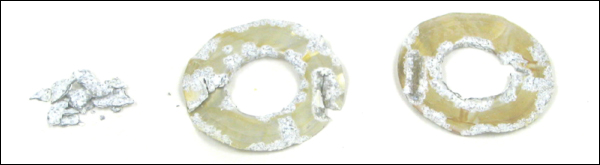 |
| Aluminum fins from a geothermal power plant subjected to 24,000 wet/dry cycles of exposure to briny conditions. The far left fin, with no protective coating, completely dissolved. The middle fin had a nano coating with a low level of cerium oxide, while the far right fin had a coating with a higher concentration of cerium oxide nanoparticles. |
Abstract:
Thinner, less toxic than existing coatings; efficient and economical to produce
Scientists Patent Corrosion-Resistant Nano-Coating for Metals
Upton, NY | Posted on March 25th, 2009Scientists at the U.S. Department of Energy's Brookhaven National Laboratory have developed a method for coating metal surfaces with an ultrathin film containing nanoparticles - particles measuring billionths of a meter - which renders the metal resistant to corrosion and eliminates the use of toxic chromium for this purpose. The scientists have been awarded U.S. Patent number 7,507,480 for their method and the corrosion-resistant metals made from it. The technology is available for licensing.
"Our coating is produced right on the metal using a simple two- or three-step process to produce a thin film structure by crosslinking among the component compounds," said chemist Toshifumi Sugama, a guest researcher at Brookhaven Lab. "The result is a layer less than 10 nanometers thick that protects the metal from corrosion, even in briny conditions."
Corrosion resistance is essential for metals used in a wide range of applications, from electronics to aviation to power plants. Traditionally, compounds containing a toxic form of chromium have provided the best corrosion resistance. Scientists looking to develop chromium-free alternatives have been unable to achieve the thin layers desirable for many applications. "Ultrathin coatings reduce the amount of material needed to provide corrosion resistance, thereby reducing the cost," Sugama explained.
Sugama's approach achieves several goals - low toxicity and excellent corrosion resistance in a film measuring less than 10 nanometers that can be applied to a wide array of metals, including aluminum, steel, nickel, zinc, copper, bronze, and brass. According to Sugama, the coating should be of specific interest to industries that produce coated valves, pumps, and other components, as well as the manufacturers of aluminum fins used in air-cooled condensers at geothermal power plants, where preventing brine-induced corrosion is a high priority.
The coating can be made in a variety of ways suited to a particular application. In one embodiment, it starts as a liquid solution that can be sprayed onto the metal, or the metal can be dipped into it. The metal is then subjected to one or more treatment steps, sometimes including heating for a period of time, to trigger cross-linking reactions between the compounds, and simultaneously, to form corrosion-inhibiting metal oxide nanoparticles, such as environmentally benign cerium-based oxides.
"Among the key factors that ensure the maximum corrosion-mitigating performance of these ultrathin coating films are the great water-repellency, the deposition of metal oxide nanoparticles over the metal's surface, and their excellent adhesion to metal. The combination of these factors considerably decreased the corrosion of metals," said Sugama.
The corrosion resistance of these coatings can be comparable, and even superior, to chromium-based coatings, he said. In fact, these new coatings provide even better coverage of metal surfaces than chromium coatings. Sugama added, "This is particularly advantageous when the metal to be coated possesses fine structural detail."
Because the method deposits such a thin coating of material, it is highly economical and efficient.
For information about licensing this technology, contact Brookhaven Lab Licensing Associate Poornima Upadhya, (631)-344-4711,
This research was funded by DOE's Office of Energy Efficiency and Renewable Energy.
####
About Brookhaven National Laboratory
One of ten national laboratories overseen and primarily funded by the Office of Science of the U.S. Department of Energy (DOE), Brookhaven National Laboratory conducts research in the physical, biomedical, and environmental sciences, as well as in energy technologies and national security. Brookhaven Lab also builds and operates major scientific facilities available to university, industry and government researchers. Brookhaven is operated and managed for DOE's Office of Science by Brookhaven Science Associates, a limited-liability company founded by the Research Foundation of State University of New York on behalf of Stony Brook University, the largest academic user of Laboratory facilities, and Battelle, a nonprofit, applied science and technology organization.
Contacts:
Karen McNulty Walsh
(631) 344-8350
Mona Rowe
(631) 344-5056
Copyright © Brookhaven National Laboratory
If you have a comment, please Contact us.Issuers of news releases, not 7th Wave, Inc. or Nanotechnology Now, are solely responsible for the accuracy of the content.
Bookmark:


| Related News Press |
News and information
 Quantum computer improves AI predictions April 17th, 2026
Flexible sensor gains sensitivity under pressure April 17th, 2026
A reusable chip for particulate matter sensing April 17th, 2026
Detecting vibrational quantum beating in the predissociation dynamics of SF6 using time-resolved photoelectron spectroscopy April 17th, 2026
Thin films
Tiny nanosheets, big leap: A new sensor detects ethanol at ultra-low levels January 30th, 2026
Utilizing palladium for addressing contact issues of buried oxide thin film transistors April 5th, 2024
Understanding the mechanism of non-uniform formation of diamond film on tools: Paving the way to a dry process with less environmental impact March 24th, 2023
New study introduces the best graphite films: The work by Distinguished Professor Feng Ding at UNIST has been published in the October 2022 issue of Nature Nanotechnology November 4th, 2022
Products
Spectradyne Partners with Particle Technology Labs for Measurement Services December 6th, 2018
Mode-Changing MEMS Accelerometer from STMicroelectronics Combines High Measurement Resolution and Ultra-Low Power for Industrial Applications November 7th, 2018
Fat-Repellent Nanolayers Can Make Oven Cleaning Easier October 17th, 2018
Aculon, Inc. Enters into Strategic Partnership Agreement with Henkel Corporation to Supply Key Mobile Device Manufacturers with NanoProof® PCB Waterproof Technology October 17th, 2018
Materials/Metamaterials/Magnetoresistance
First real-time observation of two-dimensional melting process: Researchers at Mainz University unveil new insights into magnetic vortex structures August 8th, 2025
Researchers unveil a groundbreaking clay-based solution to capture carbon dioxide and combat climate change June 6th, 2025
A 1960s idea inspires NBI researchers to study hitherto inaccessible quantum states June 6th, 2025
Institute for Nanoscience hosts annual proposal planning meeting May 16th, 2025
Announcements
A fundamentally new therapeutic approach to cystic fibrosis: Nanobody repairs cellular defect April 17th, 2026
UC Irvine physicists discover method to reverse ‘quantum scrambling’ : The work addresses the problem of information loss in quantum computing system April 17th, 2026
Patents/IP/Tech Transfer/Licensing
Getting drugs across the blood-brain barrier using nanoparticles March 3rd, 2023
Metasurfaces control polarized light at will: New research unlocks the hidden potential of metasurfaces August 13th, 2021
Arrowhead Pharmaceuticals Announces Closing of Agreement with Takeda November 27th, 2020
Environment
A reusable chip for particulate matter sensing April 17th, 2026
Researchers unveil a groundbreaking clay-based solution to capture carbon dioxide and combat climate change June 6th, 2025
 |
||
 |
||
| The latest news from around the world, FREE | ||
 |
||
|
|
||
| Premium Products | ||
 |
||
|
Only the news you want to read!
Learn More |
||
 |
||
|
Full-service, expert consulting
Learn More |
||
|
|
||