Home > Press > Northeastern University Physicists Create Assembly Technique for Carbon Nanotubes
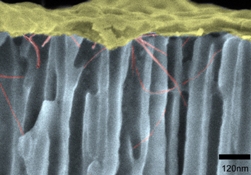 |
| A cross-sectional view of SEM micrographs of assembled SWNTs in anodic alumina array fabricated on Silican |
Abstract:
Srinivas Sridhar, Ph.D., distinguished professor and chair of Physics at Northeastern University, Evin Gultepe and their team of researchers from the university's Electronic Materials Research Institute have demonstrated a technique to assemble single-walled carbon nanotubes (SWNT) into three-dimensional structures. This technique will be useful for the large scale, accelerated assembly of SWNTs at room temperature, which is more suitable for nanoscale electronic applications, such as flat panel displays and electronic memory devices.
Northeastern University Physicists Create Assembly Technique for Carbon Nanotubes
Boston, MA | Posted on October 29th, 2008This research was published in an October 2008 issue of the journal Nanotechnology.
The electronic properties of SWNTs, such as large current capacities and quick mobility, makes them one of the most highly researched structures for the development of nanoscale electronics. They are able to conduct energy more quickly and efficiently than current structures and provide a platform from which to build smaller-scale products. Widely used materials, such as copper, do not meet the requirements as effective electrical interconnects on a smaller scale.
The challenge of utilizing carbon nanotubes (CNT) in the nanoscale is to assemble them into three-dimensional structures for large scale applications. Currently, manufacturing CNTs requires growing or assembling them into a device, which requires very hot temperatures and complex post-assembly procedures. In contrast, a post-synthesis assembly method allows for the arrangement of CNTs in ambient temperatures, which gives more flexibility in the manufacturing process.
In this newly discovered process, Gultepe, Sridhar and their colleagues manufactured nanotemplates, with billions of nano-sized holes in which to house the SWNTs. Utilizing electrical fields, they were able assemble the SWNTs vertically into the alumina nanotemplate, with a silican substrate bottom layer and a metal top layer. The vertically-assembled three-dimensional SWNTs provide the electrical interconnection between the nanotemplates and the silicon substrates.
"The greatest significance of this process is the potential to manufacture three-dimensional SWNTs electrical interconnects at a high-rate and on a larger scale," said Sridhar, who is also the Director of the Electronic Materials Research Institute at Northeastern. "Scaling down the nominal feature size means greater performance and decreased costs."
In addition to Sridhar, the team of researches involved with this project includes Ahmed Busnaina, Ph.D., Director of Northeastern's Center for High-rate Nanomanufacturing, Dattatri Nagesha, Ph.D., Bernard Diddier Frederic Casse, Ph.D., and Selvapraba Selvarasah. This research was supported by the IGERT Nanomedicine Science and Technology and the NSF Nanoscale Science and Engineering Centers Program.
####
About Northeastern University
Founded in 1898, Northeastern University is a private research university located in the heart of Boston. Northeastern is a leader in interdisciplinary research, urban engagement, and the integration of classroom learning with real-world experience. The university’s distinctive cooperative education program, where students alternate semesters of full-time study with semesters of paid work in fields relevant to their professional interests and major, is one of the largest and most innovative in the world. The University offers a comprehensive range of undergraduate and graduate programs leading to degrees through the doctorate in six undergraduate colleges, eight graduate schools, and two part-time divisions.
For more information, please click here
Contacts:
Jenny Eriksen
(617) 373-2802
Copyright © Northeastern University
If you have a comment, please Contact us.Issuers of news releases, not 7th Wave, Inc. or Nanotechnology Now, are solely responsible for the accuracy of the content.
Bookmark:


| Related News Press |
News and information
 Quantum computer improves AI predictions April 17th, 2026
Flexible sensor gains sensitivity under pressure April 17th, 2026
A reusable chip for particulate matter sensing April 17th, 2026
Detecting vibrational quantum beating in the predissociation dynamics of SF6 using time-resolved photoelectron spectroscopy April 17th, 2026
Display technology/LEDs/SS Lighting/OLEDs
Spinel-type sulfide semiconductors to operate the next-generation LEDs and solar cells For solar-cell absorbers and green-LED source October 3rd, 2025
Efficient and stable hybrid perovskite-organic light-emitting diodes with external quantum efficiency exceeding 40 per cent July 5th, 2024
Memory Technology
Researchers tackle the memory bottleneck stalling quantum computing October 3rd, 2025
First real-time observation of two-dimensional melting process: Researchers at Mainz University unveil new insights into magnetic vortex structures August 8th, 2025
Utilizing palladium for addressing contact issues of buried oxide thin film transistors April 5th, 2024
Nanotubes/Buckyballs/Fullerenes/Nanorods/Nanostrings/Nanosheets
Tiny nanosheets, big leap: A new sensor detects ethanol at ultra-low levels January 30th, 2026
Enhancing power factor of p- and n-type single-walled carbon nanotubes April 25th, 2025
Chainmail-like material could be the future of armor: First 2D mechanically interlocked polymer exhibits exceptional flexibility and strength January 17th, 2025
Innovative biomimetic superhydrophobic coating combines repair and buffering properties for superior anti-erosion December 13th, 2024
Discoveries
Quantum computer improves AI predictions April 17th, 2026
Flexible sensor gains sensitivity under pressure April 17th, 2026
A reusable chip for particulate matter sensing April 17th, 2026
Detecting vibrational quantum beating in the predissociation dynamics of SF6 using time-resolved photoelectron spectroscopy April 17th, 2026
Announcements
A fundamentally new therapeutic approach to cystic fibrosis: Nanobody repairs cellular defect April 17th, 2026
UC Irvine physicists discover method to reverse ‘quantum scrambling’ : The work addresses the problem of information loss in quantum computing system April 17th, 2026
 |
||
 |
||
| The latest news from around the world, FREE | ||
 |
||
|
|
||
| Premium Products | ||
 |
||
|
Only the news you want to read!
Learn More |
||
 |
||
|
Full-service, expert consulting
Learn More |
||
|
|
||