Home > Press > Tiny Technology
 |
| CREDIT "Microphotonics Group" |
Abstract:
A team of researchers at the University of St. Andrews has developed one of the smallest optical switches ever made.
Tiny Technology
UK | Posted on December 20th, 2007The technology may eventually be used in small consumer devices that connect every home or office to an optical fibre and supply high data rates, including television on demand
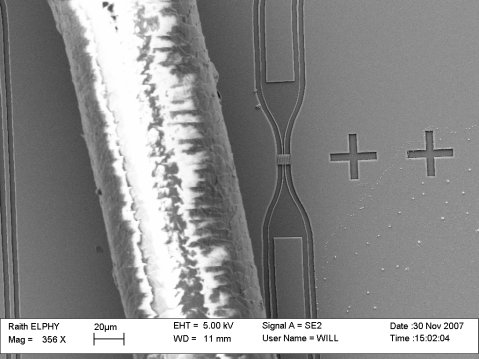
The researchers, based at the School of Physics and Astronomy and led by Professor Thomas Krauss, have used photonic crystal technology to reduce the size of the switch to only a few wavelengths of light. Consequently, the entire switch is only about one tenth of the size of a human hair.
Professor Krauss explained, "The switch is aimed at applications in telecommunications where we foresee its use in routing of optical signals.
"The idea of using fibre in the home or office requires small optical circuits that operate with low power. When these can be mass-produced in a cost-effective way it helps to keep the cost of the products down.
"At the moment, optical switches tend to be millimetres in size. It is difficult to state which is the smallest optical switch ever made - but this is certainly one of them."
The team inspecting one of their devices. (from left) T.F. Krauss, L. O'Faolain, T.P. White and D. Beggs.
By focussing on silicon as the material platform, the photonic devices developed by the group can be mass-produced in a similar way as computer chips for the microelectronics industry, and integrated with electronic circuitry on the same chip.
The group aims to address the increasing need for optical components at all levels of the communications network that carries the ever-increasing flow of data over the internet.
The work is part of the UK Silicon Photonics project, a consortium led by Surrey University, which has just received a funding boost from EPSRC, with £1.4M awarded to St. Andrews.
NOTE TO EDITORS: Professor Thomas Krauss is available for interview on 44 01334 463107.
####
About University of St Andrews
St Andrews is Scotland's first University and the third oldest in the UK. For almost six centuries, we have proudly upheld the tradition of academic excellence, attracting scholars of international repute and students from all over the world.
Today, we continue to offer the latest in teaching and research, all within a superbly picturesque mediaeval setting. Although St Andrews is not a campus University, it has grown and developed with the town and is now comfortably integrated.
Owing to the size of St Andrews, students feel they belong here and enjoy the benefits of studying at a highly residential University where academic and social lives intermingle.
For more information, please click here
Contacts:
Fiona Armstrong
Press Officer
44 01334 462530 / 462529,
Copyright © University of St Andrews
If you have a comment, please Contact us.Issuers of news releases, not 7th Wave, Inc. or Nanotechnology Now, are solely responsible for the accuracy of the content.
Bookmark:


| Related News Press |
News and information
 Quantum computer improves AI predictions April 17th, 2026
Flexible sensor gains sensitivity under pressure April 17th, 2026
A reusable chip for particulate matter sensing April 17th, 2026
Detecting vibrational quantum beating in the predissociation dynamics of SF6 using time-resolved photoelectron spectroscopy April 17th, 2026
Chip Technology
A reusable chip for particulate matter sensing April 17th, 2026
Metasurfaces smooth light to boost magnetic sensing precision January 30th, 2026
Nanoelectronics
Lab to industry: InSe wafer-scale breakthrough for future electronics August 8th, 2025
Interdisciplinary: Rice team tackles the future of semiconductors Multiferroics could be the key to ultralow-energy computing October 6th, 2023
Key element for a scalable quantum computer: Physicists from Forschungszentrum Jülich and RWTH Aachen University demonstrate electron transport on a quantum chip September 23rd, 2022
Reduced power consumption in semiconductor devices September 23rd, 2022
Discoveries
Quantum computer improves AI predictions April 17th, 2026
Flexible sensor gains sensitivity under pressure April 17th, 2026
A reusable chip for particulate matter sensing April 17th, 2026
Detecting vibrational quantum beating in the predissociation dynamics of SF6 using time-resolved photoelectron spectroscopy April 17th, 2026
Announcements
A fundamentally new therapeutic approach to cystic fibrosis: Nanobody repairs cellular defect April 17th, 2026
UC Irvine physicists discover method to reverse ‘quantum scrambling’ : The work addresses the problem of information loss in quantum computing system April 17th, 2026
Photonics/Optics/Lasers
Metasurfaces smooth light to boost magnetic sensing precision January 30th, 2026
From sensors to smart systems: the rise of AI-driven photonic noses January 30th, 2026
 |
||
 |
||
| The latest news from around the world, FREE | ||
 |
||
|
|
||
| Premium Products | ||
 |
||
|
Only the news you want to read!
Learn More |
||
 |
||
|
Full-service, expert consulting
Learn More |
||
|
|
||