Home > Press > VITROCELL® SYSTEMS finds during EUROTOX 2007 growing interest in its in vitro cultivation and exposure systems for the analysis of the effects of nano
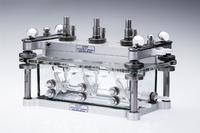 |
| VITROCELL® cultivation module for the exposure to nano particles |
Abstract:
The 44th Congress of the European Societies of Toxicology was held in Amsterdam, the Netherlands and closed yesterday on 10. October 2007.
VITROCELL® SYSTEMS finds during EUROTOX 2007 growing interest in its in vitro cultivation and exposure systems for the analysis of the effects of nano
Amsterdam, Netherlands | Posted on October 11th, 2007More than 700 scientific presentations were held on various topics such as the newest developments in toxicogenomics, alternatives for animals testing, risk assessment, immunotoxicity, reproductive toxicity, environmental toxicity, genotoxicity and carcino-genesis, endocrine disruption, molecular toxicology, signal transduction, the risks of nanotechnology, REACH and idiosyncratic effects.
VITROCELL® SYSTEMS participated in the exhibition and presented its broad product program of equipment for the in vitro analysis of airborne substances such as gases, nano particles and complex mixtures. Key interest was shown in the VITROCELL® technology for the exposure of lung epithelial cells to nano materials at the air/liquid interface. Frequently these materials are just added to the cell culture medium which is - according to VITROCELL® SYSTEMS - a method giving relatively low sensitivity due to interaction of the particles with the medium. In using the VITROCELL® direct exposure technology, the cells are first cultivated on membrane inserts (e. g. ThinCerts® from Greiner, Costar® from Corning or Falcon® from Becton Dickenson). The membrane inserts are placed in the VITROCELL® modules which are tempered at 37°C. The medium supply is performed either static or by permanent exchange so that the cells receive the cell culture medium from below through the membrane of the insert. The special aerosol inlets of the module are from stainless steel with a PFA-based surface treatment and deliver the particles to the cells by a low vacuum flow. As the cells are not covered with medium, they are exposed in the most efficient way at air/liquid interface. The same technological approach can be applied also to bacteria.
####
About VITROCELL® SYSTEMS
VITROCELL® SYSTEMS supplies in addition the required aerosol generators as well as turnkey installations. The customers of VITROCELL® SYSTEMS are leading medical and environmental research institutes as well as the pharmaceutical and other industries.
For more information, please click here
Contacts:
Tobias Krebs
Phone: +49 172 60 40 370
Ansprechpartner:
Herr Tobias Krebs
E-Mail:
Telefon: +49 (7681) 24-100
Fax: +49 (7681) 43-54
Copyright © VITROCELL® SYSTEMS
If you have a comment, please Contact us.Issuers of news releases, not 7th Wave, Inc. or Nanotechnology Now, are solely responsible for the accuracy of the content.
Bookmark:


| Related News Press |
Nanomedicine
 A fundamentally new therapeutic approach to cystic fibrosis: Nanobody repairs cellular defect April 17th, 2026
New molecular technology targets tumors and simultaneously silences two ‘undruggable’ cancer genes August 8th, 2025
New imaging approach transforms study of bacterial biofilms August 8th, 2025
Electrifying results shed light on graphene foam as a potential material for lab grown cartilage June 6th, 2025
Announcements
A fundamentally new therapeutic approach to cystic fibrosis: Nanobody repairs cellular defect April 17th, 2026
UC Irvine physicists discover method to reverse ‘quantum scrambling’ : The work addresses the problem of information loss in quantum computing system April 17th, 2026
Tools
Metasurfaces smooth light to boost magnetic sensing precision January 30th, 2026
From sensors to smart systems: the rise of AI-driven photonic noses January 30th, 2026
Japan launches fully domestically produced quantum computer: Expo visitors to experience quantum computing firsthand August 8th, 2025
Events/Classes
Institute for Nanoscience hosts annual proposal planning meeting May 16th, 2025
A New Blue: Mysterious origin of the ribbontail ray’s electric blue spots revealed July 5th, 2024
Researchers demonstrate co-propagation of quantum and classical signals: Study shows that quantum encryption can be implemented in existing fiber networks January 20th, 2023
 |
||
 |
||
| The latest news from around the world, FREE | ||
 |
||
|
|
||
| Premium Products | ||
 |
||
|
Only the news you want to read!
Learn More |
||
 |
||
|
Full-service, expert consulting
Learn More |
||
|
|
||