Home > Press > Using magnets to toggle nanolasers leads to better photonics: Controlling nanolasers with magnets lays the groundwork for more robust optical signalling
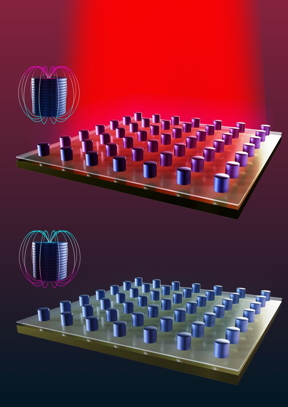 |
| A plasmonic laser is turned on (top) and off (bottom) by switching the magnetisation of a nanodot array. The zoomed insets show the magnetic field around a single nanodot. |
Abstract:
A magnetic field can be used to switch nanolasers on and off, shows new research from Aalto University. The physics underlying this discovery paves the way for the development of optical signals that cannot be disturbed by external disruptions, leading to unprecedented robustness in signal processing.
Using magnets to toggle nanolasers leads to better photonics: Controlling nanolasers with magnets lays the groundwork for more robust optical signalling
Aalto, Finland | Posted on December 24th, 2021Lasers concentrate light into extremely bright beams that are useful in a variety of domains, such as broadband communication and medical diagnostics devices. About ten years ago, extremely small and fast lasers known as plasmonic nanolasers were developed. These nanolasers are potentially more power-efficient than traditional lasers, and they have been of great advantage in many fields—for example, nanolasers have increased the sensitivity of biosensors used in medical diagnostics.
So far, switching nanolasers on and off has required manipulating them directly, either mechanically or with the use of heat or light. Now, researchers have found a way to remotely control nanolasers.
‘The novelty here is that we are able to control the lasing signal with an external magnetic field. By changing the magnetic field around our magnetic nanostructures, we can turn the lasing on and off,’ says Professor Sebastiaan van Dijken of Aalto University.
The team accomplished this by making plasmonic nanolasers from different materials than normal. Instead of the usual noble metals, such as gold or silver, they used magnetic cobalt-platinum nanodots patterned on a continuous layer of gold and insulating silicon dioxide. Their analysis showed that both the material and the arrangement of the nanodots in periodic arrays were required for the effect.
Photonics advances towards extremely robust signal processing
The new control mechanism may prove useful in a range of devices that make use of optical signals, but its implications for the emerging field of topological photonics are even more exciting. Topological photonics aims to produce light signals that are not disturbed by external disruptions. This would have applications in many domains by providing very robust signal processing.
‘The idea is that you can create specific optical modes that are topological, that have certain characteristics which allow them to be transported and protected against any disturbance,’ explains van Dijken. ‘That means if there are defects in the device or because the material is rough, the light can just pass them by without being disturbed, because it is topologically protected.’
So far, creating topologically protected optical signals using magnetic materials has required strong magnetic fields. The new research shows that the effect of magnetism in this context can be unexpectedly amplified using a nanoparticle array of a particular symmetry. The researchers believe their findings could point the way to new, nanoscale, topologically protected signals.
‘Normally, magnetic materials can cause a very minor change in the absorption and polarization of light. In these experiments, we produced very significant changes in the optical response— up to 20 percent. This has never been seen before,’ says van Dijken.
Academy Professor Päivi Törmä adds that ‘these results hold great potential for the realization of topological photonic structures wherein magnetization effects are amplified by a suitable choice of the nanoparticle array geometry.’
These findings are the result of a long-lasting collaboration between the Nanomagnetism and Spintronics group led by Professor van Dijken and the Quantum Dynamics group led by Professor Törmä, both in the Department of Applied Physics at Aalto University.
####
For more information, please click here
Contacts:
Sedeer el-Showk
Aalto University
Expert Contacts
Päivi Törmä
Aalto University
Cell: +358 50 3826770
Sebastiaan van Dijken
Aalto University
Cell: +358 50 3160969
Copyright © Aalto University
If you have a comment, please Contact us.Issuers of news releases, not 7th Wave, Inc. or Nanotechnology Now, are solely responsible for the accuracy of the content.
Bookmark:


| Related Links |
| Related News Press |
News and information
 Quantum computer improves AI predictions April 17th, 2026
Flexible sensor gains sensitivity under pressure April 17th, 2026
A reusable chip for particulate matter sensing April 17th, 2026
Detecting vibrational quantum beating in the predissociation dynamics of SF6 using time-resolved photoelectron spectroscopy April 17th, 2026
Physics
UC Irvine physicists discover method to reverse ‘quantum scrambling’ : The work addresses the problem of information loss in quantum computing system April 17th, 2026
Magnetism/Magnons
Metasurfaces smooth light to boost magnetic sensing precision January 30th, 2026
Researchers develop molecular qubits that communicate at telecom frequencies October 3rd, 2025
First real-time observation of two-dimensional melting process: Researchers at Mainz University unveil new insights into magnetic vortex structures August 8th, 2025
Possible Futures
A fundamentally new therapeutic approach to cystic fibrosis: Nanobody repairs cellular defect April 17th, 2026
UC Irvine physicists discover method to reverse ‘quantum scrambling’ : The work addresses the problem of information loss in quantum computing system April 17th, 2026
Discoveries
Quantum computer improves AI predictions April 17th, 2026
Flexible sensor gains sensitivity under pressure April 17th, 2026
A reusable chip for particulate matter sensing April 17th, 2026
Detecting vibrational quantum beating in the predissociation dynamics of SF6 using time-resolved photoelectron spectroscopy April 17th, 2026
Announcements
A fundamentally new therapeutic approach to cystic fibrosis: Nanobody repairs cellular defect April 17th, 2026
UC Irvine physicists discover method to reverse ‘quantum scrambling’ : The work addresses the problem of information loss in quantum computing system April 17th, 2026
Interviews/Book Reviews/Essays/Reports/Podcasts/Journals/White papers/Posters
A fundamentally new therapeutic approach to cystic fibrosis: Nanobody repairs cellular defect April 17th, 2026
UC Irvine physicists discover method to reverse ‘quantum scrambling’ : The work addresses the problem of information loss in quantum computing system April 17th, 2026
Photonics/Optics/Lasers
Metasurfaces smooth light to boost magnetic sensing precision January 30th, 2026
From sensors to smart systems: the rise of AI-driven photonic noses January 30th, 2026
 |
||
 |
||
| The latest news from around the world, FREE | ||
 |
||
|
|
||
| Premium Products | ||
 |
||
|
Only the news you want to read!
Learn More |
||
 |
||
|
Full-service, expert consulting
Learn More |
||
|
|
||