Home > Press > Nano-infused paint can detect strain: Rice University's fluorescent nanotube coating can reveal stress on planes, bridges, buildings
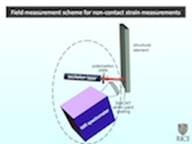 |
| An illustration shows how polarized light from a laser and a near-infrared spectrometer could read levels of strain in a material coated with nanotube-infused paint invented at Rice University. (Credit: Bruce Weisman/Rice University) |
Abstract:
A new type of paint made with carbon nanotubes at Rice University can help detect strain in buildings, bridges and airplanes.
Nano-infused paint can detect strain: Rice University's fluorescent nanotube coating can reveal stress on planes, bridges, buildings
Houston, TX | Posted on June 21st, 2012The Rice scientists call their mixture "strain paint" and are hopeful it can help detect deformations in structures like airplane wings. Their study, published online this month by the American Chemical Society journal Nano Letters details a composite coating they invented that could be read by a handheld infrared spectrometer.
This method could tell where a material is showing signs of deformation well before the effects become visible to the naked eye, and without touching the structure. The researchers said this provides a big advantage over conventional strain gauges, which must be physically connected to their read-out devices. In addition, the nanotube-based system could measure strain at any location and along any direction.
Rice chemistry professor Bruce Weisman led the discovery and interpretation of near-infrared fluorescence from semiconducting carbon nanotubes in 2002, and he has since developed and used novel optical instrumentation to explore nanotubes' physical and chemical properties.
Satish Nagarajaiah, a Rice professor of civil and environmental engineering and of mechanical engineering and materials science, and his collaborators led the 2004 development of strain sensing for structural integrity monitoring at the macro level using the electrical properties of carbon nanofilms - dense networks/ensembles of nanotubes. Since then he has continued to investigate novel strain sensing methods using various nanomaterials.
But it was a stroke of luck that Weisman and Nagarajaiah attended the same NASA workshop in 2010. There, Weisman gave a talk on nanotube fluorescence. As a flight of fancy, he said, he included an illustration of a hypothetical system that would use lasers to reveal strains in the nano-coated wing of a space shuttle.
"I went up to him afterward and said, 'Bruce, do you know we can actually try to see if this works?'" recalled Nagarajaiah.
Nanotube fluorescence shows large, predictable wavelength shifts when the tubes are deformed by tension or compression. The paint -- and therefore each nanotube, about 50,000 times thinner than a human hair -- would suffer the same strain as the surface it's painted on and give a clear picture of what's happening underneath.
"For an airplane, technicians typically apply conventional strain gauges at specific locations on the wing and subject it to force vibration testing to see how it behaves," Nagarajaiah said. "They can only do this on the ground and can only measure part of a wing in specific directions and locations where the strain gauges are wired. But with our non-contact technique, they could aim the laser at any point on the wing and get a strain map along any direction."
He said strain paint could be designed with multifunctional properties for specific applications. "It can also have other benefits," Nagarajaiah said. "It can be a protective film that impedes corrosion or could enhance the strength of the underlying material."
Weisman said the project will require further development of the coating before such a product can go to market. "We'll need to optimize details of its composition and preparation, and find the best way to apply it to the surfaces that will be monitored," he said. "These fabrication/engineering issues should be addressed to ensure proper performance, even before we start working on portable read-out instruments."
"There are also subtleties about how interactions among the nanotubes, the polymeric host and the substrate affect the reproducibility and long-term stability of the spectral shifts. For real-world measurements, these are important considerations," Weisman said.
But none of those problems seem insurmountable, he said, and construction of a handheld optical strain reader should be relatively straightforward. "There are already quite compact infrared spectrometers that could be battery-operated," Weisman said. "Miniature lasers and optics are also readily available. So it wouldn't require the invention of new technologies, just combining components that already exist.
"I'm confident that if there were a market, the readout equipment could be miniaturized and packaged. It's not science fiction."
Lead author of the paper is Paul Withey, an associate professor of physics at the University of Houston - Clear Lake, who spent a sabbatical in Weisman's lab at Rice studying the fluorescence of nanotubes in polymers. Co-authors are Rice civil engineering graduate student Venkata Srivishnu Vemuru in Nagarajaiah's group and Sergei Bachilo, a research scientist in Weisman's group.
Support for the research came from the National Science Foundation, the Welch Foundation, the Air Force Research Laboratory and the Infrastructure-Center for Advanced Materials at Rice.
####
About Rice University
Located on a 300-acre forested campus in Houston, Rice University is consistently ranked among the nation's top 20 universities by U.S. News & World Report. Rice has highly respected schools of Architecture, Business, Continuing Studies, Engineering, Humanities, Music, Natural Sciences and Social Sciences and is known for its "unconventional wisdom." With 3,708 undergraduates and 2,374 graduate students, Rice's undergraduate student-to-faculty ratio is 6-to-1. Its residential college system builds close-knit communities and lifelong friendships, just one reason why Rice has been ranked No. 1 for best quality of life multiple times by the Princeton Review and No. 4 for "best value" among private universities by Kiplinger's Personal Finance. To read "What they're saying about Rice," go to www.rice.edu/nationalmedia/Rice.pdf.
For more information, please click here
Contacts:
David Ruth
713-348-6327
Mike Williams
713-348-6728
Copyright © Rice University
If you have a comment, please Contact us.Issuers of news releases, not 7th Wave, Inc. or Nanotechnology Now, are solely responsible for the accuracy of the content.
Bookmark:


| Related Links |
 Richard E. Smalley Institute for Nanoscale Science and Technology:
| Related News Press |
News and information
Simulating magnetization in a Heisenberg quantum spin chain April 5th, 2024
NRL charters Navy’s quantum inertial navigation path to reduce drift April 5th, 2024
Discovery points path to flash-like memory for storing qubits: Rice find could hasten development of nonvolatile quantum memory April 5th, 2024
Videos/Movies
New X-ray imaging technique to study the transient phases of quantum materials December 29th, 2022
Solvent study solves solar cell durability puzzle: Rice-led project could make perovskite cells ready for prime time September 23rd, 2022
Scientists prepare for the world’s smallest race: Nanocar Race II March 18th, 2022
Visualizing the invisible: New fluorescent DNA label reveals nanoscopic cancer features March 4th, 2022
Govt.-Legislation/Regulation/Funding/Policy
NRL charters Navy’s quantum inertial navigation path to reduce drift April 5th, 2024
Discovery points path to flash-like memory for storing qubits: Rice find could hasten development of nonvolatile quantum memory April 5th, 2024
Chemical reactions can scramble quantum information as well as black holes April 5th, 2024
Nanotubes/Buckyballs/Fullerenes/Nanorods/Nanostrings
Tests find no free-standing nanotubes released from tire tread wear September 8th, 2023
Detection of bacteria and viruses with fluorescent nanotubes July 21st, 2023
Discoveries
Chemical reactions can scramble quantum information as well as black holes April 5th, 2024
New micromaterial releases nanoparticles that selectively destroy cancer cells April 5th, 2024
Utilizing palladium for addressing contact issues of buried oxide thin film transistors April 5th, 2024
Materials/Metamaterials/Magnetoresistance
Nanoscale CL thermometry with lanthanide-doped heavy-metal oxide in TEM March 8th, 2024
Focused ion beam technology: A single tool for a wide range of applications January 12th, 2024
Announcements
NRL charters Navy’s quantum inertial navigation path to reduce drift April 5th, 2024
Discovery points path to flash-like memory for storing qubits: Rice find could hasten development of nonvolatile quantum memory April 5th, 2024
Tools
Ferroelectrically modulate the Fermi level of graphene oxide to enhance SERS response November 3rd, 2023
The USTC realizes In situ electron paramagnetic resonance spectroscopy using single nanodiamond sensors November 3rd, 2023
Military
NRL charters Navy’s quantum inertial navigation path to reduce drift April 5th, 2024
What heat can tell us about battery chemistry: using the Peltier effect to study lithium-ion cells March 8th, 2024
New chip opens door to AI computing at light speed February 16th, 2024
Photonics/Optics/Lasers
With VECSELs towards the quantum internet Fraunhofer: IAF achieves record output power with VECSEL for quantum frequency converters April 5th, 2024
Nanoscale CL thermometry with lanthanide-doped heavy-metal oxide in TEM March 8th, 2024
Optically trapped quantum droplets of light can bind together to form macroscopic complexes March 8th, 2024
HKUST researchers develop new integration technique for efficient coupling of III-V and silicon February 16th, 2024
Construction
Temperature-sensing building material changes color to save energy January 27th, 2023
Strain-sensing smart skin ready to deploy: Nanotube-embedded coating detects threats from wear and tear in large structures July 15th, 2022
A sunlight-driven “self-healing” anti-corrosion coating May 27th, 2022
Polymer fibers with graphene nanotubes make it possible to heat hard-to-reach, complex-shaped items February 11th, 2022
 |
||
 |
||
| The latest news from around the world, FREE | ||
 |
||
|
|
||
| Premium Products | ||
 |
||
|
Only the news you want to read!
Learn More |
||
 |
||
|
Full-service, expert consulting
Learn More |
||
|
|
||