Home > Press > Detection of bacteria and viruses with fluorescent nanotubes
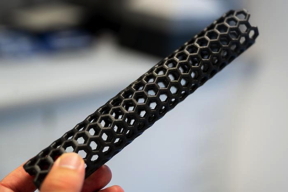 |
| 3D printed model of a carbon nanotube, the main building block for the new biosensors. Unlike in this 3D printed model, the real nanotubes are 100,000 times thinner than a human hair. CREDIT RUB, Marquard |
Abstract:
An interdisciplinary research team from Bochum, Duisburg and Zurich has developed a new approach to construct modular optical sensors which are capable of detecting viruses and bacteria. For this purpose, the researchers used fluorescent carbon nanotubes with a novel type of DNA anchors that act as molecular handles. The anchor structures can be used to conjugate biological recognition units such as antibodies aptamers to the nanotubes. The recognition unit can subsequently interact with bacterial or viral molecules to the nanotubes. These interactions effect the fluorescence of the nanotubes and increase or decrease their brightness.
Detection of bacteria and viruses with fluorescent nanotubes
Bochum, Germany | Posted on July 21st, 2023A team consisting of Professor Sebastian Kruss, Justus Metternich and four co-workers from Ruhr University Bochum (Germany), the Fraunhofer Institute for Microelectronic Circuits and Systems and the ETH Zurich reported their findings in the Journal of the American Chemical Society, published online on 27 June 2023.
Straightforward customisation of carbon nanotube biosensors
The team used tubular nanosensors that were made of carbon and had a diameter of less than one nanometre. When irradiated with visible light, carbon nanotubes emit light in the near-infrared range. Near-infrared light is not visible to the human eye. However, it is perfect for optical applications, because the level of other signals in this range is highly reduced. In earlier studies, Sebastian Kruss’ team had already shown how the fluorescence of nanotubes can be manipulated in order to detect vital biomolecules. Now, the researchers searched for a way to customise the carbon sensors for use with different target molecules in a straightforward manner.
The key to success were DNA structures with so-called guanine quantum defects. This involved linking DNA bases to the nanotube to create a defect in the crystal structure of the nanotube. As a result, the fluorescence of the nanotubes changed at the quantum level. Additionally, the defect acted as a molecular handle that allowed to introduce a detection unit, which can be adapted to the respective target molecule for the purpose of identifying a specific viral or bacterial protein. “Through the attachment of the detection unit to the DNA anchors, the assembly of such a sensor resembles a system of building blocks – except that the individual parts are 100,000 times smaller than a human hair,” outlines Sebastian Kruss.
Sensor identifies different bacterial and viral targets
The group showcased the new sensor concept using the SARS CoV-2 spike protein as an example. To this end, the researchers used aptamers, that bind to the SARS CoV-2 spike protein. “Aptamers are folded DNA or RNA strands. Due to their structure, they can selectively bind to proteins,” explains Justus Metternich. “In the next step, one could transfer the concept to antibodies or other detection units.”
The fluorescent sensors indicated the presence of the SARS-CoV-2 protein with a high degree of reliability. The selectivity of sensors with guanine quantum defects was higher than the selectivity of sensors without such defects. Moreover, the sensors with guanine quantum defects were more stable in solution. “This is an advantage if you think about measurements beyond simple aqueous solutions. For diagnostic applications, we have to measure in complex environments e.g. with cells, in the blood or in the organism itself,” says Sebastian Kruss, who heads the Functional Interfaces and Biosystems Group at Ruhr University Bochum and is a member of the Ruhr Explores Solvation Cluster of Excellence (RESOLV) and the International Graduate School of Neuroscience.
####
For more information, please click here
Contacts:
Media Contact
Julia Weiler
Ruhr-University Bochum
Office: +49-234-322-5228
Expert Contact
Sebastian Kruss
Functional Interfaces and Biosystems Group, Ruhr University Bochum, Germany
Office: +49 234 32 29946
Copyright © Ruhr-University Bochum
If you have a comment, please Contact us.Issuers of news releases, not 7th Wave, Inc. or Nanotechnology Now, are solely responsible for the accuracy of the content.
Bookmark:


| Related Links |
| Related News Press |
News and information
 Quantum computer improves AI predictions April 17th, 2026
Flexible sensor gains sensitivity under pressure April 17th, 2026
A reusable chip for particulate matter sensing April 17th, 2026
Detecting vibrational quantum beating in the predissociation dynamics of SF6 using time-resolved photoelectron spectroscopy April 17th, 2026
Chemistry
Projecting light to dispense liquids: A new route to ultra-precise microdroplets January 30th, 2026
From sensors to smart systems: the rise of AI-driven photonic noses January 30th, 2026
"Nanoreactor" cage uses visible light for catalytic and ultra-selective cross-cycloadditions October 3rd, 2025
Cambridge chemists discover simple way to build bigger molecules – one carbon at a time June 6th, 2025
Possible Futures
A fundamentally new therapeutic approach to cystic fibrosis: Nanobody repairs cellular defect April 17th, 2026
UC Irvine physicists discover method to reverse ‘quantum scrambling’ : The work addresses the problem of information loss in quantum computing system April 17th, 2026
Nanotubes/Buckyballs/Fullerenes/Nanorods/Nanostrings/Nanosheets
Tiny nanosheets, big leap: A new sensor detects ethanol at ultra-low levels January 30th, 2026
Enhancing power factor of p- and n-type single-walled carbon nanotubes April 25th, 2025
Chainmail-like material could be the future of armor: First 2D mechanically interlocked polymer exhibits exceptional flexibility and strength January 17th, 2025
Innovative biomimetic superhydrophobic coating combines repair and buffering properties for superior anti-erosion December 13th, 2024
Nanomedicine
A fundamentally new therapeutic approach to cystic fibrosis: Nanobody repairs cellular defect April 17th, 2026
New molecular technology targets tumors and simultaneously silences two ‘undruggable’ cancer genes August 8th, 2025
New imaging approach transforms study of bacterial biofilms August 8th, 2025
Electrifying results shed light on graphene foam as a potential material for lab grown cartilage June 6th, 2025
Discoveries
Quantum computer improves AI predictions April 17th, 2026
Flexible sensor gains sensitivity under pressure April 17th, 2026
A reusable chip for particulate matter sensing April 17th, 2026
Detecting vibrational quantum beating in the predissociation dynamics of SF6 using time-resolved photoelectron spectroscopy April 17th, 2026
Announcements
A fundamentally new therapeutic approach to cystic fibrosis: Nanobody repairs cellular defect April 17th, 2026
UC Irvine physicists discover method to reverse ‘quantum scrambling’ : The work addresses the problem of information loss in quantum computing system April 17th, 2026
Interviews/Book Reviews/Essays/Reports/Podcasts/Journals/White papers/Posters
A fundamentally new therapeutic approach to cystic fibrosis: Nanobody repairs cellular defect April 17th, 2026
UC Irvine physicists discover method to reverse ‘quantum scrambling’ : The work addresses the problem of information loss in quantum computing system April 17th, 2026
 |
||
 |
||
| The latest news from around the world, FREE | ||
 |
||
|
|
||
| Premium Products | ||
 |
||
|
Only the news you want to read!
Learn More |
||
 |
||
|
Full-service, expert consulting
Learn More |
||
|
|
||