Home > Press > Focused ion beam technology: A single tool for a wide range of applications
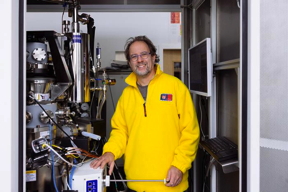 |
| Physicist Gregor Hlawacek, head of the EU project FIT4NANO, is responsible for a state-of-the-art facility at the HZDR where he can produce and analyze nanostructures using a particularly finely focused ion beam. CREDIT Oliver Killig/HZDR |
Abstract:
Processing materials on the nanoscale, producing prototypes for microelectronics or analyzing biological samples: The range of applications for finely focused ion beams is huge. Experts from the EU collaboration FIT4NANO have now reviewed the many options and developed a roadmap for the future. The article, published in “Applied Physics Review” (DOI: 10.1063/5.0162597), is aimed at students, users from industry and science as well as research policy makers.
Focused ion beam technology: A single tool for a wide range of applications
Dresden, Germany | Posted on January 12th, 2024"We realized that focused ion beams can be used in many different ways, and we thought we had a good overview at the start of the project. But then we discovered that there are many more applications than we thought. In many publications, the use of focused ion beams is not even explicitly mentioned, but is hidden in the methods section. It was detective work," says Dr Katja Höflich, physicist at the Ferdinand-Braun-Institut and the Helmholtz-Zentrum Berlin (HZB), who coordinated the comprehensive report. "In particular, we found work from the 1960s and 1970s that was ahead of its time and unjustly forgotten. Even today, they still provide important insights".
The report provides an overview of the current state of focused ion beam (FIB) technology, its applications with many examples, the most important equipment developments and future prospects. "We wanted to provide a reference work that is useful for academic research and industrial R&D departments, but also helps research management to find their way in this field," says Dr Gregor Hlawacek, group leader at the Institute of Ion Beam Physics and Materials Research at Helmholtz-Zentrum Dresden-Rossendorf (HZDR). Hlawacek leads the FIT4NANO project, an EU project on FIB technologies, in which the authors of the report are involved.
From basic research to the finished component
FIB instruments use a focused ion beam of typically two to 30 kiloelectronvolts (keV). With its small diameter in the nanometer and sub-nanometer range, such an ion beam scans the sample and can change its surface with nanometer precision. FIB instruments are a universal tool for analysis, maskless local material modification and rapid prototyping of microelectronic components. The first FIB instruments were used in the semiconductor industry to correct photomasks with focused gallium ions. Today, FIB instruments are available with many different types of ions. An important application is the preparation of samples for high-resolution, nanometer-precision imaging in the electron microscope. FIB methods have also been used in the life sciences, for example to analyze and image micro-organisms and viruses with FIB-based tomography, providing deep insights into microscopic structures and their function.
FIB instruments are constantly evolving towards other energies, heavier ions and new capabilities, such as the spatially resolved generation of single atomic defects in otherwise perfect crystals. Such FIB processing of materials and components has enormous potential in quantum and information technology. The range of applications, from fundamental research to the finished device, from physics, materials science and chemistry to life sciences and even archaeology, is absolutely unique. "We hope that this roadmap will inspire scientific and technological breakthroughs and act as an incubator for future developments," says Gregor Hlawacek.
####
For more information, please click here
Contacts:
Media Contact
Simon Schmitt
Helmholtz-Zentrum Dresden-Rossendorf
Office: 351-260-3400
Expert Contacts
Dr. Gregor Hlawacek
Helmholtz-Zentrum Dresden-Rossendorf
Office: ++49 351 260 3409
Dr. Katja Höflich
Ferdinand-Braun-Institut and Helmholtz-Zentrum Berlin (HZB)
Copyright © Helmholtz-Zentrum Dresden-Rossendorf
If you have a comment, please Contact us.Issuers of news releases, not 7th Wave, Inc. or Nanotechnology Now, are solely responsible for the accuracy of the content.
Bookmark:


| Related Links |
| Related News Press |
News and information
 Quantum computer improves AI predictions April 17th, 2026
Flexible sensor gains sensitivity under pressure April 17th, 2026
A reusable chip for particulate matter sensing April 17th, 2026
Detecting vibrational quantum beating in the predissociation dynamics of SF6 using time-resolved photoelectron spectroscopy April 17th, 2026
Physics
UC Irvine physicists discover method to reverse ‘quantum scrambling’ : The work addresses the problem of information loss in quantum computing system April 17th, 2026
Chemistry
Projecting light to dispense liquids: A new route to ultra-precise microdroplets January 30th, 2026
From sensors to smart systems: the rise of AI-driven photonic noses January 30th, 2026
"Nanoreactor" cage uses visible light for catalytic and ultra-selective cross-cycloadditions October 3rd, 2025
Cambridge chemists discover simple way to build bigger molecules – one carbon at a time June 6th, 2025
Possible Futures
A fundamentally new therapeutic approach to cystic fibrosis: Nanobody repairs cellular defect April 17th, 2026
UC Irvine physicists discover method to reverse ‘quantum scrambling’ : The work addresses the problem of information loss in quantum computing system April 17th, 2026
Nanomedicine
A fundamentally new therapeutic approach to cystic fibrosis: Nanobody repairs cellular defect April 17th, 2026
New molecular technology targets tumors and simultaneously silences two ‘undruggable’ cancer genes August 8th, 2025
New imaging approach transforms study of bacterial biofilms August 8th, 2025
Electrifying results shed light on graphene foam as a potential material for lab grown cartilage June 6th, 2025
Discoveries
Quantum computer improves AI predictions April 17th, 2026
Flexible sensor gains sensitivity under pressure April 17th, 2026
A reusable chip for particulate matter sensing April 17th, 2026
Detecting vibrational quantum beating in the predissociation dynamics of SF6 using time-resolved photoelectron spectroscopy April 17th, 2026
Materials/Metamaterials/Magnetoresistance
First real-time observation of two-dimensional melting process: Researchers at Mainz University unveil new insights into magnetic vortex structures August 8th, 2025
Researchers unveil a groundbreaking clay-based solution to capture carbon dioxide and combat climate change June 6th, 2025
A 1960s idea inspires NBI researchers to study hitherto inaccessible quantum states June 6th, 2025
Institute for Nanoscience hosts annual proposal planning meeting May 16th, 2025
Announcements
A fundamentally new therapeutic approach to cystic fibrosis: Nanobody repairs cellular defect April 17th, 2026
UC Irvine physicists discover method to reverse ‘quantum scrambling’ : The work addresses the problem of information loss in quantum computing system April 17th, 2026
Interviews/Book Reviews/Essays/Reports/Podcasts/Journals/White papers/Posters
A fundamentally new therapeutic approach to cystic fibrosis: Nanobody repairs cellular defect April 17th, 2026
UC Irvine physicists discover method to reverse ‘quantum scrambling’ : The work addresses the problem of information loss in quantum computing system April 17th, 2026
Nanobiotechnology
A fundamentally new therapeutic approach to cystic fibrosis: Nanobody repairs cellular defect April 17th, 2026
New molecular technology targets tumors and simultaneously silences two ‘undruggable’ cancer genes August 8th, 2025
New imaging approach transforms study of bacterial biofilms August 8th, 2025
Electrifying results shed light on graphene foam as a potential material for lab grown cartilage June 6th, 2025
 |
||
 |
||
| The latest news from around the world, FREE | ||
 |
||
|
|
||
| Premium Products | ||
 |
||
|
Only the news you want to read!
Learn More |
||
 |
||
|
Full-service, expert consulting
Learn More |
||
|
|
||