Home > Press > The USTC realizes In situ electron paramagnetic resonance spectroscopy using single nanodiamond sensors
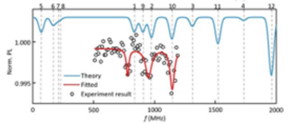 |
| experimental results CREDIT USTC |
Abstract:
Teams led by Prof. DU Jiangfeng, Prof. SHI Fazhan and Prof. KONG Fei from the University of Science and Technology of China (USTC) of the Chinese Academy of Sciences (CAS) used the Nitrogen-Vacancy (NV) center inside a single nanodiamond for quantum sensing to overcome the problem of random particle rotation.
The USTC realizes In situ electron paramagnetic resonance spectroscopy using single nanodiamond sensors
Hefei, China | Posted on November 3rd, 2023The study was published on Oct. 7th in Nature Communications.
It is an important goal to detect and analyze molecules under physiological in situ conditions in the field of life sciences. Only by observing biomolecules under this condition can we reveal conformation changes when they realize physiological functions.
Thanks to its high sensitivity, good biocompatibility, and the characteristics of magnetic resonance detection of single molecules at room temperature atmosphere, the NV center quantum sensor is rather suitable for physiological in situ detection than traditional magnetic spectrum resonance instruments.
However, the results of tracking the movement of nanodiamond in living cells show that it rotates randomly both inside the cell and on the cell membrane, making the current common magnetic resonance detection methods ineffective.
To solve this problem, the research team designed an amplitude-modulation sequence, which will generate a series of equally spaced energy levels on the NV center.
When the energy level of the NV center matches the energy level of the measured target, resonance will occur and the state of the NV center will change.
By scanning the modulation frequency, the electron paramagnetic resonance (EPR) spectroscopy of the target can be obtained, and the position of the spectral peak is no longer affected by the spatial orientation of the NV center.
In this work, the ions in the solution environment of nanodiamond were measured by EPR spectroscopy under the condition of in situ. The research team simulated the movement of nanodiamonds in the cell to detect the solution of oxygen vanadium ions.
When there is rotation of nanodiamond, it is difficult to conduct accurate quantum manipulation of NV centers, but zero-field EPR spectrum of oxo-vanadium ions can still be measured.
This result proves in principle that it is feasible to use NV center in nanodiamond to realize the detection of intracellular physiological in-situ magnetic resonance.
The oxygen vanadium ions detected in this work itself have biological functions. The ultra-fine constant of oxygen vanadium ions can be analyzed and obtained by the EPR spectrum measured by a single moving nanodiamond.
The research team has previously relaxed the detection conditions of single-molecular magnetic resonance detection from solid conditions to aqueous solution environment, and this work has further promoted it to the in situ environment.
####
For more information, please click here
Contacts:
Jane Fan
University of Science and Technology of China
Copyright © University of Science and Technology of China
If you have a comment, please Contact us.Issuers of news releases, not 7th Wave, Inc. or Nanotechnology Now, are solely responsible for the accuracy of the content.
Bookmark:


| Related Links |
| Related News Press |
News and information
 Quantum computer improves AI predictions April 17th, 2026
Flexible sensor gains sensitivity under pressure April 17th, 2026
A reusable chip for particulate matter sensing April 17th, 2026
Detecting vibrational quantum beating in the predissociation dynamics of SF6 using time-resolved photoelectron spectroscopy April 17th, 2026
Quantum Physics
Detecting vibrational quantum beating in the predissociation dynamics of SF6 using time-resolved photoelectron spectroscopy April 17th, 2026
Beyond silicon: Electronics at the scale of a single molecule January 30th, 2026
Imaging
Possible Futures
A fundamentally new therapeutic approach to cystic fibrosis: Nanobody repairs cellular defect April 17th, 2026
UC Irvine physicists discover method to reverse ‘quantum scrambling’ : The work addresses the problem of information loss in quantum computing system April 17th, 2026
Discoveries
Quantum computer improves AI predictions April 17th, 2026
Flexible sensor gains sensitivity under pressure April 17th, 2026
A reusable chip for particulate matter sensing April 17th, 2026
Detecting vibrational quantum beating in the predissociation dynamics of SF6 using time-resolved photoelectron spectroscopy April 17th, 2026
Announcements
A fundamentally new therapeutic approach to cystic fibrosis: Nanobody repairs cellular defect April 17th, 2026
UC Irvine physicists discover method to reverse ‘quantum scrambling’ : The work addresses the problem of information loss in quantum computing system April 17th, 2026
Interviews/Book Reviews/Essays/Reports/Podcasts/Journals/White papers/Posters
A fundamentally new therapeutic approach to cystic fibrosis: Nanobody repairs cellular defect April 17th, 2026
UC Irvine physicists discover method to reverse ‘quantum scrambling’ : The work addresses the problem of information loss in quantum computing system April 17th, 2026
Tools
Metasurfaces smooth light to boost magnetic sensing precision January 30th, 2026
From sensors to smart systems: the rise of AI-driven photonic noses January 30th, 2026
Japan launches fully domestically produced quantum computer: Expo visitors to experience quantum computing firsthand August 8th, 2025
 |
||
 |
||
| The latest news from around the world, FREE | ||
 |
||
|
|
||
| Premium Products | ||
 |
||
|
Only the news you want to read!
Learn More |
||
 |
||
|
Full-service, expert consulting
Learn More |
||
|
|
||