Home > Press > Nanoanalysis Tool Used to Evaluate Hypersensitivity Toothpaste
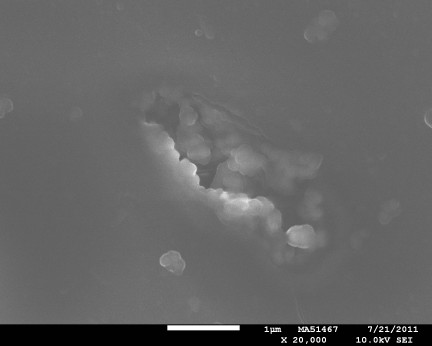 |
| High magnification FESEM image of dentin treated with Clinpro 5000 after acid challenge. Mineral deposits visibly block the tubules. (Karlinsey, et al. American Journal of Dentistry (2011) 24; 357) |
Abstract:
McCrone Associates, Inc. conducted nanoscale analysis that provided Indiana Nanotech and 3M ESPE with visual proof for patient-reported hypersensitivity benefits of its professional-strength toothpaste.
Nanoanalysis Tool Used to Evaluate Hypersensitivity Toothpaste
Westmont, IL | Posted on February 13th, 2012Teeth hypersensitivity , is a sharp, momentary pain felt when nerves in the dentin are exposed to stimuli such as hot or cold drinks. Toothpastes that claim to relieve the pain of sensitive teeth are believed to work by blocking the tubules in the dentin that lead to the nerves.
The analysis was published in the December 2011 issue of American Journal of Dentistry by Dr. Robert Karlinsey, Indiana Nanotech's CEO. Dr. Karlinsey discovered that Clinpro toothpaste, which contains a fluoride-compatible tricalcium phosphate system he invented, was the most effective at filling the tubules in a comparison with four leading brands.
With the published findings, the dental community now has visual evidence of Clinpro's patient-reported hypersensitivity benefits.
Dr. Karlinsey's conclusion was made possible by field emission scanning electron microscopy (FESEM) imagery performed at McCrone Associates. It was there that senior research scientist and a co-author of the AJD paper, Craig Schwandt, Ph.D., analyzed demineralized dentin treated with various toothpastes to determine if Clinpro could form mineral deposits in the tubules.
"Craig delivered high quality images," said Dr. Karlinsey. "I loved working with him and I would use McCrone Associates again."
Using FESEM, Dr. Schwandt showed that Clinpro products promoted mineral deposits in the dentin tubules. The deposits were also resistant to acid, which, for instance, can take the form as an acidic beverage like coffee, or be generated as a byproduct of bacteria as it breaks down sugar in the mouth. FESEM also revealed that the other toothpastes only exhibited moderate abilities to block the tubules, and none of their deposits were acid resistant.
"Field emission SEM is an easy and fast way to inspect samples at the nanoscale," said Dr. Schwandt.
####
For more information, please click here
Contacts:
Ken Li
Phone: 312.997.2436
Copyright © McCrone Associates, Inc.
If you have a comment, please Contact us.Issuers of news releases, not 7th Wave, Inc. or Nanotechnology Now, are solely responsible for the accuracy of the content.
Bookmark:


| Related News Press |
News and information
 Quantum computer improves AI predictions April 17th, 2026
Flexible sensor gains sensitivity under pressure April 17th, 2026
A reusable chip for particulate matter sensing April 17th, 2026
Detecting vibrational quantum beating in the predissociation dynamics of SF6 using time-resolved photoelectron spectroscopy April 17th, 2026
Imaging
Simple algorithm paired with standard imaging tool could predict failure in lithium metal batteries August 8th, 2025
Announcements
A fundamentally new therapeutic approach to cystic fibrosis: Nanobody repairs cellular defect April 17th, 2026
UC Irvine physicists discover method to reverse ‘quantum scrambling’ : The work addresses the problem of information loss in quantum computing system April 17th, 2026
Tools
Metasurfaces smooth light to boost magnetic sensing precision January 30th, 2026
From sensors to smart systems: the rise of AI-driven photonic noses January 30th, 2026
Japan launches fully domestically produced quantum computer: Expo visitors to experience quantum computing firsthand August 8th, 2025
Dental
Innovations in dentistry: Navigational surgery, robotics, and nanotechnology October 2nd, 2020
First measurement of electron energy distributions, could enable sustainable energy technologies June 5th, 2020
Gas storage method could help next-generation clean energy vehicles: Tremendous amounts of hydrogen and methane can be stored in nanoscopic pores April 17th, 2020
 |
||
 |
||
| The latest news from around the world, FREE | ||
 |
||
|
|
||
| Premium Products | ||
 |
||
|
Only the news you want to read!
Learn More |
||
 |
||
|
Full-service, expert consulting
Learn More |
||
|
|
||