Home > Press > Behind the Secrets of Silk Lie High-Tech Opportunities
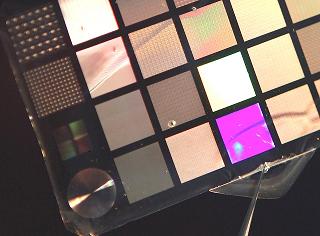 |
| Using biocompatible green processing, silk cocoons can yield a pure silk protein with numerous applications in fields such as medicine and electronics. The silk card above shows diffractive optics entirely constituted by pure silk obtained by pouring silk solution on nanopatterned molds and letting the solution dry and crystallize. The resulting film retains the pattern and is a free-standing optical component so flexible it can be rolled up. (Fiorenzo Omenetto/Tufts University) |
Abstract:
A Decade of Research Yields New Uses for Ancient Material
Behind the Secrets of Silk Lie High-Tech Opportunities
Medford/Somerville, MA | Posted on July 31st, 2010Tougher than a bullet-proof vest yet synonymous with beauty and luxury, silk fibers are a masterpiece of nature whose remarkable properties have yet to be fully replicated in the laboratory.
Thanks to their amazing mechanical properties as well as their looks, silk fibers have been important materials in textiles, medical sutures, and even armor for 5,000 years.
Silk spun by spiders and silk worms combines high strength and extensibility. This one-two punch is unmatched by synthetics, even though silk is made from a relatively simple protein processed from water.
But in recent years scientists have begun to unravel the secrets of silk.
In the July 30, 2010, issue of the journal Science, Tufts biomedical engineering researchers Fiorenzo Omenetto, Ph.D., and David Kaplan, Ph.D., report that "Silk-based materials have been transformed in just the past decade from the commodity textile world to a growing web of applications in more high technology directions."
Fundamental discoveries into how silk fibers are made have shown that chemistry, molecular biology and biophysics all play a role in the process. These discoveries have provided the basis for a new generation of applications for silk materials, from medical devices and drug delivery to electronics.
Edible Optics, Implantable Electronics
The Science paper notes that the development of silk hydrogels, films, fibers and sponges is making possible advances in photonics and optics, nanotechnology, electronics, adhesives and microfluidics, as well as engineering of bone and ligaments. Because silk fiber formation does not rely on complex or toxic chemistries, such materials are biologically and environmentally friendly, even able to integrate with living systems.
Down the silk road of the future, Kaplan and Omenetto believe applications could include degradable and flexible electronic displays for sensors that are biologically and environmentally compatible and implantable optical systems for diagnosis and treatment. Progress in "edible optics" and implantable electronics has already been demonstrated by Kaplan and Omenetto, John Rogers at the University of Illinois at Urbana-Champaign, and others.
Many challenges remain. Kaplan and Omenetto say that key questions include how to fully replicate native silk assembly in the lab, how best to mimic silk protein sequences via genetic engineering to scale-up materials production, and how to use silk as a model polymer to spur new synthetic polymer designs that mimic natural silk's green chemistry.
Techniques for reprocessing natural silk protein in the lab continue to advance. Silks are also being cloned and expressed in a variety of hosts, including E. coli bacteria, fungi, plants and mammals, and through transgenic silkworms.
One day, efficient transgenic plants could be used to crop silk in much the same way that cotton is harvested today, the Tufts researchers note in their paper. In some regions, silk production might create a new microeconomy, as demand grows and production techniques improve.
"Based on the recent and rapid progression of silk materials from the ancient textile use into a host of new high-technology applications, we anticipate growth in the use of silks in a wide platform of applications will continue as answers to these remaining questions are obtained," say Omenetto and Kaplan.
Kaplan is chair of the Biomedical Engineering Department at Tufts School of Engineering and the Stern Family Professor in Engineering. He also directs the NIH Tissue Engineering Resource Center that involves Tufts and Columbia University. His work lies at the interface between biology and materials science and engineering, and he has been studying novel biomaterials, many of them silk-based, for 30 years. Professor of Biomedical Engineering Fiorenzo Omenetto is a frequent collaborator with Kaplan who has pioneered silk optics and use of silk as a green material for photonics and other high tech applications.
Support for this research on silk comes from the National Institutes of Health, National Science Foundation, Air Force Office of Science Research and the Defense Advanced Research Projects Agency.
####
About Tufts University
Tufts University, located on three Massachusetts campuses in Boston, Medford/Somerville, and Grafton, and in Talloires, France, is recognized among the premier research universities in the United States. Tufts enjoys a global reputation for academic excellence and for the preparation of students as leaders in a wide range of professions. A growing number of innovative teaching and research initiatives span all Tufts campuses, and collaboration among the faculty and students in the undergraduate, graduate and professional programs across the university's schools is widely encouraged.
For more information, please click here
Contacts:
Kim Thurler
617-627-3175
Copyright © Tufts University
If you have a comment, please Contact us.Issuers of news releases, not 7th Wave, Inc. or Nanotechnology Now, are solely responsible for the accuracy of the content.
Bookmark:


| Related News Press |
News and information
 Simulating magnetization in a Heisenberg quantum spin chain April 5th, 2024
NRL charters Navy’s quantum inertial navigation path to reduce drift April 5th, 2024
Discovery points path to flash-like memory for storing qubits: Rice find could hasten development of nonvolatile quantum memory April 5th, 2024
Good as gold - improving infectious disease testing with gold nanoparticles April 5th, 2024
Display technology/LEDs/SS Lighting/OLEDs
Utilizing palladium for addressing contact issues of buried oxide thin film transistors April 5th, 2024
Light guide plate based on perovskite nanocomposites November 3rd, 2023
Simple ballpoint pen can write custom LEDs August 11th, 2023
A universal HCl-assistant powder-to-powder strategy for preparing lead-free perovskites March 24th, 2023
Microfluidics/Nanofluidics
Implantable device shrinks pancreatic tumors: Taming pancreatic cancer with intratumoral immunotherapy April 14th, 2023
Researchers design new inks for 3D-printable wearable bioelectronics: Potential uses include printing electronic tattoos for medical tracking applications August 19th, 2022
Govt.-Legislation/Regulation/Funding/Policy
NRL charters Navy’s quantum inertial navigation path to reduce drift April 5th, 2024
Discovery points path to flash-like memory for storing qubits: Rice find could hasten development of nonvolatile quantum memory April 5th, 2024
Chemical reactions can scramble quantum information as well as black holes April 5th, 2024
Possible Futures
Discovery points path to flash-like memory for storing qubits: Rice find could hasten development of nonvolatile quantum memory April 5th, 2024
With VECSELs towards the quantum internet Fraunhofer: IAF achieves record output power with VECSEL for quantum frequency converters April 5th, 2024
Academic/Education
Rice University launches Rice Synthetic Biology Institute to improve lives January 12th, 2024
Multi-institution, $4.6 million NSF grant to fund nanotechnology training September 9th, 2022
Chip Technology
Discovery points path to flash-like memory for storing qubits: Rice find could hasten development of nonvolatile quantum memory April 5th, 2024
Utilizing palladium for addressing contact issues of buried oxide thin film transistors April 5th, 2024
HKUST researchers develop new integration technique for efficient coupling of III-V and silicon February 16th, 2024
Nanomedicine
New micromaterial releases nanoparticles that selectively destroy cancer cells April 5th, 2024
Good as gold - improving infectious disease testing with gold nanoparticles April 5th, 2024
Researchers develop artificial building blocks of life March 8th, 2024
Sensors
Nanoelectronics
Interdisciplinary: Rice team tackles the future of semiconductors Multiferroics could be the key to ultralow-energy computing October 6th, 2023
Key element for a scalable quantum computer: Physicists from Forschungszentrum Jülich and RWTH Aachen University demonstrate electron transport on a quantum chip September 23rd, 2022
Reduced power consumption in semiconductor devices September 23rd, 2022
Atomic level deposition to extend Moore’s law and beyond July 15th, 2022
Discoveries
Chemical reactions can scramble quantum information as well as black holes April 5th, 2024
New micromaterial releases nanoparticles that selectively destroy cancer cells April 5th, 2024
Utilizing palladium for addressing contact issues of buried oxide thin film transistors April 5th, 2024
Announcements
NRL charters Navy’s quantum inertial navigation path to reduce drift April 5th, 2024
Discovery points path to flash-like memory for storing qubits: Rice find could hasten development of nonvolatile quantum memory April 5th, 2024
Environment
Billions of nanoplastics released when microwaving baby food containers: Exposure to plastic particles kills up to 75% of cultured kidney cells July 21st, 2023
Nanobiotechnology
New micromaterial releases nanoparticles that selectively destroy cancer cells April 5th, 2024
Good as gold - improving infectious disease testing with gold nanoparticles April 5th, 2024
Researchers develop artificial building blocks of life March 8th, 2024
Photonics/Optics/Lasers
With VECSELs towards the quantum internet Fraunhofer: IAF achieves record output power with VECSEL for quantum frequency converters April 5th, 2024
Nanoscale CL thermometry with lanthanide-doped heavy-metal oxide in TEM March 8th, 2024
Optically trapped quantum droplets of light can bind together to form macroscopic complexes March 8th, 2024
HKUST researchers develop new integration technique for efficient coupling of III-V and silicon February 16th, 2024
 |
||
 |
||
| The latest news from around the world, FREE | ||
 |
||
|
|
||
| Premium Products | ||
 |
||
|
Only the news you want to read!
Learn More |
||
 |
||
|
Full-service, expert consulting
Learn More |
||
|
|
||