Home > Press > Light guide plate based on perovskite nanocomposites
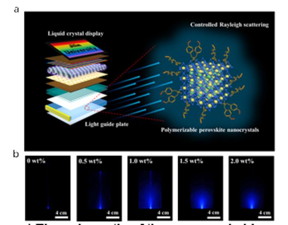 |
| (a), The graphical abstract of the work: The PNCs/PS nanocomposite is fabricated through a two-type ligand strategy, which is proper to serve as LGP in LCD-related application based on the Rayleigh scattering behavior of the PNCs. (b), The function of LGP: When the blue laser light transports through the bulk nanocomposite with different doping content, the light and its surface output can be uniformized and enhanced. CREDIT by Chongming Liu, Zhicheng Zhu, Kaibo Pan, Yuan Fu, Kai Zhang and Bai Yang |
Abstract:
The fact that nanoparticle and polymer hybrid materials can often combine the advantages of each has been demonstrated in several fields. Embedding PNCs into polymer is an effective strategy to enhance the PNCs stability and polymer can endow the PNCs with other positive effects based on different structure and functional groups. The uniform distribution of PNCs in polymer matrix is critical to the properties of the nanocomposites and the aggregation of PNCs induced by high surface energy has a severe influence on the performance of related applications. As such, the loading fraction is limited owing to the phase separation between PNCs and polymer. Chemical interaction between PNCs and polymer is necessary to suppress the phase separation. Meanwhile, most of the fabrication methods of PNCs/polymer nanocomposites are spin coating, swelling-shrinking and electrospinning based on the in-situ synthesis of PNCs in polymer matrix and physical mixing, but extremely few works can achieve the fabrication of PNCs/polymer nanocomposites by bulk polymerization.
Light guide plate based on perovskite nanocomposites
Changchun, China | Posted on November 3rd, 2023In a new paper published in Light Science & Application, a team of scientists, led by Professor Bai Yang from State Key Laboratory of Supramolecular Structure and Materials, College of Chemistry, Jilin University, China, and co-workers have adopted a two-type ligand strategy to fabricate PNCs/polystyrene (PS) nanocomposites, where the undec-10-en-1-amine help PNCs disperse in styrene and the synthetic bis[(4-ethenylphenyl)methyl]dimethylammonium chloride works as polymerizable capping ligands to endow the PNCs with polymerization activity. The bulk CsPbCl3 PNCs/PS nanocomposites can still maintain high transparency even at the doping content up to 5 wt%.
The high transparency can be ascribed to the Rayleigh scattering as the PNCs distribute uniformly without obvious aggregation. Based on this behavior, the scientists further exploit the potential of the PNCs/PS nanocomposites to serve as LGP and study the principle of this new type of LGP.
Through the facile composition adjustment of CsPbClxBr3-x (1≤x≤3) PNCs, the Rayleigh scattering behavior can be adjusted and the scientists systematically study the influence of PNCs composition on the performance of LGP by calculating the volume scattering coefficient and optical radiation efficiency of the nanocomposites.
Furthermore, this new type of LGP is compatible with the advanced liquid crystal display (LCD) technology. Both of surface illuminance and uniformity show obvious improvement. For 5.0-inch LGP, the best performing LGP doping with 1 wt% CsPbCl2.5Br0.5 PNCs exhibits about 20.5 times higher illuminance and 1.8 times higher uniformity in display than the control.
This kind of LGP has huge potential in LCD-related applications and will draw much attention in LGP-related fields, especially as a base material to combine with the advanced LGP processing technologies such as the micro-optical pattern on the bottom or the adoption of the wedge-shaped plates.
####
For more information, please click here
Contacts:
Media Contact
Yaobiao Li
Light Publishing Center, Changchun Institute of Optics, Fine Mechanics And Physics, CAS
Office: 86-431-861-76851
Expert Contact
Bai Yang
Jilin University, China
Copyright © Light Publishing Center, Changchun Institute of Optics, Fine Mechanics And Physics, CAS
If you have a comment, please Contact us.Issuers of news releases, not 7th Wave, Inc. or Nanotechnology Now, are solely responsible for the accuracy of the content.
Bookmark:


| Related Links |
| Related News Press |
News and information
 Quantum computer improves AI predictions April 17th, 2026
Flexible sensor gains sensitivity under pressure April 17th, 2026
A reusable chip for particulate matter sensing April 17th, 2026
Detecting vibrational quantum beating in the predissociation dynamics of SF6 using time-resolved photoelectron spectroscopy April 17th, 2026
Display technology/LEDs/SS Lighting/OLEDs
Spinel-type sulfide semiconductors to operate the next-generation LEDs and solar cells For solar-cell absorbers and green-LED source October 3rd, 2025
Perovskites
KAIST researchers introduce new and improved, next-generation perovskite solar cell November 8th, 2024
Possible Futures
A fundamentally new therapeutic approach to cystic fibrosis: Nanobody repairs cellular defect April 17th, 2026
UC Irvine physicists discover method to reverse ‘quantum scrambling’ : The work addresses the problem of information loss in quantum computing system April 17th, 2026
Discoveries
Quantum computer improves AI predictions April 17th, 2026
Flexible sensor gains sensitivity under pressure April 17th, 2026
A reusable chip for particulate matter sensing April 17th, 2026
Detecting vibrational quantum beating in the predissociation dynamics of SF6 using time-resolved photoelectron spectroscopy April 17th, 2026
Announcements
A fundamentally new therapeutic approach to cystic fibrosis: Nanobody repairs cellular defect April 17th, 2026
UC Irvine physicists discover method to reverse ‘quantum scrambling’ : The work addresses the problem of information loss in quantum computing system April 17th, 2026
Interviews/Book Reviews/Essays/Reports/Podcasts/Journals/White papers/Posters
A fundamentally new therapeutic approach to cystic fibrosis: Nanobody repairs cellular defect April 17th, 2026
UC Irvine physicists discover method to reverse ‘quantum scrambling’ : The work addresses the problem of information loss in quantum computing system April 17th, 2026
Photonics/Optics/Lasers
Metasurfaces smooth light to boost magnetic sensing precision January 30th, 2026
From sensors to smart systems: the rise of AI-driven photonic noses January 30th, 2026
 |
||
 |
||
| The latest news from around the world, FREE | ||
 |
||
|
|
||
| Premium Products | ||
 |
||
|
Only the news you want to read!
Learn More |
||
 |
||
|
Full-service, expert consulting
Learn More |
||
|
|
||