Home > Press > High-speed atomic force microscopy visualizes cell protein factories
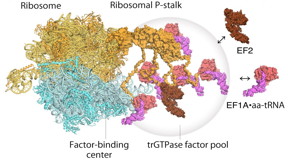 |
| Model of translating ribosomes and elongation factors. EF1A•GTP•aatRNA and EF2 assemble to the ribosomal stalk on the translating ribosome. The translation factor pool contributes to efficient protein synthesis in a crowded intracellular environment. CREDIT Proceedings of the National Academy of Sciences |
Abstract:
Ribosomes are the complexes of ribonucleoproteins at the heart of protein synthesis in cells. However in the absence of conclusive evidence, how these complexes operate has been open to debate. Now Hirotatsu Imai and Noriyuki Kodera at Kanazawa University, alongside Toshio Uchiumi at Niigata University in Japan, show visualizations of the structural dynamics and factor pooling that take place at ribosome stalk proteins as they build new proteins.
High-speed atomic force microscopy visualizes cell protein factories
Kanazawa, Japan | Posted on January 8th, 2021Ribosomes were first discovered in the 1950s and their broad function has been widely understood for some time - they read messenger RNA sequences and from that generate sequences of correctly ordered amino acids into new proteins. The ribosome stalk protein in particular plays an integral role in the protein synthesis process by recruiting protein factors responsible for translation and elongation of the amino acid sequence. However it has been hard to satisfactorily establish the structure of the bound ribosome stalk protein because of its flexibility. Here the high resolution and fast image capture of high-speed atomic force microscopy proved invaluable.
Atomic force microscopy uses a nanoscale tip to feel samples, much like a vinyl record player needle scanning over a record, except that the details identified by an atomic force microscope can have atomic-scale resolution. The versatility of the technique for different surfaces was already a huge advantage for biological studies, but with the advent of high-speed atomic force microscopy the technique was able to capture dynamic processes for the first time as well. Imai, Uchiumi and Kodera used the technique to reveal that the stalk protein actually flips between two conformations - one that agrees with previous structural models and one entirely unexpected new conformation.
As for how the ribosome operates, a two step mechanism had been previously proposed to describe how genetic information is translated through proteins known as "translational GTPase factors". The first step is the recruitment of the factors to the factor-tethering site on the protein stalk, thereby increasing the concentration of factors there - so-called factor pooling. The second step is the binding and stabilizing of a translational GTPase on the ribosomal factor-binding center to catalyse GTPase hydrolysis. From their high speed atomic force microscopy study the researchers were able to obtain the first visual evidence for the translational GTPase factor pooling mechanism by the ribosomal stalk.
Although the study was unable to give conclusive evidence of the action of the factors once bound, the researchers did note that the factors appeared to be retained in the vicinity once GTPase hydrolysis was complete, suggesting a potential role of the stalk protein in further stages of protein synthesis. The researchers conclude, "future work with HS-AFM will provide further important information to understand the dynamic behaviors of these complex translational machineries."
###
[Background]
High-speed atomic force microscopy
Atomic force microscopy was developed in the 1980s and brought the atomic scale resolution achieved by scanning tunnelling microscopy (which won the 1986 Nobel Prize for Physics) to non-conducting samples. It works using a tiny cantilever with a nanoscale tip at the end, which feels the surface. The interactions between tip and surface provide a signal that can be used to generate an image of not just the topography but also in some cases an indication of the chemical composition of structural features in a sample.
While the non-conducting surface imaging of atomic force microscopy brought huge benefits to biological research, these studies were able to move up a gear again when Toshio Ando and his team at Kanazawa University reported an atomic force microscope that operates at high speed. Atomic scale resolution images became movies bringing not just structures but also dynamics within grasp.
Ribosomes
Ribosomes are the protein factories found in all living cells. The genetic DNA sequence that encodes for a series of amino acids in the protein is transcribed to messenger RNA, to which the ribosome binds. The correct amino acids for the protein under construction are then fed to the ribosome by means of transfer RNA.
Translational GTPase factors take on the task of translation and elongation of the amino acid sequence for the protein under construction, making their role critical to the process. The mechanism by which they work with the ribosome in this operation has now been visualized by Imai, Uchiumi and Kodera using high-speed atomic force microscopy.
####
For more information, please click here
Contacts:
Hiroe Yoneda
81-762-344-550
Copyright © Kanazawa University
If you have a comment, please Contact us.Issuers of news releases, not 7th Wave, Inc. or Nanotechnology Now, are solely responsible for the accuracy of the content.
Bookmark:


| Related Links |
| Related News Press |
News and information
 Quantum computer improves AI predictions April 17th, 2026
Flexible sensor gains sensitivity under pressure April 17th, 2026
A reusable chip for particulate matter sensing April 17th, 2026
Detecting vibrational quantum beating in the predissociation dynamics of SF6 using time-resolved photoelectron spectroscopy April 17th, 2026
Imaging
Simple algorithm paired with standard imaging tool could predict failure in lithium metal batteries August 8th, 2025
Possible Futures
A fundamentally new therapeutic approach to cystic fibrosis: Nanobody repairs cellular defect April 17th, 2026
UC Irvine physicists discover method to reverse ‘quantum scrambling’ : The work addresses the problem of information loss in quantum computing system April 17th, 2026
Nanomedicine
A fundamentally new therapeutic approach to cystic fibrosis: Nanobody repairs cellular defect April 17th, 2026
New molecular technology targets tumors and simultaneously silences two ‘undruggable’ cancer genes August 8th, 2025
New imaging approach transforms study of bacterial biofilms August 8th, 2025
Electrifying results shed light on graphene foam as a potential material for lab grown cartilage June 6th, 2025
Discoveries
Quantum computer improves AI predictions April 17th, 2026
Flexible sensor gains sensitivity under pressure April 17th, 2026
A reusable chip for particulate matter sensing April 17th, 2026
Detecting vibrational quantum beating in the predissociation dynamics of SF6 using time-resolved photoelectron spectroscopy April 17th, 2026
Announcements
A fundamentally new therapeutic approach to cystic fibrosis: Nanobody repairs cellular defect April 17th, 2026
UC Irvine physicists discover method to reverse ‘quantum scrambling’ : The work addresses the problem of information loss in quantum computing system April 17th, 2026
Interviews/Book Reviews/Essays/Reports/Podcasts/Journals/White papers/Posters
A fundamentally new therapeutic approach to cystic fibrosis: Nanobody repairs cellular defect April 17th, 2026
UC Irvine physicists discover method to reverse ‘quantum scrambling’ : The work addresses the problem of information loss in quantum computing system April 17th, 2026
Tools
Metasurfaces smooth light to boost magnetic sensing precision January 30th, 2026
From sensors to smart systems: the rise of AI-driven photonic noses January 30th, 2026
Japan launches fully domestically produced quantum computer: Expo visitors to experience quantum computing firsthand August 8th, 2025
Nanobiotechnology
A fundamentally new therapeutic approach to cystic fibrosis: Nanobody repairs cellular defect April 17th, 2026
New molecular technology targets tumors and simultaneously silences two ‘undruggable’ cancer genes August 8th, 2025
New imaging approach transforms study of bacterial biofilms August 8th, 2025
Electrifying results shed light on graphene foam as a potential material for lab grown cartilage June 6th, 2025
 |
||
 |
||
| The latest news from around the world, FREE | ||
 |
||
|
|
||
| Premium Products | ||
 |
||
|
Only the news you want to read!
Learn More |
||
 |
||
|
Full-service, expert consulting
Learn More |
||
|
|
||