Home > Press > Anions matter: Zinc-ion hybrid capacitors with ideal anions in the electrolyte show extra-long performance
 |
| © Wiley-VCH, re-use with credit to 'Angewandte Chemie' and a link to the original article. |
Abstract:
Metal-ion hybrid capacitors combine the properties of capacitors and batteries. One electrode uses the capacitive mechanism, the other the battery-type redox processes. Scientists have now scrutinized the role of anions in the electrolyte. The results, which have been published in the journal Angewandte Chemie, reveal the importance of sulfate anions. Sulfate-based electrolytes gave zinc-ion hybrid capacitors outstanding performance and extra-long operability.
Anions matter: Zinc-ion hybrid capacitors with ideal anions in the electrolyte show extra-long performance
Heidelberg, Germany | Posted on November 13th, 2020Capacitors can uptake and release an enormous amount of charge in a short time, whereas batteries can store a lot of energy in a small volume. To combine both properties, scientists are investigating hybrid electrochemical cells, which contain both capacitor- and battery-type electrodes. Among these cells, researchers have identified metal-ion hybrid capacitors as especially promising devices. Here, the positive electrode includes pseudocapacitive properties, which means it can also store energy in the manner of a battery, by intercalation of the metal ions, while the negative electrode is made of a redox-active metal.
However, their electrolyte has long been neglected, says Chunyi Zhi who is investigating battery materials together with his team at the City University of Hong Kong. The researchers believe the type of electrolyte anion affects the performance of the device. "Paying more attention to the introduction of appropriate anions can effectively improve the power and energy density of a capacitor," they say.
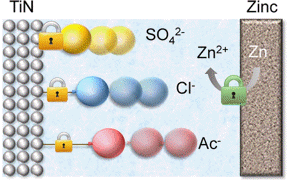
The researchers focused their attention on zinc-ion capacitors. This cell type consists of a zinc metal anode and a cathode made of titanium nitride nanofibers. The nanofibers are robust, and their porous surface allows the electrolyte to infiltrate. The scientists argue that the electrolyte anions, when attached to the titanium nitride surface, make the material more conductive. Moreover, the adsorbed anions may directly contribute to the charging process. The charging of the hybrid capacitor involves the extraction of the intercalated zinc ions.
Zhi and his colleagues compared the effects of three electrolyte anions: sulfate, acetate, and chloride. They looked at both their binding to the electrode surface and the performances of the electrochemical cells. It was a clear result.
The scientists reported that the sulfate anions stood out among the three anions. They observed that cells based on a zinc sulfate electrolyte performed best, and the sulfates bound stronger to the titanium nitride surface than the other anions. Moreover, sulfate-treated electrodes showed the lowest self-discharging. The authors attributed the findings to the electronic effects of sulfate. Its electron-pulling nature provides tight binding to the surface atoms and prevents the electrode from self-discharging, the authors concluded.
For a zinc-sulfate-based zinc-ion hybrid capacitor, the scientists reported high-performance operation for more than nine months. Moreover, these devices are flexible, which is especially useful for portable electronics. The scientists tested the device in an electronic watch and found excellent performance.
###
About the Author
Dr. Chunyi Zhi is a Professor at the Department of Materials Science & Engineering at the City University of Hong Kong. His research interests span the practical application of flexible energy-storage devices, zinc-based batteries with new electrode materials and electrolytes, and catalysts for oxygen and nitrogen reduction reactions.
http://www.comfortablenergy.net/
####
For more information, please click here
Contacts:
Mario Mueller
Copyright © Wiley
If you have a comment, please Contact us.Issuers of news releases, not 7th Wave, Inc. or Nanotechnology Now, are solely responsible for the accuracy of the content.
Bookmark:


| Related News Press |
News and information
 Quantum computer improves AI predictions April 17th, 2026
Flexible sensor gains sensitivity under pressure April 17th, 2026
A reusable chip for particulate matter sensing April 17th, 2026
Detecting vibrational quantum beating in the predissociation dynamics of SF6 using time-resolved photoelectron spectroscopy April 17th, 2026
Possible Futures
A fundamentally new therapeutic approach to cystic fibrosis: Nanobody repairs cellular defect April 17th, 2026
UC Irvine physicists discover method to reverse ‘quantum scrambling’ : The work addresses the problem of information loss in quantum computing system April 17th, 2026
Discoveries
Quantum computer improves AI predictions April 17th, 2026
Flexible sensor gains sensitivity under pressure April 17th, 2026
A reusable chip for particulate matter sensing April 17th, 2026
Detecting vibrational quantum beating in the predissociation dynamics of SF6 using time-resolved photoelectron spectroscopy April 17th, 2026
Announcements
A fundamentally new therapeutic approach to cystic fibrosis: Nanobody repairs cellular defect April 17th, 2026
UC Irvine physicists discover method to reverse ‘quantum scrambling’ : The work addresses the problem of information loss in quantum computing system April 17th, 2026
Interviews/Book Reviews/Essays/Reports/Podcasts/Journals/White papers/Posters
A fundamentally new therapeutic approach to cystic fibrosis: Nanobody repairs cellular defect April 17th, 2026
UC Irvine physicists discover method to reverse ‘quantum scrambling’ : The work addresses the problem of information loss in quantum computing system April 17th, 2026
Battery Technology/Capacitors/Generators/Piezoelectrics/Thermoelectrics/Energy storage
Decoding hydrogen‑bond network of electrolyte for cryogenic durable aqueous zinc‑ion batteries January 30th, 2026
COF scaffold membrane with gate‑lane nanostructure for efficient Li+/Mg2+ separation January 30th, 2026
MXene nanomaterials enter a new dimension Multilayer nanomaterial: MXene flakes created at Drexel University show new promise as 1D scrolls January 30th, 2026
 |
||
 |
||
| The latest news from around the world, FREE | ||
 |
||
|
|
||
| Premium Products | ||
 |
||
|
Only the news you want to read!
Learn More |
||
 |
||
|
Full-service, expert consulting
Learn More |
||
|
|
||