Home > Press > Two quantum cheshire cats exchange grins
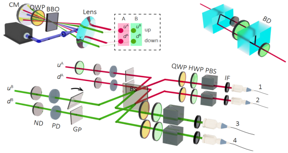 |
| Figure 1: Schematic illustration and design of experiments (Image by LI Chuanfeng et al.) |
Abstract:
Prof. LI Chuanfeng, XU Jinshi, and XU Xiaoye from University of Science and Technology of China (USTC) of the Chinese Academy of Sciences (CAS), collaborating with Prof. CHEN Jingling from Nankai University, realized the non-contacing exchange of the polarization of two photons, revealing the unique quantum characteristics of the "Quantum Cheshire Cat".
Two quantum cheshire cats exchange grins
Hefei, P.R.China | Posted on June 19th, 2020The study, published in Nature Communications, deepens the understanding of the fundamental problem of physics, "what is physical reality."
In classical world, an object should carry all of its physical properties. However, in quantum world, a quantum object may not act in such a manner - it can temporarily leave some of its physical properties where it never appears. This phenomenon is first proposed in 2013 by Yakir Aharonov, which is known as the quantum Cheshire cat effect. Cheshire Cat is a grinning cat in the fairy tale "Alice in Wonderland". It can disappear, but its grin is still hanging in the air.
In the next few years, experimental physicists observed the separation of the particle properties from the particles in the neutron and photon interference experiments. Scientists soon realized that the results of these experiments could be explained by the classic interference theory. To show the unique quantum effects of "Quantum Cheshire Cat", however, more complicated experiments were needed.
Prof. LI's group, for the first time, used the two-photon system to demonstrate the unique quantum effect of two "quantum Cheshire Cats" exchanging grins. Weak values are required to characterize the location of Cheshire cat and its grin in experiments. However the extraction of weak values in multi-body quantum systems is a big problem.
In this study, scientists proved that the traditional weak measurement method can be bypassed by applying a perturbation to the system. The weak value can be obtained directly by using the inherent relationship between the system detection probability and the strength of the perturbation.
They prepared a two-photon hyper-entangled state, that is, the polarization and path degrees of freedom of the two photons are respectively in the maximum entangled state but there are no correlations between the two degrees of freedom. Then imaginary time evolution introduces perturbation to obtain the weak value of path and polarization of the photon.
Through these weak values, scientists observed that every photon and its polarization are separated, and finally the polarization of the other photon is obtained. The non-contacting grin exchange of the two "quantum Cheshire cats" is realized.
####
For more information, please click here
Contacts:
Jane FAN Qiong
86-551-636-07280
Copyright © University of Science and Technology of China (USTC)
If you have a comment, please Contact us.Issuers of news releases, not 7th Wave, Inc. or Nanotechnology Now, are solely responsible for the accuracy of the content.
Bookmark:


| Related News Press |
News and information
 Quantum computer improves AI predictions April 17th, 2026
Flexible sensor gains sensitivity under pressure April 17th, 2026
A reusable chip for particulate matter sensing April 17th, 2026
Detecting vibrational quantum beating in the predissociation dynamics of SF6 using time-resolved photoelectron spectroscopy April 17th, 2026
Quantum Physics
Detecting vibrational quantum beating in the predissociation dynamics of SF6 using time-resolved photoelectron spectroscopy April 17th, 2026
Beyond silicon: Electronics at the scale of a single molecule January 30th, 2026
MXene nanomaterials enter a new dimension Multilayer nanomaterial: MXene flakes created at Drexel University show new promise as 1D scrolls January 30th, 2026
Physics
UC Irvine physicists discover method to reverse ‘quantum scrambling’ : The work addresses the problem of information loss in quantum computing system April 17th, 2026
Possible Futures
A fundamentally new therapeutic approach to cystic fibrosis: Nanobody repairs cellular defect April 17th, 2026
UC Irvine physicists discover method to reverse ‘quantum scrambling’ : The work addresses the problem of information loss in quantum computing system April 17th, 2026
Discoveries
Quantum computer improves AI predictions April 17th, 2026
Flexible sensor gains sensitivity under pressure April 17th, 2026
A reusable chip for particulate matter sensing April 17th, 2026
Detecting vibrational quantum beating in the predissociation dynamics of SF6 using time-resolved photoelectron spectroscopy April 17th, 2026
Announcements
A fundamentally new therapeutic approach to cystic fibrosis: Nanobody repairs cellular defect April 17th, 2026
UC Irvine physicists discover method to reverse ‘quantum scrambling’ : The work addresses the problem of information loss in quantum computing system April 17th, 2026
Interviews/Book Reviews/Essays/Reports/Podcasts/Journals/White papers/Posters
A fundamentally new therapeutic approach to cystic fibrosis: Nanobody repairs cellular defect April 17th, 2026
UC Irvine physicists discover method to reverse ‘quantum scrambling’ : The work addresses the problem of information loss in quantum computing system April 17th, 2026
 |
||
 |
||
| The latest news from around the world, FREE | ||
 |
||
|
|
||
| Premium Products | ||
 |
||
|
Only the news you want to read!
Learn More |
||
 |
||
|
Full-service, expert consulting
Learn More |
||
|
|
||