Home > Press > Turning heat into electricity: A new thermoelectric material developed at FEFU: Young scientists from FEFU manufactured new thermoelectric material based on strontium titanate and titanium oxide
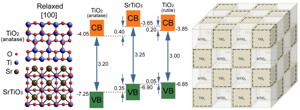 |
| Graphical abstract CREDIT FEFU press-office |
Abstract:
Young scientists from Far Eastern Federal University (FEFU) developed the concept and manufactured samples of a new thermoelectric material -- biphase nanoceramics based on strontium titanate SrTiO3 and titanium oxide TiO2. It can help to transform exhaust heat (heat losses amounting to about 60% of heat exchange) into electrical energy and to protect devices operating at temperatures above 1,000°? from overheating. The article was published in the special Advanced Thermoelectric Materials issue of the Materials journal.
Turning heat into electricity: A new thermoelectric material developed at FEFU: Young scientists from FEFU manufactured new thermoelectric material based on strontium titanate and titanium oxide
Vladivostok, Russia | Posted on September 27th, 2019The team from FEFU worked together with scientists from the Institute of Chemistry of the Far Eastern Department of the Russian Academy of Sciences and has already obtained the first experimental samples of biphase nanoceramics. The material has high mechanical performance, thermal, and chemical resistance. The team is currently testing its thermoelectric properties.
'Many technological properties cause the emission of exhaust heat at high temperatures. For example, the temperature on the outer side of an exhaust pipe can reach about 700°C. In these conditions popular thermoelectric materials based on bismuth telluride Bi2Te3 and lead telluride PbTe face increased risks of thermal breakdown which may lead to environmental pollution with heavy metals. Our task was to develop a high-quality thermoelectric material that would be chemically stable and resistant to high temperatures,' said Alexey Zavjalov, a researcher at the School of Natural Sciences, FEFU, who developed the composition of the new material.
The team from FEFU suggested a biphase ceramic system based on metal oxides: strontium titanate SrTiO3 and titanium oxide TiO2. The oxides have high thermal and chemical resistance at temperatures above 1,000° but do not show excellent thermoelectric properties on their own. The biphase structure and nanosized grains considerably increase the material's thermoelectric efficacy.
Increased density and mechanical performance of the material along with the nanosize of its grains and high concentration of intergranular boundaries are important properties for extreme temperature conditions. In the new material they were obtained by means of high-speed consolidation of SrCO3 and anatase TiO2 nanopowders under pressure. This process is called reactive spark plasma sintering.
'The new material may be used not only for secondary exhaust heat processing, but also as a part of high-tech applications as an active heat buffer. TiO2-SrTiO3 based nanoceramics can increase the service life and characteristics of devices that operate at temperatures above 1,000°,' said Denis Kosyanov, a senior researcher at the Center for National Technological Initiatives, FEFU, and the head of the group.
The team of young researchers from FEFU won a grant of the Russian Foundation for Basic Research for the development of new materials for laser technologies based on 'optical ceramics - thermoelectrics' heterostructures in 2018. The concept of the new thermoelectric ceramics is a result of grant work.
###
FEFU runs a Materials priority project, and a Center for National Technological Initiatives in Neurotechnologies, VR/AR Technologies (grant No. 1/1251/2018 dated October 16, 2018). The researchers working in these areas develop scientific and technical bases for multifunctional ceramic materials to be used in microelectronics, lighting technologies, and radiochemistry.
The research was carried out within the framework of grant No. 18-29-11044 provided by the Russian Foundation for Basic Research.
####
For more information, please click here
Contacts:
Alexander Zverev
Copyright © Far Eastern Federal University
If you have a comment, please Contact us.Issuers of news releases, not 7th Wave, Inc. or Nanotechnology Now, are solely responsible for the accuracy of the content.
Bookmark:


| Related Links |
| Related News Press |
News and information
 Quantum computer improves AI predictions April 17th, 2026
Flexible sensor gains sensitivity under pressure April 17th, 2026
A reusable chip for particulate matter sensing April 17th, 2026
Detecting vibrational quantum beating in the predissociation dynamics of SF6 using time-resolved photoelectron spectroscopy April 17th, 2026
Govt.-Legislation/Regulation/Funding/Policy
Quantum computer improves AI predictions April 17th, 2026
Metasurfaces smooth light to boost magnetic sensing precision January 30th, 2026
New imaging approach transforms study of bacterial biofilms August 8th, 2025
Possible Futures
A fundamentally new therapeutic approach to cystic fibrosis: Nanobody repairs cellular defect April 17th, 2026
UC Irvine physicists discover method to reverse ‘quantum scrambling’ : The work addresses the problem of information loss in quantum computing system April 17th, 2026
Discoveries
Quantum computer improves AI predictions April 17th, 2026
Flexible sensor gains sensitivity under pressure April 17th, 2026
A reusable chip for particulate matter sensing April 17th, 2026
Detecting vibrational quantum beating in the predissociation dynamics of SF6 using time-resolved photoelectron spectroscopy April 17th, 2026
Materials/Metamaterials/Magnetoresistance
First real-time observation of two-dimensional melting process: Researchers at Mainz University unveil new insights into magnetic vortex structures August 8th, 2025
Researchers unveil a groundbreaking clay-based solution to capture carbon dioxide and combat climate change June 6th, 2025
A 1960s idea inspires NBI researchers to study hitherto inaccessible quantum states June 6th, 2025
Institute for Nanoscience hosts annual proposal planning meeting May 16th, 2025
Announcements
A fundamentally new therapeutic approach to cystic fibrosis: Nanobody repairs cellular defect April 17th, 2026
UC Irvine physicists discover method to reverse ‘quantum scrambling’ : The work addresses the problem of information loss in quantum computing system April 17th, 2026
Interviews/Book Reviews/Essays/Reports/Podcasts/Journals/White papers/Posters
A fundamentally new therapeutic approach to cystic fibrosis: Nanobody repairs cellular defect April 17th, 2026
UC Irvine physicists discover method to reverse ‘quantum scrambling’ : The work addresses the problem of information loss in quantum computing system April 17th, 2026
Battery Technology/Capacitors/Generators/Piezoelectrics/Thermoelectrics/Energy storage
Decoding hydrogen‑bond network of electrolyte for cryogenic durable aqueous zinc‑ion batteries January 30th, 2026
COF scaffold membrane with gate‑lane nanostructure for efficient Li+/Mg2+ separation January 30th, 2026
MXene nanomaterials enter a new dimension Multilayer nanomaterial: MXene flakes created at Drexel University show new promise as 1D scrolls January 30th, 2026
 |
||
 |
||
| The latest news from around the world, FREE | ||
 |
||
|
|
||
| Premium Products | ||
 |
||
|
Only the news you want to read!
Learn More |
||
 |
||
|
Full-service, expert consulting
Learn More |
||
|
|
||