Home > Press > New study shows nanoscale pendulum coupling
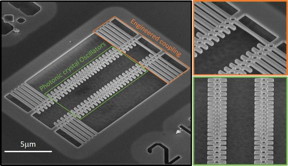 |
| Researchers could synchronize two crystal optomechanical oscillators mechanically coupled. CREDIT D. Navarro |
Abstract:
In 1665, Lord Christiaan Huygens found that two pendulum clocks, hung in the same wooden structure, oscillated spontaneously and perfectly in line but in opposite directions: the clocks oscillated in anti-phase. Since then, synchronization of coupled oscillators in nature has been described at several scales: from heart cells to bacteria, neural networks and even in binary star systems -spontaneously synchronized.
New study shows nanoscale pendulum coupling
Barcelona, Spain | Posted on July 3rd, 2019Mechanical oscillators are typical in these systems. In the nanoscale, the challenge is to synchronize these. In these lines, an article published in the journal Physical Review Letters -by a team of researchers from the Institute of Nanoscience and Nanotechnology of the UB (IN2UB) together with ICN2 researchers showed a version of mechanic oscillators at a nanoscale. Through a series of experiments, researchers could synchronize two crystal optomechanical oscillators mechanically coupled, located in the same silicon platform and activated through independent optical impulses. These nanometric oscillators have a size of 15 micrometres per 500 nanometres.
While a mechanical pendulum receives impulses from the clock to keep its movement, the optomechanical pendulums use the pressure from radiation, but interaction of oscillators is the same in both experiments. The study also shows that the collective dynamics can be controlled acting externally on one oscillator only.
"Results show a good base for the creation of reconfigurable networks of optomechanical oscillators thanks to these collective dynamics that are dominated by a weak mechanical coupling. This could have applications in photonics, for instance, for pattern recognition tasks or a more complex cognitive process", notes Daniel Navarro Urrios, from IN2UB, who led the research.
####
For more information, please click here
Contacts:
Bibiana Bonmatí
0034-934-035-544
Copyright © University of Barcelona
If you have a comment, please Contact us.Issuers of news releases, not 7th Wave, Inc. or Nanotechnology Now, are solely responsible for the accuracy of the content.
Bookmark:


| Related Links |
| Related News Press |
News and information
 Quantum computer improves AI predictions April 17th, 2026
Flexible sensor gains sensitivity under pressure April 17th, 2026
A reusable chip for particulate matter sensing April 17th, 2026
Detecting vibrational quantum beating in the predissociation dynamics of SF6 using time-resolved photoelectron spectroscopy April 17th, 2026
Physics
UC Irvine physicists discover method to reverse ‘quantum scrambling’ : The work addresses the problem of information loss in quantum computing system April 17th, 2026
Quantum computers simulate fundamental physics: shedding light on the building blocks of nature June 6th, 2025
Possible Futures
A fundamentally new therapeutic approach to cystic fibrosis: Nanobody repairs cellular defect April 17th, 2026
UC Irvine physicists discover method to reverse ‘quantum scrambling’ : The work addresses the problem of information loss in quantum computing system April 17th, 2026
Discoveries
Quantum computer improves AI predictions April 17th, 2026
Flexible sensor gains sensitivity under pressure April 17th, 2026
A reusable chip for particulate matter sensing April 17th, 2026
Detecting vibrational quantum beating in the predissociation dynamics of SF6 using time-resolved photoelectron spectroscopy April 17th, 2026
Announcements
A fundamentally new therapeutic approach to cystic fibrosis: Nanobody repairs cellular defect April 17th, 2026
UC Irvine physicists discover method to reverse ‘quantum scrambling’ : The work addresses the problem of information loss in quantum computing system April 17th, 2026
Interviews/Book Reviews/Essays/Reports/Podcasts/Journals/White papers/Posters
A fundamentally new therapeutic approach to cystic fibrosis: Nanobody repairs cellular defect April 17th, 2026
UC Irvine physicists discover method to reverse ‘quantum scrambling’ : The work addresses the problem of information loss in quantum computing system April 17th, 2026
Research partnerships
Lab to industry: InSe wafer-scale breakthrough for future electronics August 8th, 2025
HKU physicists uncover hidden order in the quantum world through deconfined quantum critical points April 25th, 2025
 |
||
 |
||
| The latest news from around the world, FREE | ||
 |
||
|
|
||
| Premium Products | ||
 |
||
|
Only the news you want to read!
Learn More |
||
 |
||
|
Full-service, expert consulting
Learn More |
||
|
|
||