Home > Press > Breaking the symmetry in the quantum realm
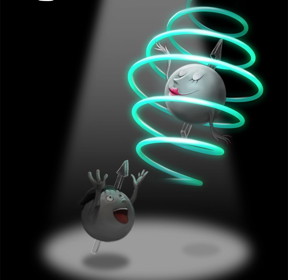 |
| The figure describes the dynamics of two spins as a harmonious couple-dance. Different from a solo-dance of a single spin, the couple-dance would present more unique and charming features, such as parity-time symmetry breaking demonstrated in the work. CREDIT images created by Guoyan Wang & Lei Chen |
Abstract:
For the first time, researchers have observed a break in a single quantum system. The observation--and how they made the observation--has potential implications for physics beyond the standard understanding of how quantum particles interact to produce matter and allow the world to function as we know it.
Breaking the symmetry in the quantum realm
Anhui, P.R.China | Posted on May 31st, 2019The researchers published their results on May 31st, in the journal Science.
Called Parity-Time (PT) Symmetry, the mathematical term describes the properties of a quantum system--the evolution of time for a quantum particle, as well as if the particle is even or odd. Whether the particle moves forward or backward in time, the state of oddness or evenness remains the same in the balanced system. When the parity changes, the balance of system -- the symmetry of the system -- breaks.
In order to better understand quantum interactions and develop next-generation devices, researchers must be able to control the symmetry of systems. If they can break the symmetry, they could manipulate the spin state of the quantum particles as they interact, resulting in controlled and predicted outcomes.
"Our work is about that quantum control," said Yang Wu, an author on the paper and a PhD student in the Hefei National Laboratory for Physical Sciences at the Microscale and Department of Modern Physics at the University of Science and Technology of China. Wu is also a member of the Chinese Academy of Sciences Key Laboratory of Microscale Magnetic Resonance.
Wu, his PhD supervisor Rong and colleagues used a nitrogen-vacancy center in a diamond as their platform. The nitrogen atom with an extra electron, surrounded by carbon atoms, creates the perfect capsule to further investigate the PT symmetry of the electron. The electron is a single-spin system, meaning the researchers can manipulate the entire system just by changing the evolution of the electron spin state.
Through what Wu and Rong call a dilation method, the researchers applied a magnetic field to the axis of the nitrogen-vacancy center, pulling the electron into a state of excitability. They then applied oscillating microwave pulses, changing the parity and time direction of the system and causing it to break and decay with time.
"Due to the universality of our dilation method and the highly controllability of our platform, this work paves the way to study experimentally some new physical phenomena related to PT symmetry," Wu said.
Corresponding authors Jiangfeng Du and Xing Rong, professors with the Hefei National Laboratory for Physical Sciences at the Microscale and Department of Modern Physics at the University of Science and Technology of China, were in agreement.
"The information extracted from such dynamics extends and deepens the understanding of quantum physics," said Du, who is also an academician of the Chinese Academy of Sciences. "The work opens the door to the study of exotic physics with non-classical quantum systems."
The other authors include Wenquan Liu, Jianpei Geng, Xingrui Song, Xiangyu Ye, Chang-Kui Duan and Xing Rong. All of the authors are affiliated with the Hefei National Laboratory for Physical Sciences at the Microscale and Department of Modern Physics at the University of Science and Technology of China. Liu, Ye, Duan, Rong and Du are also affiliated with both the University's CAS Key Laboratory of Microscale Magnetic Resonance, and the University's Synergetic Innovation Center of Quantum Information and Quantum Physics.
####
For more information, please click here
Contacts:
Professor Xing Rong is available for interviews in English and Chinese.
Xing Rong
Department of Modern Physics
University of Science and Technology of China (USTC)
Jane Fan Qiong
86-137-210-79518
Copyright © University of Science and Technology of China (USTC)
If you have a comment, please Contact us.Issuers of news releases, not 7th Wave, Inc. or Nanotechnology Now, are solely responsible for the accuracy of the content.
Bookmark:


| Related Links |
| Related News Press |
News and information
 Quantum computer improves AI predictions April 17th, 2026
Flexible sensor gains sensitivity under pressure April 17th, 2026
A reusable chip for particulate matter sensing April 17th, 2026
Detecting vibrational quantum beating in the predissociation dynamics of SF6 using time-resolved photoelectron spectroscopy April 17th, 2026
Quantum Physics
Detecting vibrational quantum beating in the predissociation dynamics of SF6 using time-resolved photoelectron spectroscopy April 17th, 2026
Beyond silicon: Electronics at the scale of a single molecule January 30th, 2026
MXene nanomaterials enter a new dimension Multilayer nanomaterial: MXene flakes created at Drexel University show new promise as 1D scrolls January 30th, 2026
Physics
UC Irvine physicists discover method to reverse ‘quantum scrambling’ : The work addresses the problem of information loss in quantum computing system April 17th, 2026
Possible Futures
A fundamentally new therapeutic approach to cystic fibrosis: Nanobody repairs cellular defect April 17th, 2026
UC Irvine physicists discover method to reverse ‘quantum scrambling’ : The work addresses the problem of information loss in quantum computing system April 17th, 2026
Discoveries
Quantum computer improves AI predictions April 17th, 2026
Flexible sensor gains sensitivity under pressure April 17th, 2026
A reusable chip for particulate matter sensing April 17th, 2026
Detecting vibrational quantum beating in the predissociation dynamics of SF6 using time-resolved photoelectron spectroscopy April 17th, 2026
Announcements
A fundamentally new therapeutic approach to cystic fibrosis: Nanobody repairs cellular defect April 17th, 2026
UC Irvine physicists discover method to reverse ‘quantum scrambling’ : The work addresses the problem of information loss in quantum computing system April 17th, 2026
Interviews/Book Reviews/Essays/Reports/Podcasts/Journals/White papers/Posters
A fundamentally new therapeutic approach to cystic fibrosis: Nanobody repairs cellular defect April 17th, 2026
UC Irvine physicists discover method to reverse ‘quantum scrambling’ : The work addresses the problem of information loss in quantum computing system April 17th, 2026
 |
||
 |
||
| The latest news from around the world, FREE | ||
 |
||
|
|
||
| Premium Products | ||
 |
||
|
Only the news you want to read!
Learn More |
||
 |
||
|
Full-service, expert consulting
Learn More |
||
|
|
||