Home > Press > Making solar cells is like buttering bread
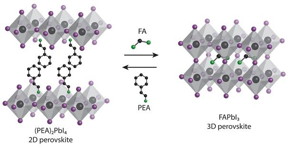 |
| The 2D films based on 2-phenylethylammonium lead iodide produce 3D formamidinium lead iodide films via cation exchange. CREDIT Loi lab / University of Groningen |
Abstract:
Formamidinium lead iodide is a very good material for photovoltaic cells, but getting the correct and stable crystal structure is a challenge. The techniques developed so far have produced rather poor results. However, University of Groningen scientists, led by Professor of Photophysics and Optoelectronics Maria Antonietta Loi, have now cracked it - using a blade and a dipping solution. The results were published in the journal Nanoscale on 15 March 2019.
Making solar cells is like buttering bread
Groningen, the Netherlands | Posted on March 22nd, 2019Formamidinium lead iodide (FAPbI3) is a perovskite, a crystal with a distinctive structure. Perovskites are named after a mineral that has the chemical formula ABX3. In an idealized cubic unit cell, the X position is occupied by anions that form an octahedron with a central cation in the B position while the corners of the cube are occupied by the A position cations (see picture).
Industrial production
'This formamidinium lead iodide material has very good characteristics, but the A position formamidinium ion causes instability in the structure,' explains Loi. 3D films made from this material most often turn out to be a mixture of a photoactive and a photoinactive phase, the latter being detrimental to the final application. Loi therefore set her PhD student Sampson Adjokatse to work to find a solution.
After trying different strategies, he found one that worked. 'And most importantly, one that is scalable and could be used for industrial production,' says Loi. After all, solar cells must be produced in large panels and it is very important to find a good and cheap technique to do so. Adjokatse started with a different perovskite, in which the formamidinium was replaced by a larger 2 phenylethylammonium molecule, and in doing so formed a 2D perovskite. This material was deposited as a thin film using the 'doctor-blade' technique, related to techniques widely used in industrial processes such as printing.
Blade
'Basically, you spread the material onto a substrate using a blade,' explains Adjokatse. The blade can be set to produce a film with a thickness of around 500 nanometres, creating the 2D perovskite layer. 'The important point is that these films are very smooth with large crystalline domains of up to 15 micrometres,' says Adjokatse. The smooth 2D films based on 2-phenylethylammonium lead iodide were used as a template to produce 3D formamidinium lead iodide films.
This was achieved by dipping the 2D film in a solution containing formamidinium iodide. This resulted in the growth of a 3D film through 'cation exchange', where formamidinium took the place of 2 phenylethylammonium. 'These films show much higher photoluminescence compared to reference 3D formamidinium lead iodide films and show increased stability when exposed to light or moisture,' says Loi. 'This means that we now have a method for the production of high-quality films for perovskite solar cells using an industrially scalable technique.'
####
For more information, please click here
Contacts:
Rene Fransen
Copyright © University of Groningen
If you have a comment, please Contact us.Issuers of news releases, not 7th Wave, Inc. or Nanotechnology Now, are solely responsible for the accuracy of the content.
Bookmark:


| Related Links |
| Related News Press |
News and information
 Quantum computer improves AI predictions April 17th, 2026
Flexible sensor gains sensitivity under pressure April 17th, 2026
A reusable chip for particulate matter sensing April 17th, 2026
Detecting vibrational quantum beating in the predissociation dynamics of SF6 using time-resolved photoelectron spectroscopy April 17th, 2026
2 Dimensional Materials
Flexible sensor gains sensitivity under pressure April 17th, 2026
ICFO researchers overcome long-standing bottleneck in single photon detection with twisted 2D materials August 8th, 2025
First real-time observation of two-dimensional melting process: Researchers at Mainz University unveil new insights into magnetic vortex structures August 8th, 2025
Lab to industry: InSe wafer-scale breakthrough for future electronics August 8th, 2025
Perovskites
Possible Futures
A fundamentally new therapeutic approach to cystic fibrosis: Nanobody repairs cellular defect April 17th, 2026
UC Irvine physicists discover method to reverse ‘quantum scrambling’ : The work addresses the problem of information loss in quantum computing system April 17th, 2026
Discoveries
Quantum computer improves AI predictions April 17th, 2026
Flexible sensor gains sensitivity under pressure April 17th, 2026
A reusable chip for particulate matter sensing April 17th, 2026
Detecting vibrational quantum beating in the predissociation dynamics of SF6 using time-resolved photoelectron spectroscopy April 17th, 2026
Materials/Metamaterials/Magnetoresistance
First real-time observation of two-dimensional melting process: Researchers at Mainz University unveil new insights into magnetic vortex structures August 8th, 2025
Researchers unveil a groundbreaking clay-based solution to capture carbon dioxide and combat climate change June 6th, 2025
A 1960s idea inspires NBI researchers to study hitherto inaccessible quantum states June 6th, 2025
Institute for Nanoscience hosts annual proposal planning meeting May 16th, 2025
Announcements
A fundamentally new therapeutic approach to cystic fibrosis: Nanobody repairs cellular defect April 17th, 2026
UC Irvine physicists discover method to reverse ‘quantum scrambling’ : The work addresses the problem of information loss in quantum computing system April 17th, 2026
Interviews/Book Reviews/Essays/Reports/Podcasts/Journals/White papers/Posters
A fundamentally new therapeutic approach to cystic fibrosis: Nanobody repairs cellular defect April 17th, 2026
UC Irvine physicists discover method to reverse ‘quantum scrambling’ : The work addresses the problem of information loss in quantum computing system April 17th, 2026
Energy
Sensors innovations for smart lithium-based batteries: advancements, opportunities, and potential challenges August 8th, 2025
Simple algorithm paired with standard imaging tool could predict failure in lithium metal batteries August 8th, 2025
Solar/Photovoltaic
Spinel-type sulfide semiconductors to operate the next-generation LEDs and solar cells For solar-cell absorbers and green-LED source October 3rd, 2025
KAIST researchers introduce new and improved, next-generation perovskite solar cell November 8th, 2024
Groundbreaking precision in single-molecule optoelectronics August 16th, 2024
Development of zinc oxide nanopagoda array photoelectrode: photoelectrochemical water-splitting hydrogen production January 12th, 2024
 |
||
 |
||
| The latest news from around the world, FREE | ||
 |
||
|
|
||
| Premium Products | ||
 |
||
|
Only the news you want to read!
Learn More |
||
 |
||
|
Full-service, expert consulting
Learn More |
||
|
|
||